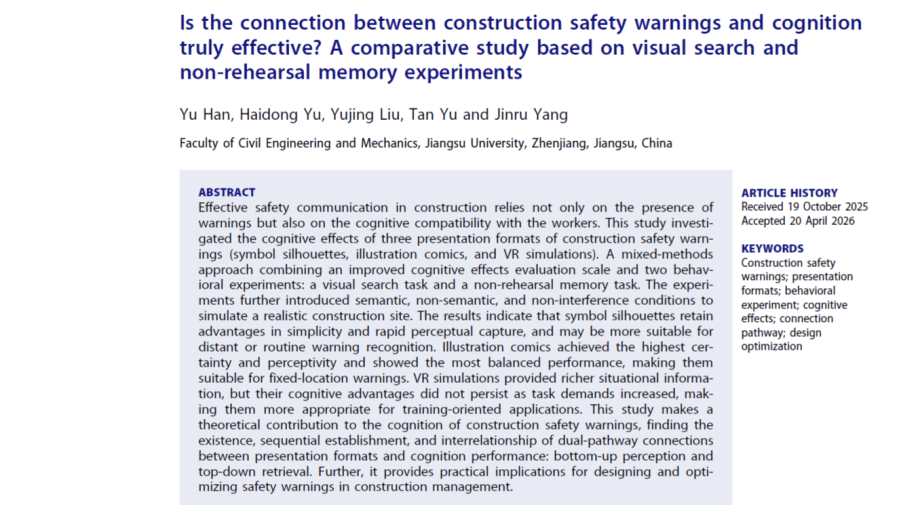
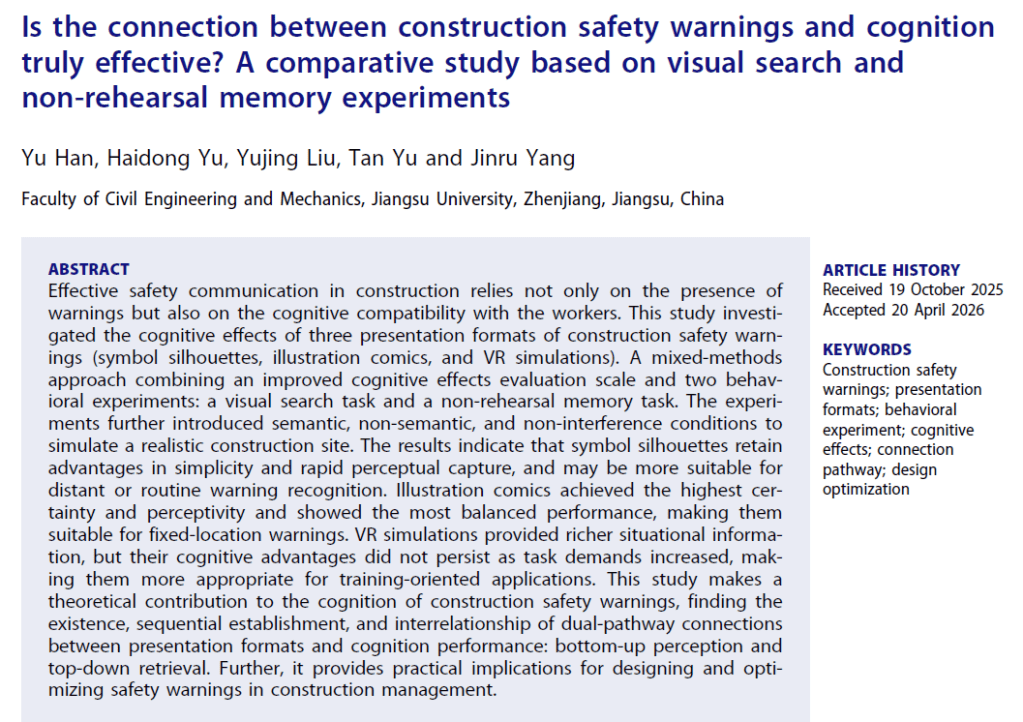
How do different warning signs influence worker cognition?
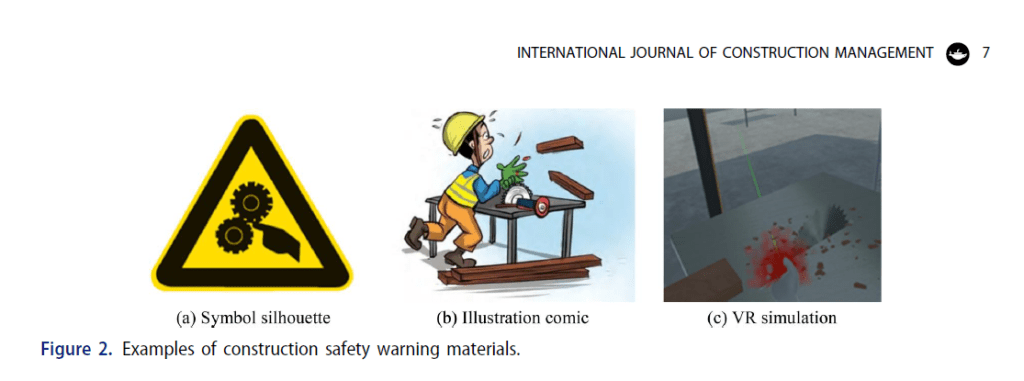
This compared three types of construction safety warnings: symbol silhouettes, illustration comics and VR simulation (image 2).
PS. Check out my YouTube: https://youtube.com/@safe_as_pod?si=iUaDPJynPemQRZhY
Background:
· There are currently “no specific professional standards for construction safety signs in the global construction industry”, and they rely on general safety sign systems, like ISO 7010
· “Conventional symbol silhouettes are common in industrial and construction settings (Chen et al. 2018), more vivid cartoon-like warnings are often used in public environments”
· Research shows that “warning effectiveness is influenced by design factors such as color, shape, text, and format, while sign cognition is also related to sign features”
· “Construction sites are typically characterized by visual clutter, occlusion, and competing task demands, so conventional safety signs may not always be sufficient”
· First, there’s “local design elements in conventional signs, such as color, shape, borders, text, and pictorial symbols”, second there’s “sign features, such as familiarity, concreteness, simplicity, meaningfulness, and semantic closeness”, third there’s “context and task-related conditions, such as actual context, field recognition, and implicit processing”
· “In practice, traditional signs are not very effective, particularly for target groups like construction workers, since conventional symbols have not significantly enhanced their understanding or retention”
· “Previous studies have shown that traditional safety signs may perform poorly in construction settings, not because safety information is absent, but because cognitively demanding site conditions reduce workers’ ability to notice, interpret, and retain warning meanings effectively”
Results:
· They found “symbol silhouettes retain advantages in simplicity and rapid perceptual capture, and may be more suitable for distant or routine warning recognition”
· Whereas “Illustration comics achieved the highest certainty and perceptivity and showed the most balanced performance”
· “VR simulations provided richer situational information, but their cognitive advantages did not persist as task demands increased, making them more appropriate for training-oriented applications”
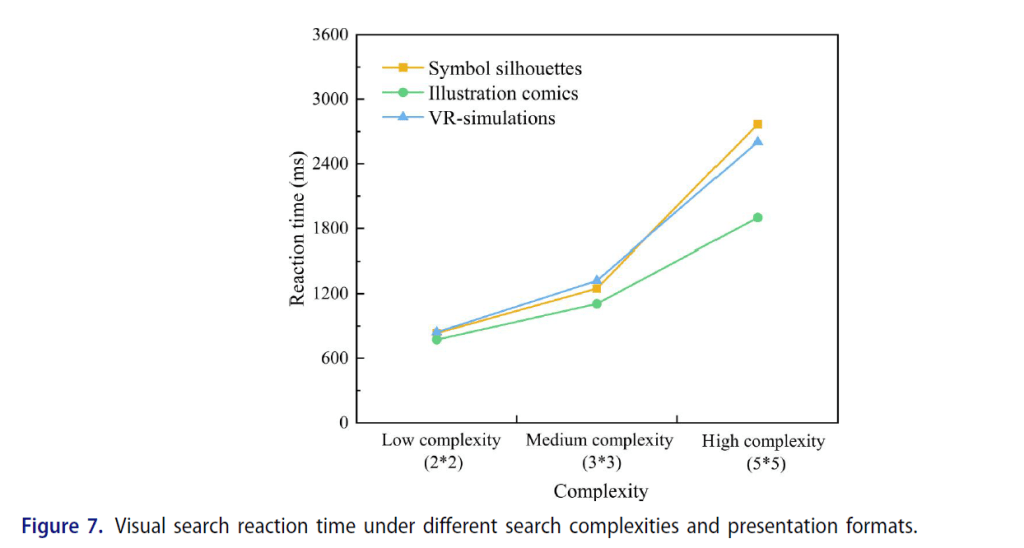
· “both symbol silhouettes and VR simulations exhibited greater increases in search time as search complexity increased, whereas the illustration comics demonstrated a flatter slope, indicating stronger resistance to increasing visual search difficulty”
· Hence, “illustrated comics appear to be more effective at maintaining visual search efficiency as interference increases”
· They say that illustrations provide “more distinctive visual features and clearer warning cues, enhancing perceptual saliency”
· And “compared to VR simulations, illustration comics eliminate redundant scene elements and emphasize key hazardous actions, effectively increasing the “signal strength” of the image”
· Illustrations also showed a more gradual decline in recall accuracy (e.g. forgetting), and more stable short-term retention as memory demands increased
· While “VR simulations offer a wider range of potential memory cues, their realistic scene structure may increase encoding demands and reduce cue specificity, thereby weakening memory stability when task load increases”
· “The present results suggest that memory performance depends not on realism alone, but on the balance between information load and the availability of task-relevant retrieval cues”
· They also showed how “The visual and auditory channels share a common spatial processing system, and attentional focus on one modality typically reduces responsiveness in another”
· An unexpected finding they say is that “the warning–cognition connection was not further strengthened by greater realism.”
· i.e. “Although VR simulations more closely resembled actual construction scenes, their advantage did not persist as task demands increased”
· And this suggests that “the effectiveness of warning presentation does not increase linearly with realism. A plausible explanation is that VR simulations introduced too many interacting scene elements during encoding”
· In all, illustration comics “provided the most balanced cognitive performance: they achieved higher certainty and perceptivity, maintained relatively stable search efficiency under increasing task complexity and auditory interference, and showed a gentler decline in memory performance as cognitive load increased”
· Symbols were simplistic, facilitated rapid perceptual capture and long-distance recognition, but more vulnerable when warning interpretation depended on limited contextual cues, or when interference increased.
Practically, they say:
· Symbols are most feasible option for large-scale routine deployment
· Illustration comics seem to be the most practical for fixed-location warnings requiring stronger comprehension and retention
· VR should be “treated primarily as supplementary tools”, including for high-risk scenario rehearsals
Study: https://doi.org/10.1080/15623599.2026.2665365
Shout a coffee: https://buymeacoffee.com/benhutchinson

 SafetyInsights.org