Some extracts from Reason’s 1998 article.
PS. Check out my YouTube: https://youtube.com/@safe_as_pod?si=iUaDPJynPemQRZhY
Extracts:
· “In almost every organization, there is a tension between the natural variability of human behaviour and the needs of the system to ensure a high degree of predictability and regularity”
· “The most obvious difficulty in the traditional pursuit of organizational safety is that success is counted by the absence of something- fatalities [& injuries etc]”
· Hence “the feedback necessary to attain safety goals is thus discontinuous and indirect: discontinuous because recorded [incidents] are comparatively rare events; indirect because these data only reflect moments of unsafety rather than the system’s intrinsic resistance to its operational hazards”
· “Moreover, since there is a large chance component in accident causation, these negative outcome data yield unreliable information regarding the true state of an organization’s safety”
· While orgs try to shape behaviour via procedures, “One of the effects of continually tightening up safe working practices is to increase the likelihood of deliberate deviations from these practices: in other words, encourage violations”
· “Whereas errors… arise from various kinds of informational underspecification… many violations are created by procedural overspecification”
· “Violations can have two important consequences: they can increase the probability of a subsequent error, and they can also increase the likelihood that it will have a bad outcome”
· “In many hazardous technologies, the important issue is not whether to violate, but when to violate”
· “Nearly all hazardous operations routinely involve the commission of actions that lie outside the prescribed boundaries, yet are regarded as acceptable practice within the work-group. Most experienced workers think they know approximately where the ‘edge’ between safety and disaster lies and do not exceed it”
· Reason presents the categories of rule-related behaviour image 1 [** upscaled in Gemini since original was pixelated]
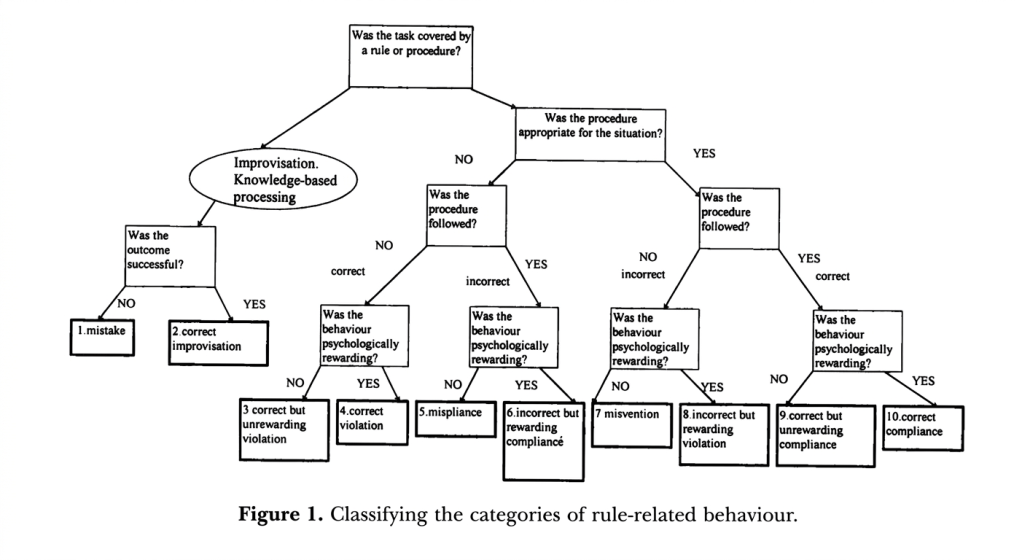
· “Three major categories of deliberate safety violation have been distinguished: routine, optimizing and situational violations”
· [* I dislike the term ‘violation’ since it’s loaded, but, whatever]
· Reason asks: ‘Was a procedure available? The problem of requisite variety”
· “the variety of rules developed to govern safe behaviour will always be less than the possible variety of unsafe situations… Wholly safe behaviour can never be controlled entirely by prescriptive controls”
· Thus, rules “will never be wholly comprehensive nor universally applicable”
· Also, ‘Was the procedure appropriate for the situation?’
· “It is not uncommon for organizations to develop and formalize procedures with little consideration for the practicalities of working with them in everyday situations”
· “Organizations are often reluctant to introduce alternative methods of control because they find the formal nature of rules reassuring—they allow the responsibility for safety to be delegated to the people who do the job… In summary, organizations like rules.”
· “Administrative process controls are both a flawed and a restricted means of regulating safe behaviour—though, for many organizations, they remain the instrument of choice”
· “Procedures… are often written for the ideal situation, yet work situations are rarely ideal”
· “Mispliances are likely to be associated with the personal characteristics of rigid compliance (‘rules must be obeyed at all times’)”
· “Risk appraisal training is of little value once the incorrect actions have become habitual. When this happens, people are not taking risks deliberately, they are running them in a largely automatic and thoughtless fashion”
· “The task of the human factors specialist is not to reduce violations of safe operating procedures willy nilly. Rather, it is to aid organizations to develop a customized portfolio of controls that is best suited to guiding safe and productive behaviour”
Shout a coffee: https://buymeacoffee.com/benhutchinson


