How does ISO 45001 contribute to resilient capacities?
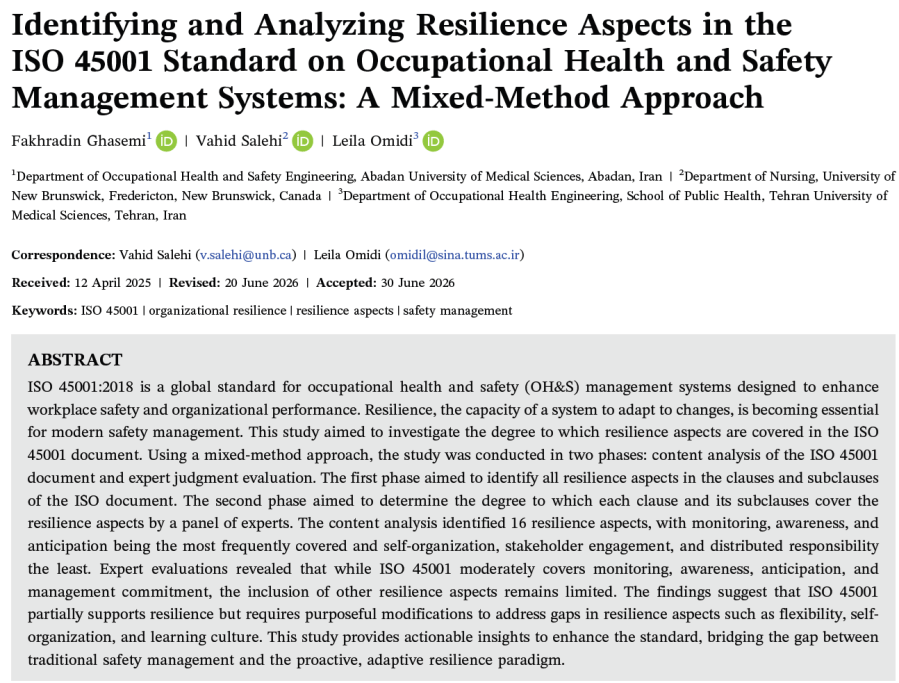
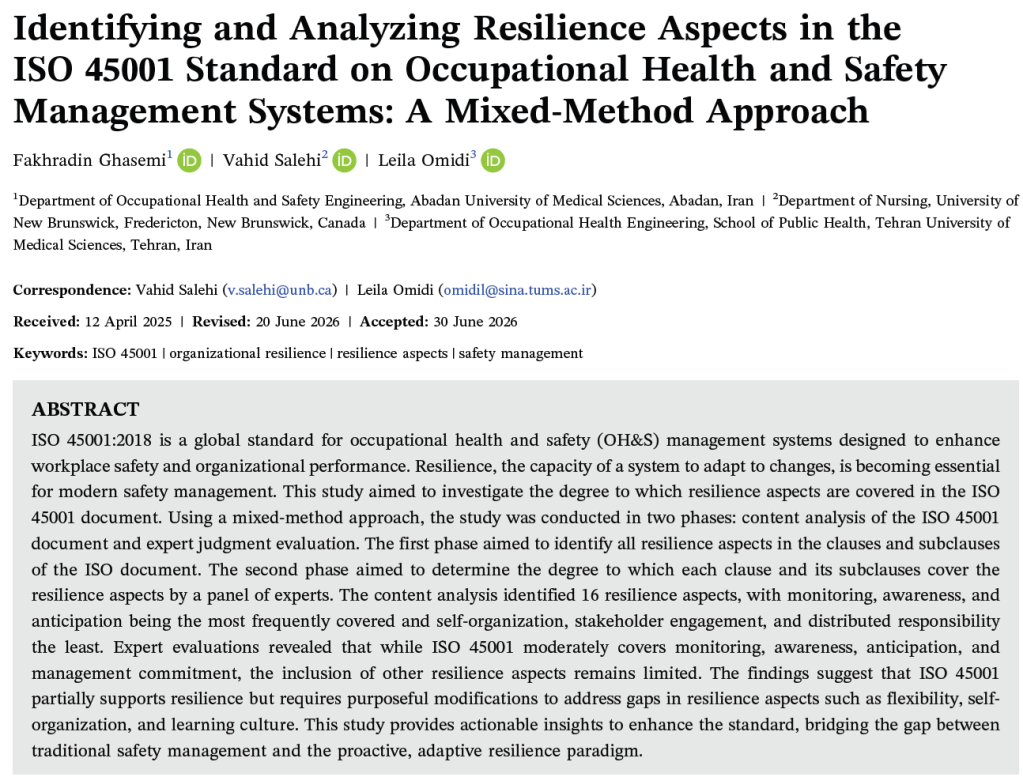
This interesting study used content analysis and expert judgement evaluation to determine whether the 45001 clauses contribute to resilient capacities.
PS. Check out my YouTube and recent Critical Control / barrier vid: https://youtube.com/@safe_as_pod?si=iUaDPJynPemQRZhY
Shout a coffee: https://buymeacoffee.com/benhutchinson
Extracts:
· “Rather than focusing solely on preventing failures, resilience engineering seeks to understand how organizations adapt to complexity, variability, and uncertainty to ensure successful outcomes”
· “ISO 45001 appears to provide a useful foundation for resilience-oriented safety management, even though resilience is not explicitly identified as a guiding principle of the standard”
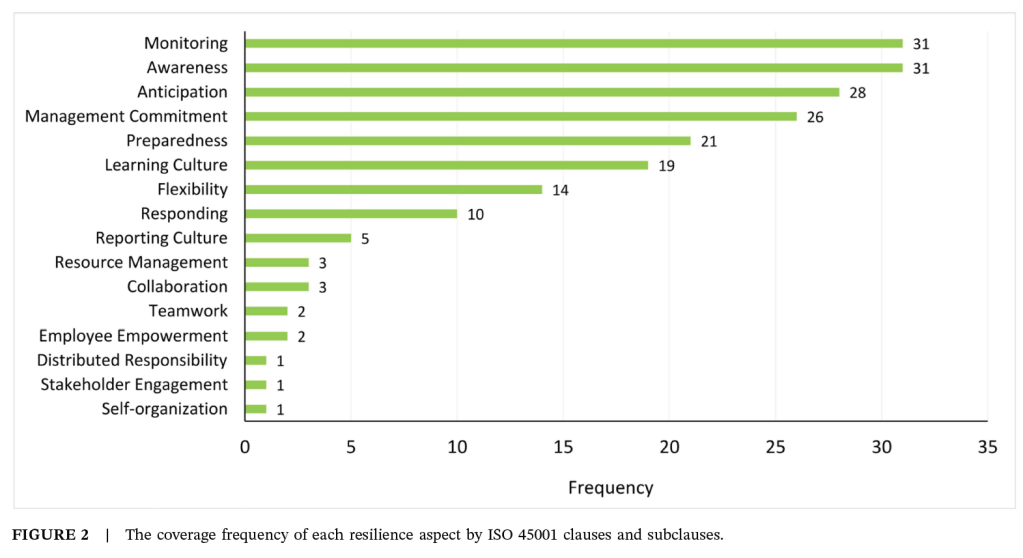
· “Expert evaluations revealed that while ISO 45001 moderately covers monitoring, awareness, anticipation, and management commitment, the inclusion of other resilience aspects remains limited”
· “An important finding is that many resilience aspects are represented implicitly rather than explicitly within ISO 45001”
· “However, implicit coverage may also create variability in implementation because organizations may interpret resilience-related requirements differently”
· And being implicit suggests “organizations implementing the standard may already be developing resilience capabilities without formally recognizing them as such”
· But “Previous resilience engineering research has emphasized the importance of making adaptive capabilities **visible** and manageable within organizational processes”
· “ISO 45001 partially supports resilience but requires purposeful modifications to address gaps in resilience aspects such as flexibility, self‐organization, and learning culture”
· “While it focuses more on learning from negative experiences and failures, it could also benefit from considering positive experiences and opportunities for OH&S improvement. ISO 45001 can be more resilient by explicitly including factors related to positive experiences, successes, and OH&S improvement opportunities”
· “the standard does not explicitly endorse a just culture. The leadership and commitment clause could be a place for modification to highlight the key role of a just culture”
· “Several aspects commonly associated with resilient organizations, including self‐organization, distributed responsibility, stakeholder engagement, and adaptive capacity, receive considerably less attention”
· ISO 45001 seems to implicitly support some resilient capacities “primarily through structured management processes and leadership mechanisms rather than through decentralized adaptation and organizational flexibility”
· It also provides limited attention to adaptive capacity and recovery
· “findings also reveal a fundamental tension between traditional safety management approaches and resilience engineering”
· “Although ISO 45001 encourages organizations to address risks and opportunities, most requirements remain oriented toward preventing failures, incidents, and nonconformities”
· “In contrast, resilience engineering advocates a Safety-II perspective that seeks to understand how everyday work succeeds under varying conditions and how organizations adapt to complexity”
· “Greater attention to successful adaptations, operational trade-offs, and positive performance outcomes could strengthen the resilience orientation of ISO 45001 and better align it with contemporary safety management thinking”
· “Organizations seeking to enhance resilience may benefit from supplementing ISO 45001 requirements with initiatives that strengthen adaptive capacity, stakeholder engagement, distributed responsibility, and learning from successful performance”
· “However, the existence of resilience-related requirements within a standard does not necessarily imply that organizations successfully develop or implement resilience capabilities in practice”
Study link: https://doi.org/10.1002/hfm.70053

 SafetyInsights.org