When is psychological safety helpful in organisations? When are higher perceived levels not?
This investigated New York City public score responses (545 schools) and 170k survey responses to explore the boundary conditions.
They contrast the effects of PS with both psychological empowerment (the extent individuals see their work as having impact or being important) and felt accountability (an expectation that one’s decisions or actions will be subject to evaluation by some salient audience).
PS. Check out my YouTube and recent Critical Control / barrier vid: https://youtu.be/Ly1mEn_KCLQ?si=yG3yRVOM0r2eyyKI
Shout a coffee: https://buymeacoffee.com/benhutchinson
Extracts:
· Despite years of demonstrated benefits associated with PS, limited research has explored its boundary conditions and unintended byproducts (** I’ve covered most of these studies on my site so check it out)
· Across 3 years, their results “unexpectedly show that psychological safety is not on its own, nor necessarily, “helpful” with regard to organizational performance over time”
· And “the best conditions for fostering organizational performance occur when psychological safety is relatively low and felt accountability is relatively high”
· “Thus, these two dimensions of workplace climate appear to be interrelated in critical ways over time, albeit unexpectedly”
· “when considered on its own, all else held constant, psychological safety had a negative effect on performance over time”
· In contrast they “found the opposite to be the case for organization-level felt accountability: it had a positive impact on schools’ likelihood of reaching their performance targets over time, all else held constant”
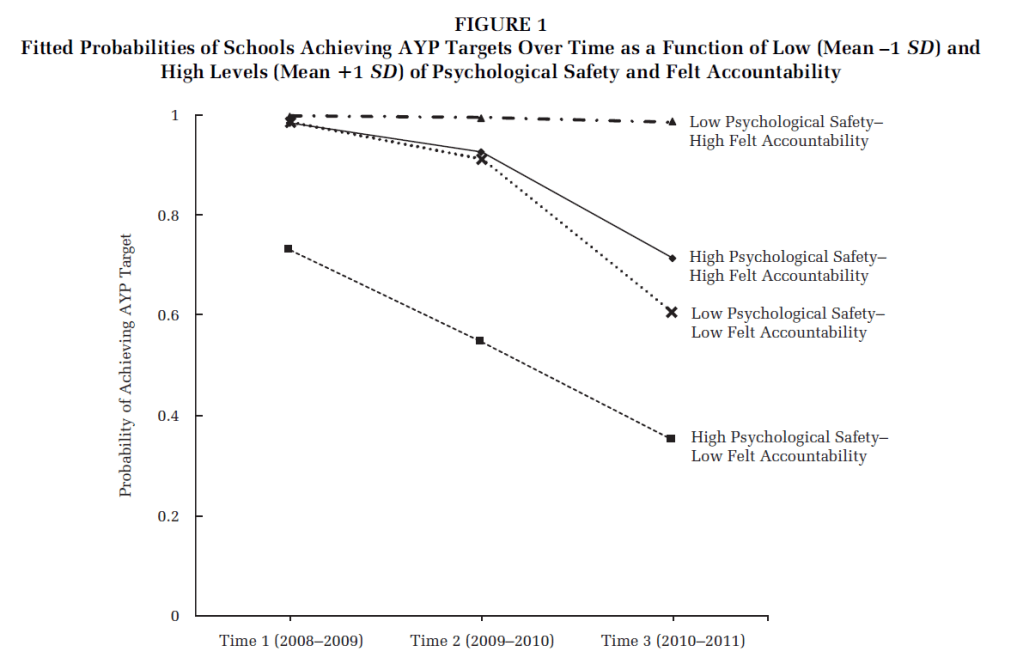
· However, factoring PS, felt accountability and time as a 3 way interaction yielded new insights: “in terms of yielding the best performance outcomes over time, was not, as might have been expected, when both elements were relatively high, or even when they were balanced (i.e., both relatively high or both relatively low). Rather, the best-performing schools in the NYC public school system were those with relatively low psychological safety and relatively high felt accountability”
· “results highlight that psychological safety’s effect on performance is more nuanced than found in prior research, with higher psychological safety not simply or directly enabling better performance—and perhaps even hindering performance—when considered on its own”
· Attention is said to be important, eg “that what individual workers attend to when they feel psychologically safe to speak up matters. We suggest that attention should have an impact on whether psychological safety actually helps or hurts performance”
· “In schools, as well as many other service-oriented contexts, particularly those that are high stakes, attention is a precious resource. That is, teachers do not simply need more time as a resource, they also need help attending to their instructional practice”
· “Otherwise, without that attention, individuals may feel psychologically safe in a “comfort zone” (Edmondson, 2008) that does not help the organization”
· “Such a comfortable space might morph into what we could call a “complaining zone,” rather than a “practice zone” in which people talk about the work at hand”
· “when teachers are given an opportunity to engage in voice or decision-making (e.g., participating in an instructional leadership team), but do not have clear roles or a sense of what the discussion is about, their time together can devolve into discourse beyond the core work of teaching and learning”
· And per prior research “people tend to exert less effort when they do not feel accountable.” Here, we are suggesting the possibility not of “less” effort on the part of teachers, but perhaps, instead, of misplaced effort”
· And high PS “might yield this kind of complaining zone or spiral when workers feel frustrated about their jobs”
· Limitations of course – one being the total range of high and low PS and accountability were relatively narrow
Study link: https://doi.org/10.5465/amd.2018.0242


