At what point does the loss of human life become mere statistics?
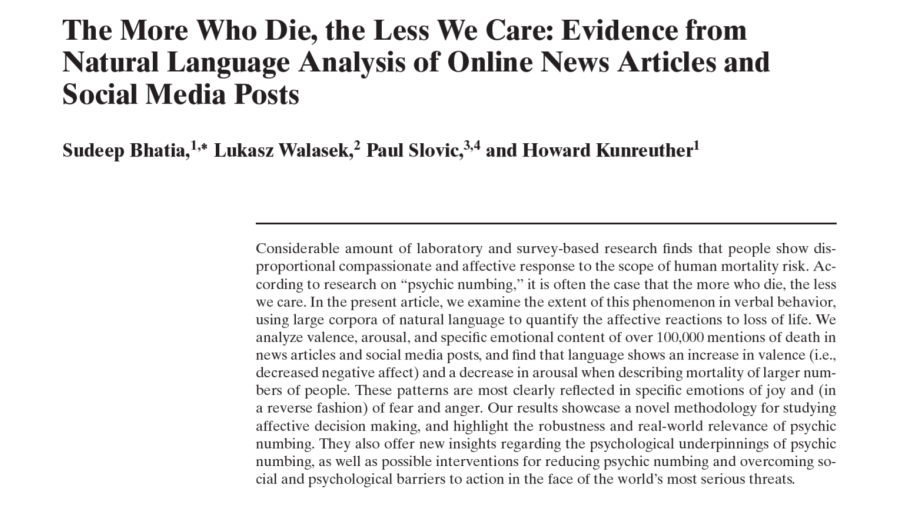
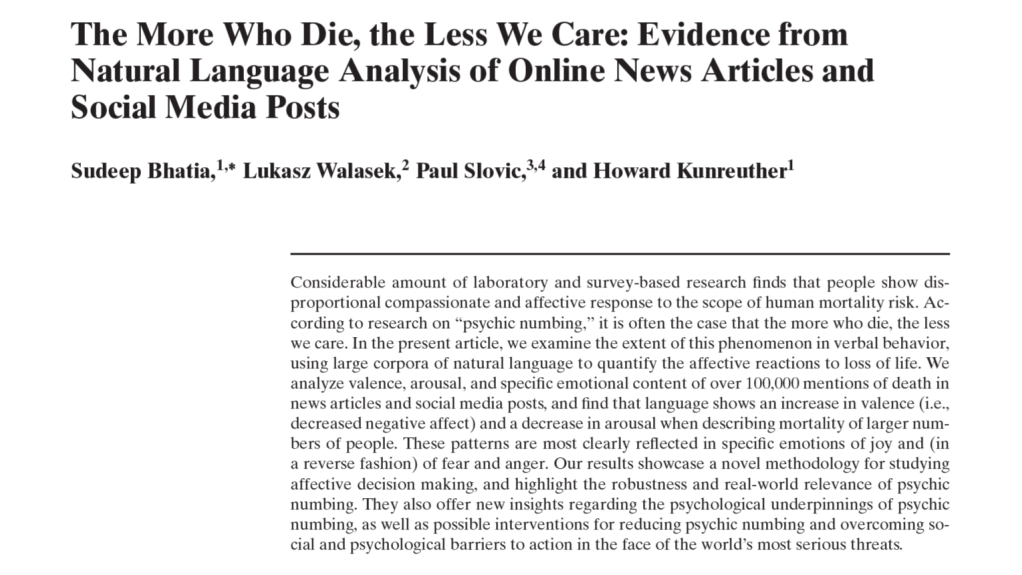
This study analysed >100k mentions of death in news articles and social media posts based on valence (overall positive or negative qualities) and arousal (the degree of intensity people have about the text), grouped by number of deaths mentioned.
Paul Slovic was a co-author.
PS. Check out my YouTube and recent Critical Control / barrier vid: https://youtu.be/Ly1mEn_KCLQ?si=yG3yRVOM0r2eyyKI
Shout a coffee: https://buymeacoffee.com/benhutchinson
Extracts:
· “We are incoherent in the value we place on protecting human lives. We are motivated to expend great effort … to protect specific individuals … but become numbly indifferent to the fate of thousands of victims of genocide”
· Importance of protecting individual lives is labelled the ‘singularity effect’, and the “emotional indifference to mass suffering has been linked to a mental state known as “psychic numbing”
· Singularity and psychic numbing combine for the “nonrational arithmetic of compassion as it implies that the more who die, the less we care”
· Research shows people are more likely to donate more money to aid identifiable victims than to unidentifiable or statistical victims (** check out all of the GoFund Me’s)
· Whereas in a rational sense the efforts to save 100 lives should be 10x larger than to save 10 lives “the value people assign to human life appears to be “inversely proportional to the magnitude of the threat” … [where this] concavity in the number of deaths suggests a rather severe numbing … [to the number of deaths in catastrophes]”
· Overall their findings were consistent with psychic numbing where “affective responses are paradoxically the most negative when a small number of people die”
· “In other words, our findings are in line with the argument that the more who die, the less we care”
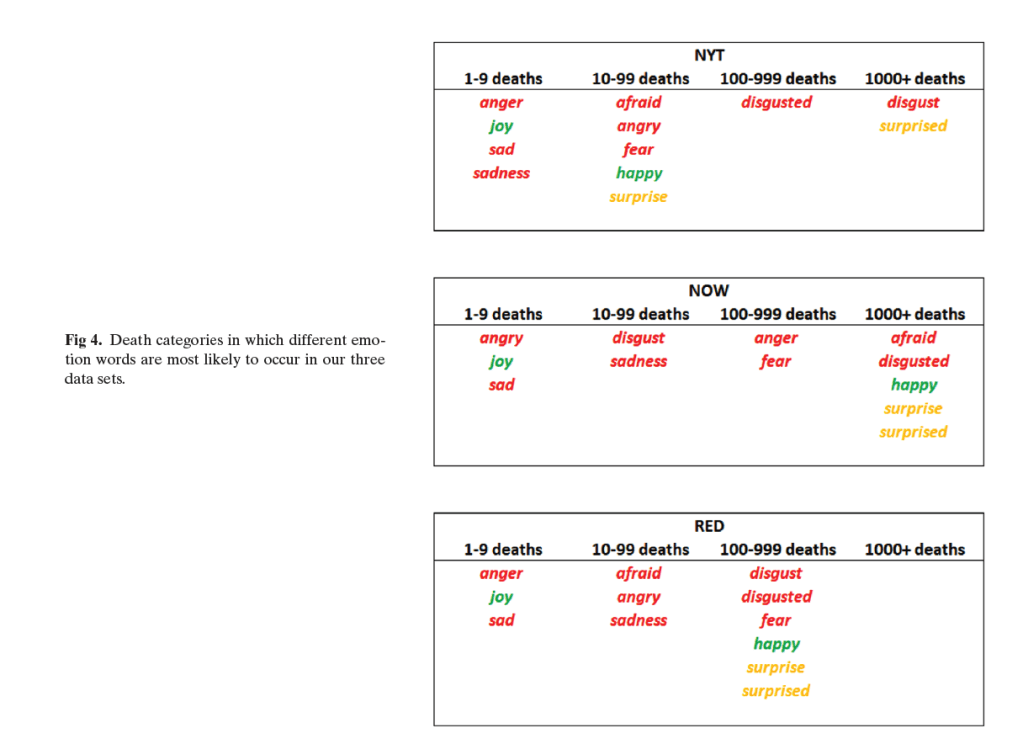
· Texts referring to loss of life are lower in valence but higher in arousal, but aligned to psychic numbing, “valence does not become more negative and arousal does not increase as the number of deaths increases. Rather, the lowest valence and highest arousal are often observed for events involving a small number of deaths (1–9 or 10–99 deaths), rather than a large number (1,000+) deaths”
· These patterns are also evident in the expression of emotions like fear & anger which are more likely “in texts mentioning smaller rather than larger numbers of deaths”
· They conclude that since news & social media play a vital role informing people about the world & threats, we need to better understand how it influences numbing and arousal.
· And reporting news with ‘just the facts’ isn’t ideal, since “emotion is known to be a necessary motivator of action”, and quantitative data ”can be numbing and demotivating and may generate systemic biases that lead people to avoid taking action before it is too late”.
Study link: https://doi.org/10.1111/risa.13582


