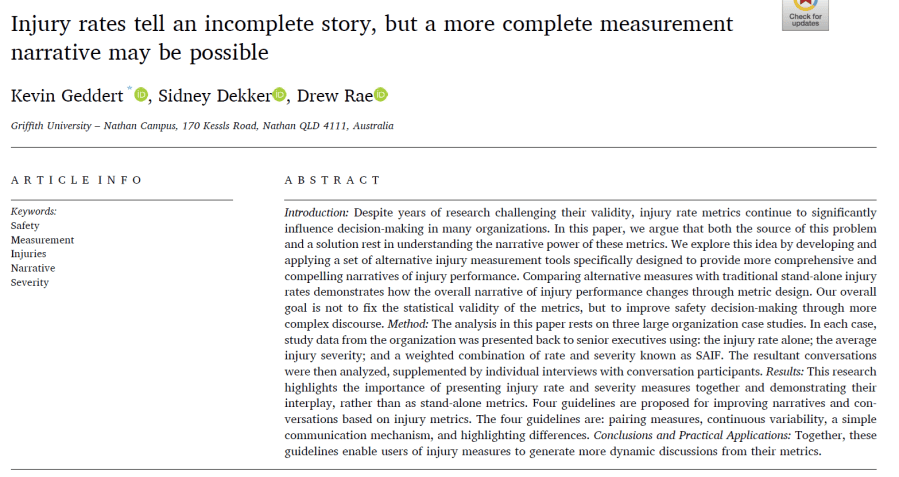
Can the same injury rate tell two different safety ‘stories’? What’s hiding in your story?
An interesting read from Kevin Geddert, Sidney Dekker and Drew Rae who explore how injury measures generate different meanings and their consequences.
They also discuss the use of SAIF – which is Severity Adjusted Injury Frequency (a weighted combination of rate & severity).
Shared under an open access licence.
I didn’t do a good job of capturing the interesting points from this article into a coherent narrative – so highly recommend reading the paper yourself.
PS. Check out my YouTube and recent Critical Control / barrier vid: https://youtu.be/Ly1mEn_KCLQ?si=yG3yRVOM0r2eyyKI
Shout a coffee: https://buymeacoffee.com/benhutchinson
Extracts:
· “The stand-alone injury rate allows users to tell a story of improved performance when rates decline or worsening performance when rates increase”
· “In the same period where the long-term trend was an 80% reduction in injury rates… the average severity of events would more than triple”
· “Reduced injury rates were more reflective of changes in the rate of low-severity events than of higher-severity events”
· “When viewing any major trend in a stand-alone injury rate, it is likely that a change in the reporting of low-severity events is a better explanation of injury rate movement than a material shift in injury performance”
· “An increase in injury rate with a decrease in severity could indicate improved reporting culture”
· “No single measure told the whole story of injury performance”
· “Rate, Average Severity and a Weighted Average measure are not separable pieces of information. All three measures must be presented together to tell a complete narrative”
· “Adding the alternative measures significantly changed the order of perceived business performance”
· “If a business were to have a significant risk that it had controlled completely, nothing would show up here”
· “The usability of the measure is more important than absolute accuracy”
· “TRIF denotes the number of people injured, and SAIF denotes the relative number with a two-week LTI”
· “Low-volume, high-severity mechanisms require different controls from high-volume, low-severity failure mechanisms”
· “The SAIF metric provides one way to meet these guidelines, but the use of SAIF in this study is as a demonstration only”
· “Injury rates may yet make a significant contribution to the discussion of safety, but not on their own, and not as the definition of safety”
· “To set any one measure as the new stand-alone definition of safety is to invite a new tyrant to enjoy the spot held so long by the stand-alone injury rate”

 SafetyInsights.org