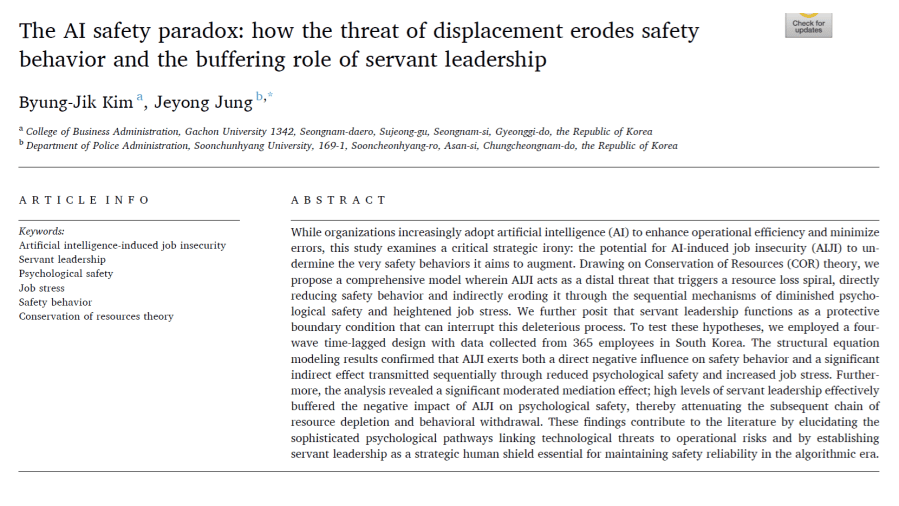
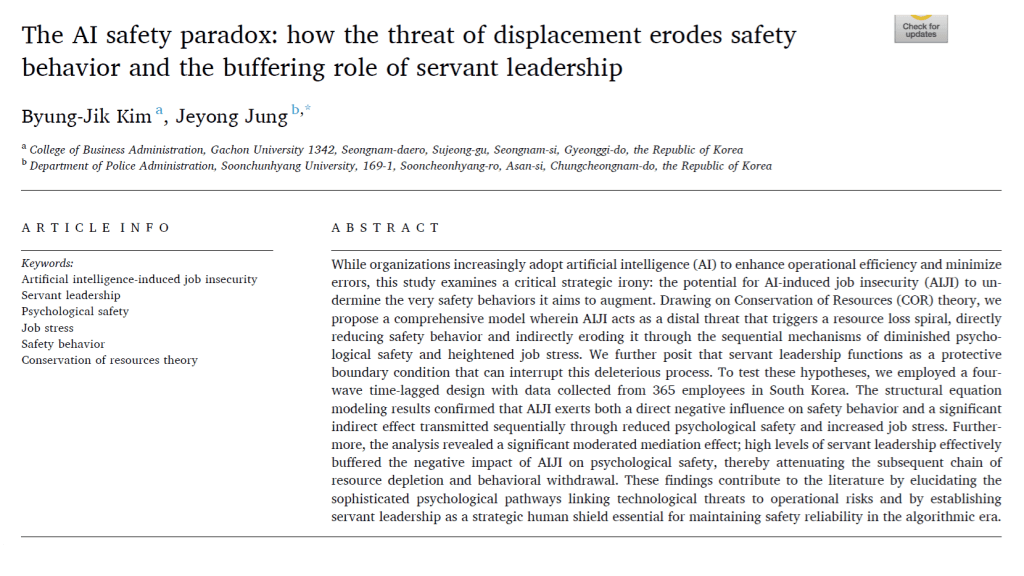
Can fear of being replaced by AI undermine workplace safety? Welcome to Artificial Intelligence-Induced Job Insecurity (AIJI).
This used a time-lagged structural equation modelling design with 365 South Korean employees, to understand how AIJI affects safety behaviours, and the role of Psychological Safety and Servant Leadership on the effects.
PS. Check out my YouTube: https://youtube.com/@safe_as_pod?si=V2dbdmW–WbnhzA9
Shout a coffee: https://buymeacoffee.com/benhutchinson
Extracts:
• When facing cognitive resource loss people “instinctively prioritize the preservation of their remaining resources”
• AIJI is a “threat signaling the potential obsolescence of professional skills and employment”, and if people perceive a AIJI threat their “limited cognitive resources are reallocated toward defensive coping activities that offer immediate protection”
• “effective safety behavior demands a surplus of cognitive energy to detect latent hazards and proactively support the safety of colleagues” and hence any resource threats or defensive coping behaviours may impact safety behaviours
• “ When AI systems are positioned as error-free alternatives to human labor, employees perceive that revealing a mistake or raising a difficult issue is not merely a learning opportunity but evidence of human inefficiency that justifies technological substitution”
• Hence, people “adopt a strategy of defensive silence, concealing errors and withholding questions to avoid being flagged by the machine logic of the organization”
• Job stress also accumulates with this shift and affects safety behaviours
• “The stressed brain restricts information processing to immediate, central tasks and filters out peripheral cues. However, effective safety behavior, such as scanning for potential hazards or strictly adhering to complex protocols, requires a broad attentional field”
• They found that “AI-induced job insecurity (AIJI) exerts a detrimental influence on safety behavior through both direct and indirect pathways”
• “the existential threat of AI directly constrains the cognitive resources required for high-cost safety behaviors”
• “we identified a sophisticated loss spiral in which the threat first destroys the social resource of psychological safety, subsequently accelerating the depletion of personal resources in the form of job stress”
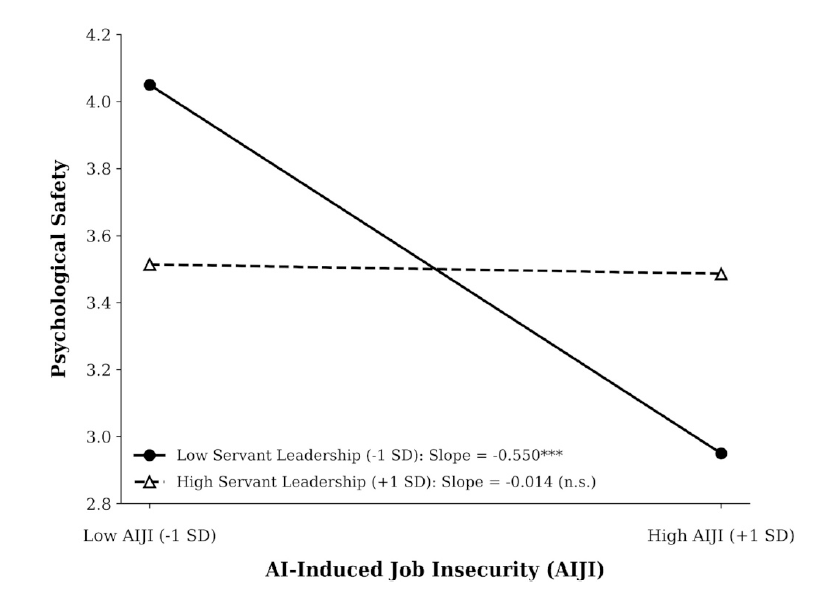
• “However, this trajectory of resource loss is not inevitable … servant leadership functions as a critical boundary condition. By acting as a “human shield,” high levels of servant leadership buffer the initial impact of AIJI on psychological safety, thereby arresting the sequential loss spiral”
• “technological insecurity significantly degrades safety behavior, a construct functioning as a high-cost resource investment requiring continuous cognitive vigilance”
• “In modern socio-technical systems, human operators function as the final safeguard necessary to monitor automated processes and detect latent algorithmic anomalies. Effective safety behavior in these environments demands a continuous surplus of cognitive bandwidth”
• (Perceived) technological displacement depletes cognitive resources and “structurally induces a state of inattentional blindness, rendering the human-in-the-loop architecture highly vulnerable to systemic failures”
• AIJI acts as a “distal antecedent that triggers a defensive stance, leading to the collapse of psychological safety”
• “The destruction of the social safety net removes the primary organizational buffer, forcing employees to expend their remaining internal resources on defensive self-regulation to conceal vulnerabilities”
• “Our findings empirically confirm that servant leadership supplies the necessary emotional replenishment to validate human worth, directly neutralizing the psychological deficit triggered by the technological threat”
For practical takeaways:
• “for top management teams … it is recommended that executives consider broadening their risk assessment frameworks to include a psychological safety impact assessment alongside technical feasibility studies”
• “at the leadership level … the adoption of servant leadership principles can serve as an effective strategic approach in high-tech environments”
• “regarding intervention strategies, the sequential mediation mechanism identified in this study suggests that traditional stress management interventions may be insufficient if applied in isolation”
Limitations as always: correlational, South Korean data (so applicability in less collectivism domains isn’t clear, but they suspect it likely is applicable), AIJI was treated as a unified construct when it’s not, and more.
#AI #psychologicalsafety #servantleadership #leadership #workplacesafety #futureofwork
Study link: https://doi.org/10.1016/j.ssci.2026.107454


