Are rule followers, breakers or rule benders better leaders?
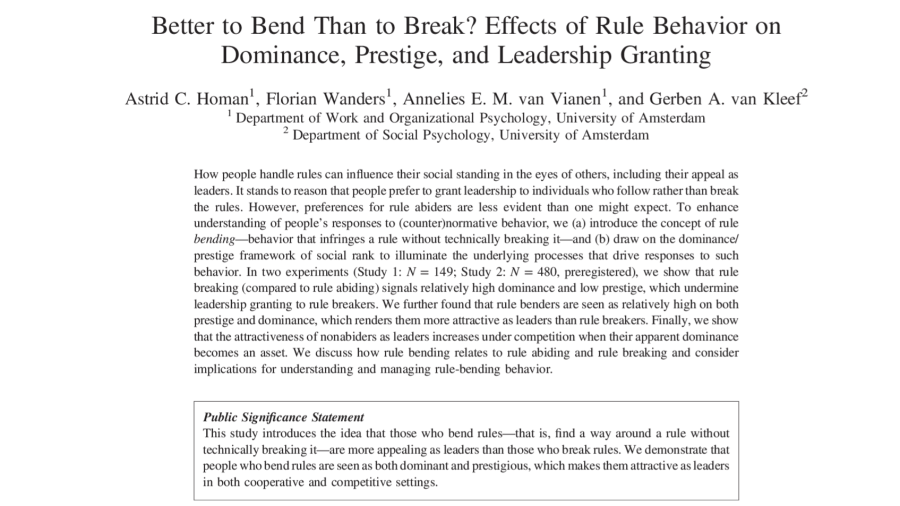
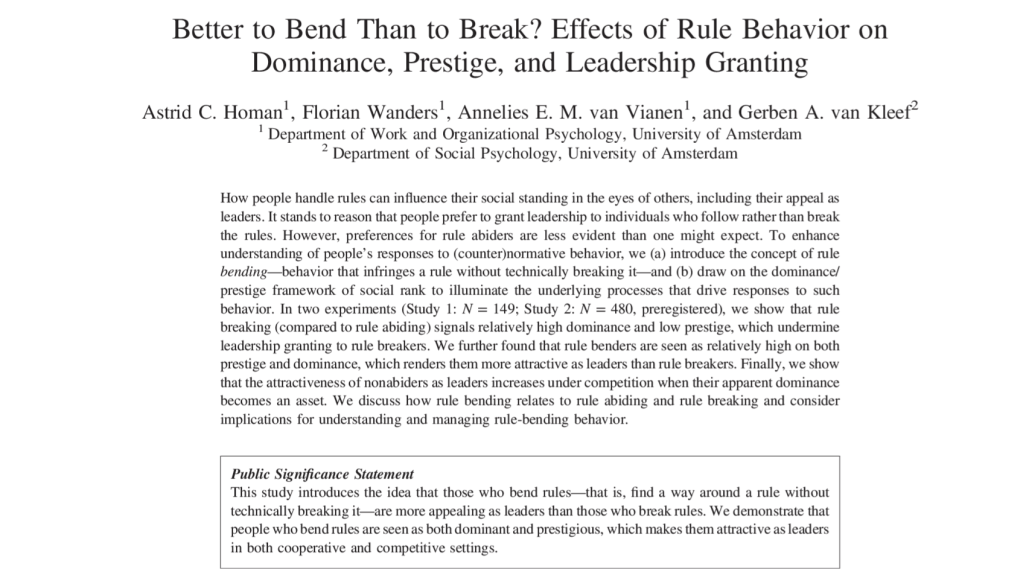
This explored how people perceive the dominance and prestige of people who follow, break and bend rules, and particularly their suitability for leadership.
PS. Check out my YouTube: https://youtube.com/@safe_as_pod?si=V2dbdmW–WbnhzA9
Shout a coffee: https://buymeacoffee.com/benhutchinson
Background:
• This article argues that those who “bend rules—that is, find a way around a rule without technically breaking it—are more appealing as leaders than those who break rules”
• While rule following may ostensibly be seen as positive, some “anecdotal evidence suggests that rule breakers may achieve greater success than people who follow the rules”
• “while rule breaking can yield benefits (i.e., rising to higher hierarchical positions, being admired) under certain conditions … it also carries significant risks (i.e., encountering anger, being punished”
• They propose that people who “break rules are perceived as relatively high on dominance (through their assertive behavior) but low on prestige (as they do not act like role models)”
• And “unlike rule abiders and rule breakers, people who bend rules are seen as relatively high on both dominance and prestige, given that they found a way to show assertiveness, without harming the collective”
• Dominance is “behaviors that rely on force or threat of force to obtain social rank” whereas “Prestige refers to social rank freely granted to individuals who deserve it”
• In competitive environments, “dominant individuals can unite collective action toward a common goal that represents the interests of the entire group” and “assertiveness of dominant individuals can provide protection against outside threats”
Results:
• They found “people who bend rules are seen as both dominant and prestigious, which makes them attractive as leaders”
• “rule breakers are granted less leadership (although they were comparatively more attractive in competitive settings) … compared to rule benders and rule abiders”
• “rule benders are granted more leadership than rule abiders but especially so in more competitive situations”
• “Whereas dominance was relatively more positively associated with leadership granting in competitive contexts, it was negatively associated with leadership granting in cooperative contexts.”
• Prestige was always positively linked with leadership granting and dominance isn’t necessarily, but “still facilitates leadership granting when competitive situations call for it”
• “When rule benders are granted leadership, this may trigger a self-reinforcing loop … through which rule benders receive ever more influence”


