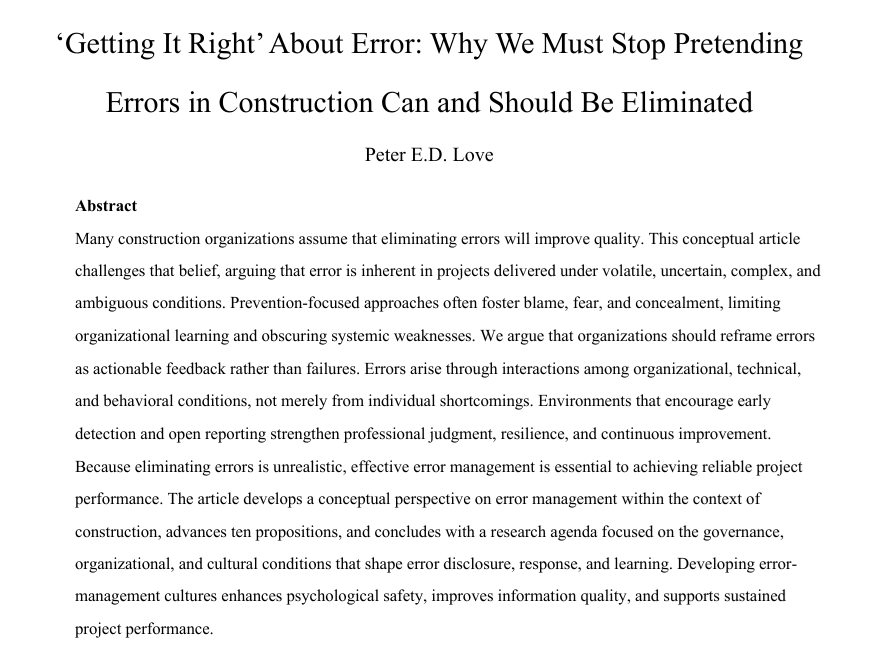
Does chasing zero errors help us improve, or make errors harder to ‘see’?
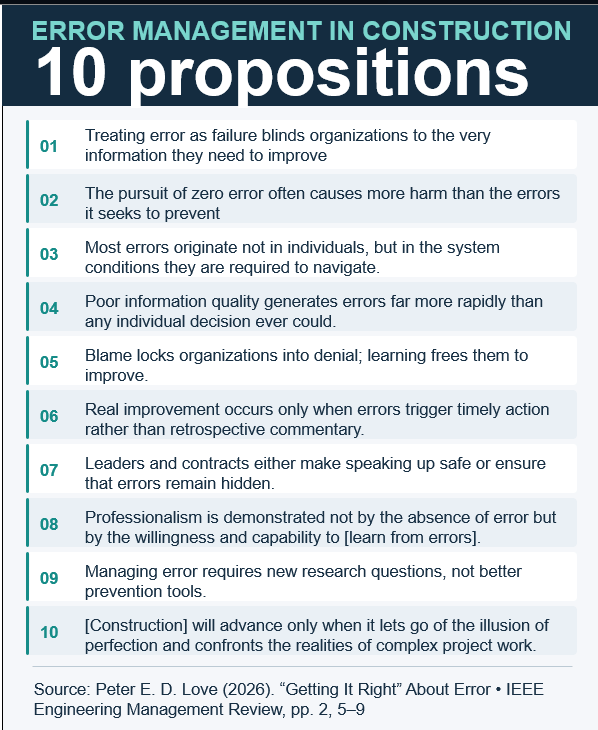
This article from Peter E.D Love reviews a range of studies to reframe error – and provides 10 alternative propositions (which I tabulated in image 1).
PS. Check out my YouTube: https://youtube.com/@safe_as_pod?si=V2dbdmW–WbnhzA9
Shout a coffee: https://buymeacoffee.com/benhutchinson
Extracts:
• “organizations should reframe errors as actionable feedback rather than failures”
• “Errors arise through interactions among organizational, technical, and behavioral conditions, not merely from individual shortcomings”
• “Because eliminating errors is unrealistic, effective error management is essential to achieving reliable [work]”
• “Errors are not merely deviations from procedure; they also reveal how individuals and organizations respond to uncertainty
• “Distinguishing errors from their manifestations is fundamental to an error management perspective”
• Because of construction working under VUCA conditions “the idea of error-free construction is not merely unrealistic; it can be counterproductive, stifling learning, encouraging risk-averse behavior, and preventing early intervention on emerging issues”
• “Designers interpret incomplete or evolving information; contractors negotiate cost, time, and quality pressures; site teams make rapid judgments in response to shifting circumstances”
• “A major obstacle to managing error is the quality and structure of project information [31]. Records are often unstructured, incomplete, or inconsistent”
• Construction can advance by “acknowledging fallibility, encouraging open reporting, and examining the circumstances that enable errors without defaulting to blame”
• We should enable “Learning Through, Not Just From, Error”
• We get stuck at ‘lessons learnt’ but this info is “rarely integrated into future projects [33]. Too often, documents are archived, checklists revised, and the next project proceeds unchanged”
• “Learning through error requires organizations to respond while work is underway, rather than relying solely on retrospective reflection”
• “Supporting these practices also requires intentional systems that enable early detection and constructive response”
• E.g. “early-warning systems that detect subtle signs of emerging problems, cross-project audits that identify recurring issues, and AI-enabled tools that detect anomalies during project delivery”
Study link: https://doi.org/10.1109/EMR.2026.3740673
#constructionsafety #workplacesafety #humanerror #humanfactors #safetyscience


