Are fewer near-miss reports good news or a trust / silence problem?
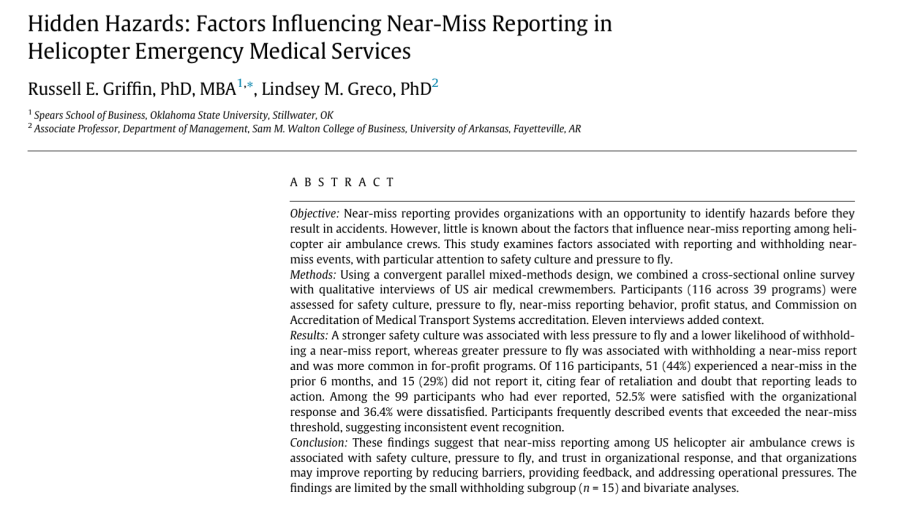
This surveyed and interviewed a total of 116 US air medical crewmembers on their near miss reporting behaviours and pressure to fly.
PS. Check out my YouTube: https://youtube.com/@safe_as_pod?si=V2dbdmW–WbnhzA9
Shout a coffee: https://buymeacoffee.com/benhutchinson
Extracts:
· “major accidents routinely reflect the accumulation of deeper organizational conditions and system vulnerabilities that become visible only after a catastrophic outcome”
· Whereas near misses can theoretically serve as early warning signs “What constitutes a near-miss varies across agencies, organizations, and industries, and the determination that an event was a near-miss can only be made after its consequences have unfolded”
· In this study, ‘safety culture’ was measured via the Integrated SC Model – so note limitations of trying to measure something like culture via survey
· “The decision to report a near-miss is fundamentally a question of trust between the employee and the organization” and participants were “more likely to report a near-miss when they believed that their concerns would be addressed, that feedback would be provided, and that the organization would learn from the event”
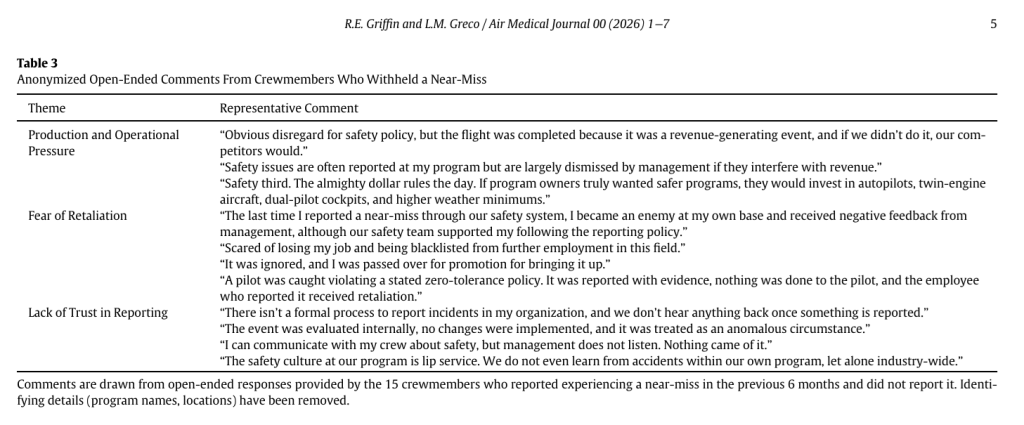
· “fear of retaliation, pressure to complete flights, and a belief that reporting would not make a difference were associated with withholding reports”
· Stronger SC survey performance was “associated with less pressure to fly and a lower likelihood of withholding a near-miss report, whereas greater pressure to fly was associated with withholding a near-miss report and was more common in for-profit programs”
· “Of 116 participants, 51 (44%) experienced a near-miss in the prior 6 months, and 15 (29%) did not report it, citing fear of retaliation and doubt that reporting leads to action”
· “Among the 99 participants who had ever reported, 52.5% were satisfied with the organizational response and 36.4% were dissatisfied”
· “Participants frequently described events that exceeded the near-miss threshold, suggesting inconsistent event recognition”
· “Pressure to fly emerged as the variable most consistently associated with withholding a near-miss report”
· “Participants reported substantial variability in pressure to fly, suggesting that some crews experience significant pressure to accept or continue flights beyond their personal safety thresholds”
· “profit status showed no direct association with withholding itself; its observed association runs through pressure to fly, a pattern consistent with commercial pressure operating on the conditions crews work under rather than on the individual reporting decision”
On Silence
· “Organizations may interpret a lack of near-miss reports as evidence of operational safety. The present findings suggest that such an interpretation may be misleading”
· “Participants who withheld reports, those who were dissatisfied with organizational responses, and those who never reported a near-miss despite experiencing one all described a common belief that reporting would not lead to action”
· Hence “the absence of reports is a better indicator of organizational silence rather than of organizational safety”
· And inconsistencies in how near misses are defined/conceptualised impacted reporting – “many events described by participants as near-misses had already crossed into incident or accident territory, including those that involved aircraft damage or declared emergencies”
· “…suggesting that uncertainty regarding what constitutes a near-miss may itself limit reporting”
Limitations as usual – sample size, reporting window of prior 6 months, recall bias, cross-sectional etc.
Study link: https://doi.org/10.1016/j.amj.2026.09.013
#NearMiss #SafetyCulture #AviationSafety #AirMedical #PsychologicalSafety #SafetyLeadership #HumanFactors #OHS


