Are your safety documents making your organisation less safe? And, the better they look, the worse it gets?
As we argued in our Safety Alchemy article:
“For many organisations, managing safety also encompasses managing a system of safety documents”
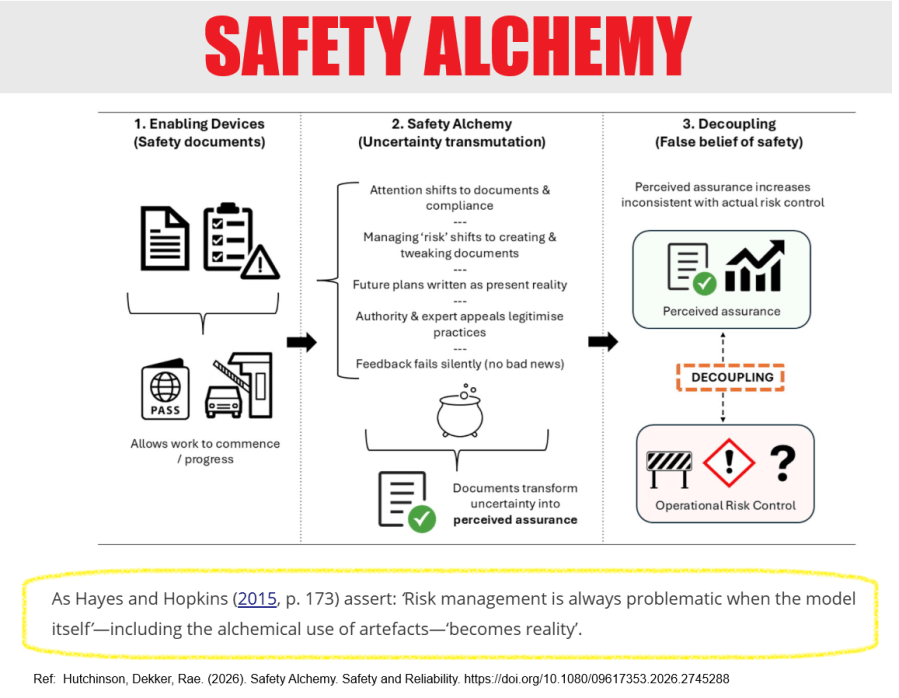
These documents are “enabling devices: they function as institutional passports that allow work to commence or advance”. This affords them a lot of power. They can shape what is, or isn’t, considered dangerous, or in or out of scope of risk assessments etc.
Organisations come to “mistake symbolic representations for reality,” and “uncertainty about operational conditions is transmuted into objective truth that the document exists and says the ‘right’ things”.
For Lee Clarke (Mission Improbable, 1999), documents also have a peculiar power to create a single source of ‘truth’, silencing other plausible interpretations of reality.
Plausibility is key – interestingly, Weick (Sensemaking in Orgs, 1995) said:
People are “driven by plausibility rather than accuracy”
For Weick, sensemaking is about “accounts that are socially acceptable and credible”. He aptly notes, “It would be nice if these acceptable accounts were also accurate”.
These accounts we create, and cement in safety documents, work as “templates… They explain. And they energize”.
We found the same thing across 7 major accidents – we called it safety alchemy:
“The process by which unresolved uncertainty, operational risk, or incomplete knowledge is transformed into perceived certainty and organisational assurance through the creation, completion, revision, or acceptance of safety artefacts, without a corresponding improvement in the underlying control of risk.”
We’re not arguing to abandon safety artefacts and systems. But, “their existence, completion, or continual refinement should not be treated as evidence that the risks they describe are adequately controlled”.
We conclude the article by adapting the beautiful quote from Hayes & Hopkins (Nightmare Pipeline Failures, 2015):
“Risk management is always problematic when the model itself”—and we argue including the alchemical use of artefacts—”becomes reality”.
PS. In the age of GenAI, I’m weirdly happy to say that this image was made entirely in PowerPoint using clipart.


