Are your indicators measuring ‘safety’, or more often activity?
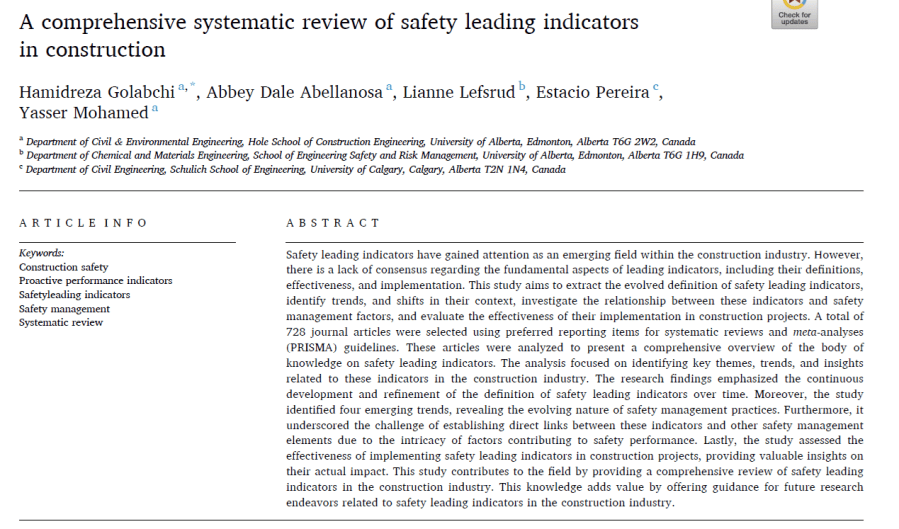
This systematic review evaluated 51 studies, unpacking indicator themes, trends & their effectiveness in construction.
Shared under an open access licence.
PS. Did you check out my video on better indicators? Link in comments – it unpacks how to identify & set measures around your risk control system.
Extracts:
· “there is a lack of consensus regarding the fundamental aspects of leading indicators, including their definitions, effectiveness, and implementation”
· “leading indicators should be measurable, actionable, and context-specific to be effective in predicting and preventing safety incidents”
· “Passive measures can predict trends over an extended period, while active measures initiate corrective actions within a shorter timeframe”
· “[Some] propose an alternative approach of labeling indicators as positive and negative indicators, rather than strictly considering them as leading or lagging”
· Such definitions “collectively embody a shared common-sense understanding characterized by three fundamental components: proactivity, predictiveness, and measurability”
· “[Some argue] to label leading and lagging indicators based on findings of causality rather than mere description”, e.g. developed in alignment with accident causation frameworks or similar
· “Instead of solely focusing on indicators that reflect safety outcomes like injuries [attention has redirected] to indicators that contribute to injury prevention”
· “Safety is no longer considered a separate entity, but an integral part of construction”
· “quantitative surveys employed to measure safety culture and climate have limitations and may not yield reliable results”
· “integrating all three categories of leading indicators, namely Organizational indicators, Operational indicators, and Cognitive and Behavioral indicators” may be important
· Lingard et al. 2017 found that leading & lagging indicators have a bidirectional relationship – eg, more safety activity (toolboxes etc) was followed by a lower injury rate a few months later, but injury rate also drove activity. So when injuries rose, more safety activity occurred, and once injuries fell that activity tapered off, and injuries rose again; they argued that this cyclical nature is “unlikely to produce long term sustained improvement in safety performance”
· “the theory underlying leading and lagging indicators is relatively simple compared to the inherent complexity of the construction projects”
· Lingard et al. 2017 ” challenged the notion that leading indicators measured at one point in time can predict safety at a subsequent point in time”
· “no single safety indicator excelled in all evaluation criteria. However … combining multiple indicators can lead to a more comprehensive evaluation”
· “Due to the complexity of injury causation factors, it becomes more challenging to establish a clear link between a leading indication and a lagging indicator”
· “As injury rates decline, larger sample sizes are needed to detect significant relationships and draw meaningful conclusions”
· “commonly used indicators are susceptible to manipulation and misinterpretation”
· “relying solely on easily measurable indicators is not advisable for construction companies. This includes placing excessive focus on the frequency of common and low severity lagging indicators or treating ordinary day-to-day actions as leading indicators”
· “certain aspects of safety are inherently difficult to measure and may not be adequately captured by the current measurement approaches”
· “indicators that capture the cultural aspects of an organization were deemed highly valuable”
· “Combining quantitative and qualitative approaches is necessary to provide clear utility for safety indicators”


