Can HOP approaches help us learn about drift?
This study evaluated “behavioral drift” via a HOP (Human & Organisational Performance) lens.
They utilised 39 audits, 272 workplace inspections, 86 hazard hunts, 41 near miss reviews, 110 incident investigations & >7k behavioural observations.
The methods and write-up in this study may divide some people on whether this is truly a HOP approach…
PS. Check out my YouTube: https://youtube.com/@safe_as_pod?si=V2dbdmW–WbnhzA9
Shout a coffee: https://buymeacoffee.com/benhutchinson
Background:
· “Operational failures rarely happen because of a single unsafe act or one bad decision”
· “Most adaptations are made with positive intent and are often viewed as practical solutions to real-world challenges”
· “drift should be viewed as a signal of system weaknesses rather than simply a compliance issue”
· “A critical characteristic of Behavioral Drift is that it is often reinforced by success”
· “Because each individual adaptation often appears reasonable and produces the desired outcome, the associated increase in risk remains largely invisible”
· “Behavioral Drift describes the gradual movement away from intended practices, while Normalization of Deviance describes the organizational acceptance of that movement once it has occurred”
· “Organizations that rely exclusively on procedures, audits, and compliance metrics may develop a false sense of assurance regarding operational performance”
Findings:
· “drift was most commonly observed in routine and repetitive activities, where previous success reinforced confidence in alternative work methods”
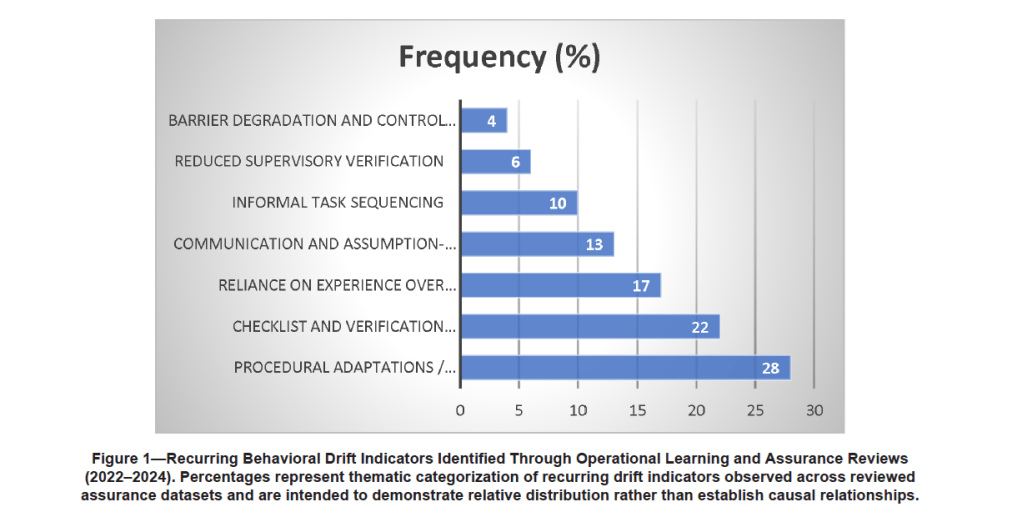
· “Procedural workarounds and checklist degradation accounted for approximately 50% of the identified drift indicators”
· “Maintenance activities were more frequently associated with procedural adaptations, while lifting operations demonstrated a greater prevalence of communication-based assumptions”
· “Certain checklist items were completed as administrative requirements rather than active verification activities”
· “Supervisory verification focused primarily on task completion rather than validation of critical procedural steps”
· “Minor deviations observed during previous reviews had not been formally challenged because no adverse outcomes had occurred”
· “Weak signals were present within audits, inspections, observations, and employee feedback, but their significance only became apparent when the information was analyzed collectively rather than in isolation”
· “In many cases, these adaptations were not perceived as deviations because they had become part of everyday operations”
· It notes an important principle of HOP: drift rarely results from intentional non-compliance but rather through “repeated successful adaptations that gradually become accepted as normal practice”
· “Behavioral Drift is a leading indicator of risk rather than a consequence identified only after an incident occurs”
· “Employee interviews consistently showed that personnel believed they were making reasonable decisions based on the conditions, resources, and pressures present at the time”
· “These interactions helped reveal hidden vulnerabilities that would not have been identified through compliance reviews alone”
· “The objective was not to eliminate adaptation through increased compliance enforcement, but rather to understand why the adaptations had developed”
· “drift cannot be eliminated completely because adaptation is a normal part of complex work”
· “The challenge for organizations is recognizing when those adaptations begin to reduce safety margins and increase risk”
· They say “Behavioral Drift requires more than enforcing procedures. It requires organizations to understand how work is actually performed, identify emerging adaptations, and address the conditions that encourage those adaptations”
Study link: https://doi.org/10.2118/236108-MS
#HOP #SafetyII #SafetyDifferently #SIF #Drift #SafetyScience


