If an investigation isn’t about blame, then why do we still expect somebody to be blamed?
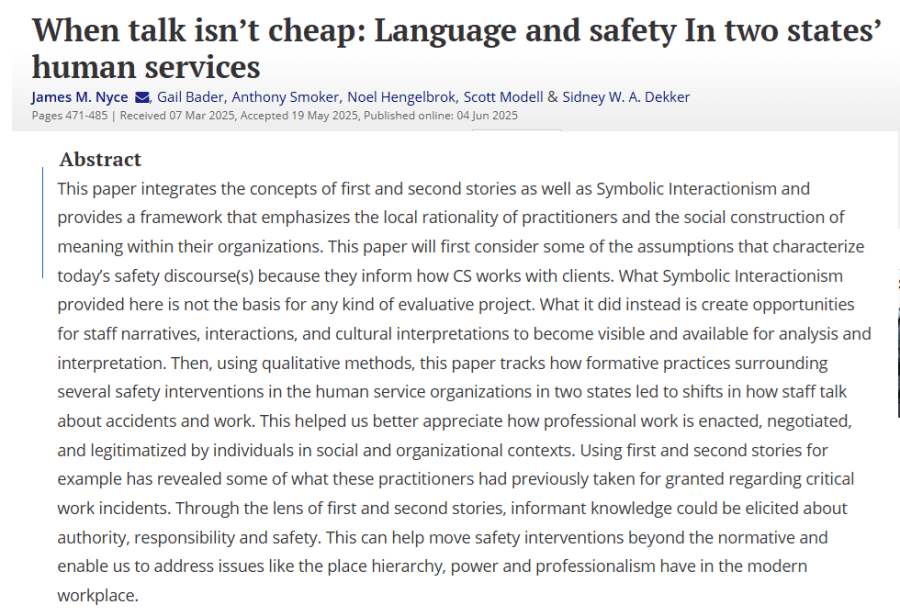
This study investigated how child welfare staff talked about incidents, blame & work – framed via first and second stories.
PS. Check out my YouTube: https://youtube.com/@safe_as_pod?si=V2dbdmW–WbnhzA9
Shout a coffee: https://buymeacoffee.com/benhutchinson
Background:
· Investigations “still too often defaults to the accountability and responsibility of practitioners… which ‘naturally’ returns the locus of ‘remediation’ back to the individual(s)”
· “rarely is any one employee empowered (enough) to be solely responsible for a critical decision”
· “Accidents often occur when an untoward cascade of events takes place. However, this is generally discovered only after the fact and only when a single actor is held to be responsible”
· First stories are “superficial, (initial) understanding of events”, “heavily impacted by hindsight, outcome and severity biases” & “characterized by variants on ‘human error’ (e.g. complacent, situationally unaware, lazy, etc.)”
· Second stories provide “more context rich narrative” focusing on “the view from the inside” & “the systemic contributions that ultimately helped set people at the sharp end up for failure (e.g. incentives, policy changes, time pressures, workload, etc.)”
· 2nd stories “look beyond default explanations that rely on ‘human error'”
Results:
· “Every single meeting I’ve ever sat in there’s a ceremonial spiel of ‘This is not to finger-point and this is not to place blame’ but it doesn’t matter”
· But “someone is always looking for someone to blame”
· “The notion of accountability upward is not part of who we are…[it’s] collateral accountability that goes down but not necessarily up”
· One provider removed “med passing privileges after three med errors”, but after changing their approach: “the error was less the person’s and more from all the circumstances we needed to address”
· Changing their approach led to staff seeing reviews as producing “a new and powerful kind of evidence that would be more difficult for others to ignore or dismiss”
· They “did not believe that blame and finger-pointing would cease to be a guiding principle in their organizations”
· E.g. until “safety science addresses the issue of hierarchy head on, safety solutions will ultimately default to the norm”
In all, “[T]alk, seemingly the most ephemeral and transient of social phenomenon, can be a vehicle for understanding and changing staff’s perception of the workplace and their jobs”
“[W]e must resist the temptation to believe…we know more about how to bring safety to the workplace than those who work there”
Ref: Nyce, J. M., Bader, G., Smoker, A., Hengelbrok, N., Modell, S., & Dekker, S. W. A. (2025). When talk isn’t cheap: Language and safety in two states’ human services. Journal of Risk Research, 28(5), 471–485.
Study link: https://doi.org/10.1080/13669877.2025.2512077
#SafetyCulture #HumanFactors #SafetyScience #JustCulture #IncidentInvestigation


