Who’s absorbing the pressures that your business dashboards don’t see?
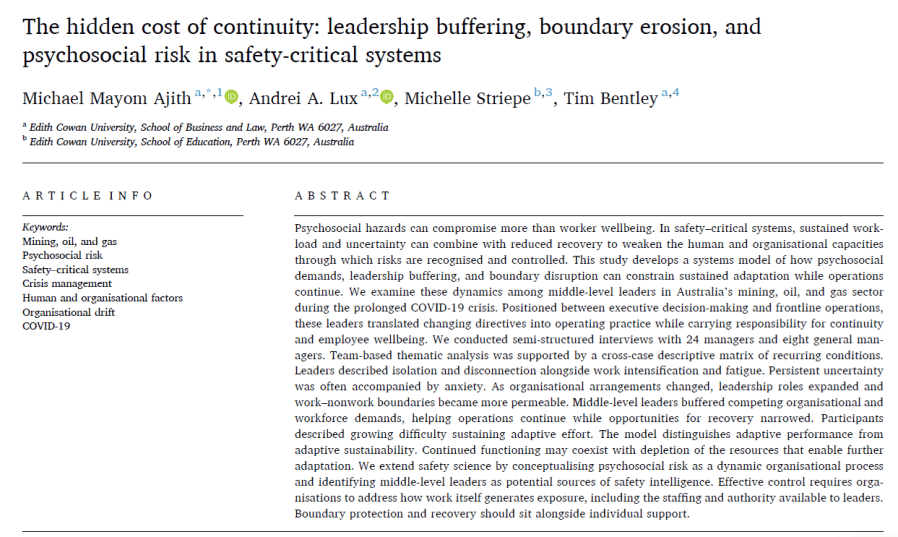
This interview study explored how the interactions of psychosocial demands, leadership buffering & more sustain performance during times of serious disruption (COVID), in Australia’s mining and oil & gas sectors.
Not a summary as usual, being lazy, but full PDF attached.
PS. Check out my YouTube: https://youtube.com/@safe_as_pod?si=V2dbdmW–WbnhzA9
Shout a coffee: https://buymeacoffee.com/benhutchinson
While buffering the pressures was ongoing, leaders’ said it “did not necessarily remove the pressures being managed … it relocated part of their operational, cognitive, or emotional cost into the leadership role”.
Leaders relate stories of working 18 hr days and lack of sleep, keeping everybody calm while dealing with the same uncertainty themselves and more.
The authors argue that “continued functioning may coexist with depletion of the resources that enable further adaptation”. As in, work continuity shows that people are adapting, but their capacities are finite.
Authors separate ‘supported buffering’ from ‘extractive buffering’. Extractive buffering refers to continuity that “depends increasingly on extended availability, discretionary effort, or repeated compensation for demands that remain structurally unresolved”.
But this has a caveat: “operational continuity alone cannot distinguish between” the two of them.
The paper recommends:
· Not relying on ‘usual’ indicators like production, compliance, injuries/incidents as these “may reveal little about accumulating fatigue, reduced recovery, or dependence on sustained compensatory effort”
· Coping support mechanisms don’t remove the source, e.g. stress management, counselling & resilience programs leave causes “largely intact when workload, staffing, role design, or organisational expectations remain unchanged”
· Middle-managers carry the burden, where they “may… manage the consequences of organisational pressures without having the authority to remove their source”
· These phenomena aren’t an individual resilience problem, e.g. fatigue, role expansion & boundary erosion “should not automatically be read as deficiencies in individual resilience”
· Try asking different questions after disruptive events, e.g. what extra work did continuity require? Which responsibilities were expanded? Where was recovery impacted or compromised? Which recurring issues relied on local compensation strategies? And more.
· In conclusion, authors suggest that resilience should be judged not only “by whether a system continues to adapt, but also by whether it preserves the capacity required to adapt again”.
Study link: https://doi.org/10.1016/j.ssci.2026.107573
#PsychosocialRisk #ResilienceEngineering #SafetyLeadership #WHS #HumanFactors


