
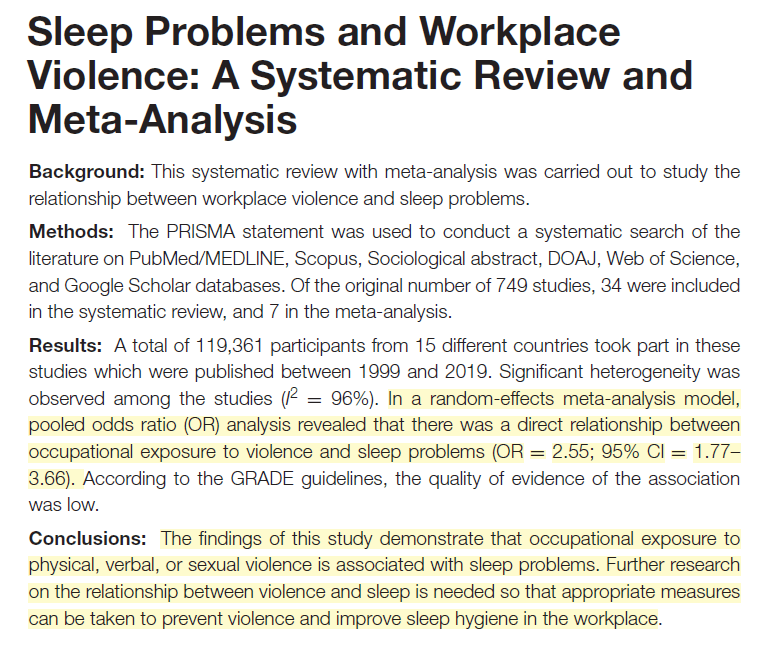
Are sleep problems (SP) and workplace violence (WV) related? Quite possibly.
This meta-analysis and systematic review unpacked 34 studies exploring the links.
Extracts:
VW can be classified into four types:
· “Type 1, Criminal Intent, when no legitimate relationship exists between the perpetrator and the business or its employees and the perpetrator commits a crime (robbery, shoplifting, trespassing) in addition to violence
· “Type 2, Violence toward the worker on the part of the customer/client”
· Type 3, worker-on-worker, commonly referred to as lateral or horizontal violence”
· “Type 4, personal relationship, in which a relationship between the perpetrator and the worker outside of work is transferred to the work environment”
· “The first type of violence, which can often be fatal, affects mainly police officers, bank employees, taxi drivers, and traders. Type 2 is common in health care and teaching. Type 3 and 4 are possible in all types of work”
· Pooled odds ratios revealed “a direct relationship between occupational exposure to violence and sleep problems (OR = 2.55; 95% CI = 1.77– 3.66)”, e.g. >2.5 the odds of WV when sleep problems are present
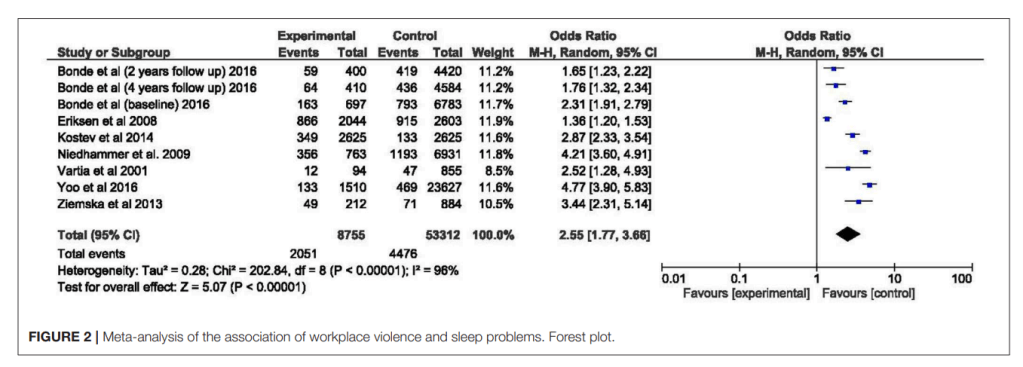
· Hence, “occupational exposure to physical, verbal, or sexual violence is associated with sleep problems”
· However, given the source data limitations they conclude “with [weak] evidence, that WV is associated with an increased risk of SPs”
· All of the studies included reported that “workers exposed to violence manifest problems related both to the quantity of sleep (e.g., sleep loss) and the quality of sleep”
· “Verbal violence perpetrated by colleagues and superiors, known as lateral violence or bullying, appears to be the most harmful type
· And “A consistently high prevalence of SPs in workers exposed to violence was found in the studies surveyed, and the risk for subjects who had experienced violence was significantly higher than for other workers”
For why:
· They note that there isn’t a fully elucidated mechanism/s on why these are related, but provide some insights
· Some mechanisms relate to the connectivity and profiles of the default mode circuit (DMN), where “Connectivity between nodes of the DMN, NA and other networks implicated in mood and anxiety disorders fluctuate as a function of sleep stage”
· “Different sleep problems could induce hyper-reactivity or hypo-connectivity of different nodes of circuits … that, in turn, contribute to the development and maintenance of emotional distress that underlies the maladaptive behaviors commonly observed in anxiety disorders”
· SP has been “shown experimentally to induce negative mood states, as well as a negative affective network profile mimicking that of anxiety and depression”
· “findings suggest that at least for some individuals, maladaptive negative affective network function may be an intermediate step between sleep disruption and anxiety and mood features, and that sleep is a modifiable target through which emotional distress can be reduced”
· While virtually all of the studies reviewed the effect of violence on quantity and quality of sleep, the reverse has rarely been studied – e.g., whether “the presence of SPs promotes WV”
· “In point of fact, violence at work can be considered a stress factor, and it is well-known that there is a close relationship between violence and stress”
· “Recent longitudinal studies have shown that violence and stress are in a cyclic relationship, i.e., violence increases stress in the worker, and the distressed worker is prone to violence”

Ref: Magnavita, N., Di Stasio, E., Capitanelli, I., Lops, E. A., Chirico, F., & Garbarino, S. (2019). Frontiers in neuroscience, 13, 997.

Shout me a coffee (one-off or monthly recurring)
Study link: https://www.frontiersin.org/journals/neuroscience/articles/10.3389/fnins.2019.00997/full
Safe As LinkedIn group: https://www.linkedin.com/groups/14717868/

 SafetyInsights.org