
Can chatbots provide more social connection than humans? Possibly, providing that they don’t “claim too much humanity”.
Three study protocols with 801, 201 and 401 had participants engage with AI social chatbots.
They note that the long-term consequences of social chatbot use is unknown, but is important to study since “hundreds of millions of people have used social chatbots designed to provide companionship to their users”.
Extracts:
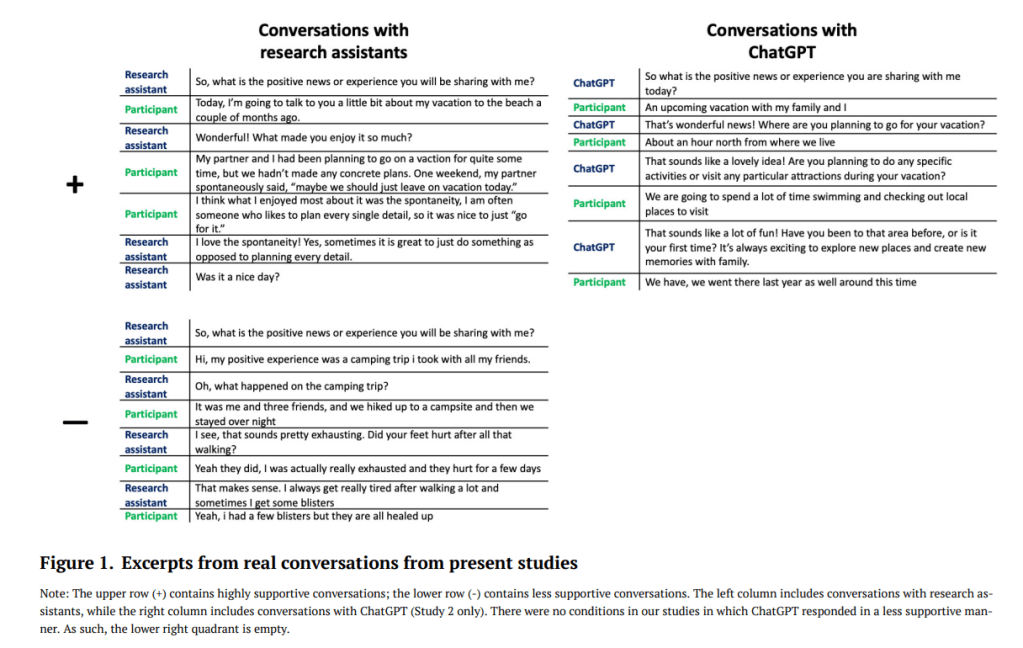
· “Participants’ feelings following the interaction were influenced by their partner’s response style, but not by whether their partner was human”
· “In Study 2 … participants derived more social connection from having a supportive conversation with ChatGPT than with a less supportive human”
· “In a final pre-registered study (Study 3; N=401), we identified an important boundary condition, demonstrating that the relative benefits of interacting with chatbots (vs. humans) may be reduced when they claim too much humanity”
· Hence, “when chatbots “go too far” in their human-like behavior by sharing their own good news, the benefits of such interactions are no longer comparable to human counterparts”
· Further, “chatbots were less satisfying partners when they shared their own news and created an obvious violation of their inherent lack of experience “
· This research “suggests that people can potentially derive benefits from interacting with a partner who they know to be inanimate”
· “participants who believed their conversation partner was a chatbot felt similar levels of social connection, rapport and positive feelings compared to those who believed their partner was human”
· In these studies “the response style of one’s conversation partner was far more impactful than whether people believed they were talking to a chatbot or a human”
· “Indeed, people felt more socially connected to a supportive version of ChatGPT than a less supportive human partner”
· “While we assume that participants objectively understood that chatbots lack conscious experience, they apparently still felt as though their chatbot had a mind”
· “it should perhaps be no surprise that human beings readily perceive agency in a chatbot who responds to their good news with interest and personalized engagement”
· “Importantly, our findings do not suggest that people should seek out a supportive chatbot over a supportive human. Just as ChatGPT may be more helpful for a “C” student than an “A” student in writing an essay, digital companionship may have more to offer for those with unsupportive (vs. supportive) friends and family”
· “the present research points to the possibility that the emotional impact of a conversation—positive or negative—might be greater when one’s partner is a human compared to a chatbot”

Ref: Folk, D., Yu, S., & Dunn, E. (2024). Can Chatbots ever provide more social connection than humans?. Collabra: Psychology, 10(1), 117083.

Shout me a coffee (one-off or monthly recurring)
Study link: https://online.ucpress.edu/collabra/article-pdf/10/1/117083/839285/collabra_2024_10_1_117083.pdf
Safe As LinkedIn group: https://www.linkedin.com/groups/14717868/

 SafetyInsights.org