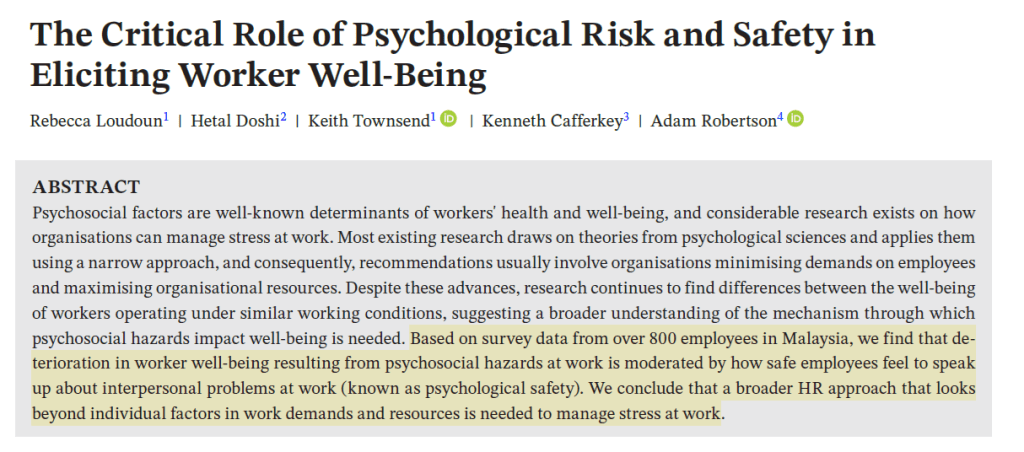
This explored the links between psychosocial risk and psychological safety on worker well-being.
Survey responses from >800 workers in Malaysian were obtained.
Usefully, it’s another study that slightly challenges the claim that you ‘can’t have too much psychological safety’. We need far more targeted evidence to make that claim.
Extracts:
· “our results revealed a significant negative relationship between psychosocial risk and well-being … and a positive relationship between worker psychological safety and well-being”
· “when employees experience an increase in psychosocial risk in the workplace, they will report lower levels of well-being and, conversely, when employees experience a decrease in psychological safety, they will report lower levels of well-being”
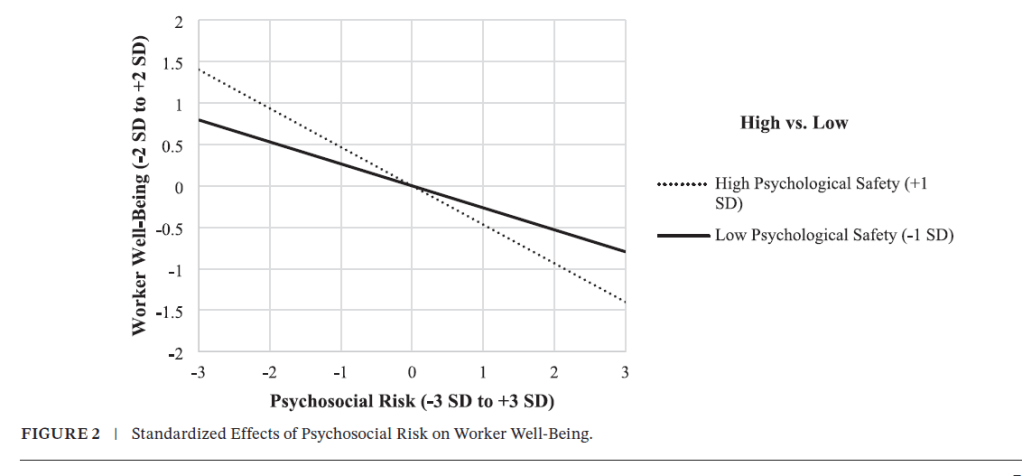
· “psychosocial safety moderated the relationship between psychosocial risk and well-being. However, the interaction between psychosocial risk and psychological safety was not as expected”
· “We found that while the negative effect of psychosocial hazards on worker well-being
· are attenuated by psychological safety, the strength of the effect is weaker when psychological safety is low versus high”
· “It is difficult to explain this result. One possible explanation is that relationships between psychosocial safety and psychosocial hazards is not linear. This proposition was first raised by Newman et al.’s (2017) in their review of the psychological safety literature. They called on researchers ”to explore possible negative consequences of ‘too much’ psychological safety at the individual, team, and organizational levels’
· Other research “found an overall positive effect of psychological safety at the mean, but a diminishing relationship between high levels of psychological safety climate and performance. They explain this result as arising because psychological safety climate can draw employees’ attention to more novel tasks at the expense of their core tasks and it encourages them to challenge the status quo and conventional methods”
· “Raising concern and ideas about controlling psychosocial risks often entails directly addressing managers’ personal conduct, such as instances of bullying or harassment … As a result, it is possible conflict can result if psychological safety rises above a certain threshold, and thus the beneficial impact on well-being is diminished”
· “it is commonly accepted that the modern workplace is ill-equipped to deal with current problems resulting from psychosocial hazards … and its management and risk management models are largely derived from research focusing on safety hazards, not health hazards”
Ref: Loudoun, R., Doshi, H., Townsend, K., Cafferkey, K., & Robertson, A. (2025). Asia Pacific Journal of Human Resources, 63(2), e70009.

Shout me a coffee (one-off or monthly recurring)
Study link: https://doi.org/10.1111/1744-7941.70009

 SafetyInsights.org