This prosecution judgement related to a serious injury, after heavy stone slabs tipped off a truck tray onto a worker.
Some extracts I found interesting:
· “state of knowledge applied to the definition of practicable is objective. It is that possessed by persons generally who are engaged in the relevant field of activity and not the actual knowledge of a specific defendant in particular circumstances”
· “The reasonably practicable requirement applies to matters which are within the power of the defendant to control, supervise and manage”
· “The word “risk” is not defined in the Act. Risk should not be interpreted in a complicated fashion. Safety cannot be ensured if a risk is present. The presence of a risk to the health or safety of a worker constitutes a breach .. of the Act”
· “It is not necessary that there be a particular accident, or that a person is actually injured. What is required is the creation of the risk”
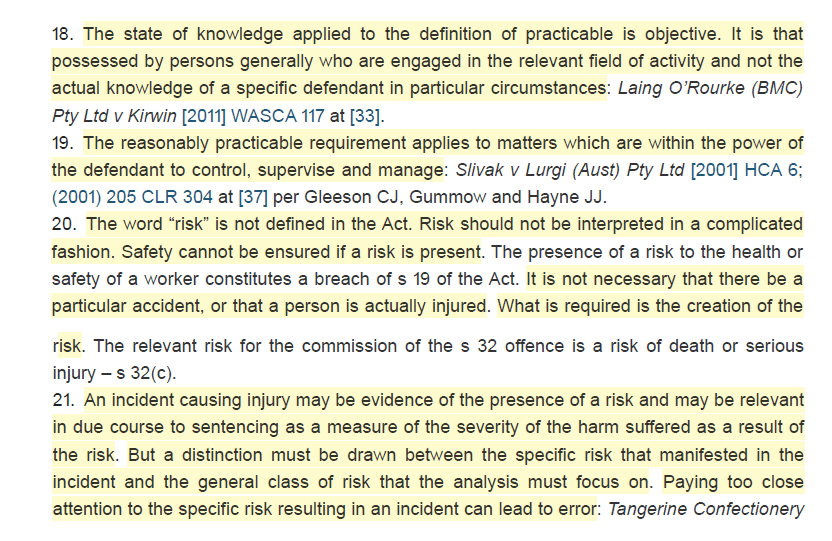
· “An incident causing injury may be evidence of the presence of a risk and may be relevant in due course to sentencing as a measure of the severity … But a distinction must be drawn between the specific risk that manifested in the incident and the general class of risk that the analysis must focus on”
· “Paying too close attention to the specific risk resulting in an incident can lead to error”
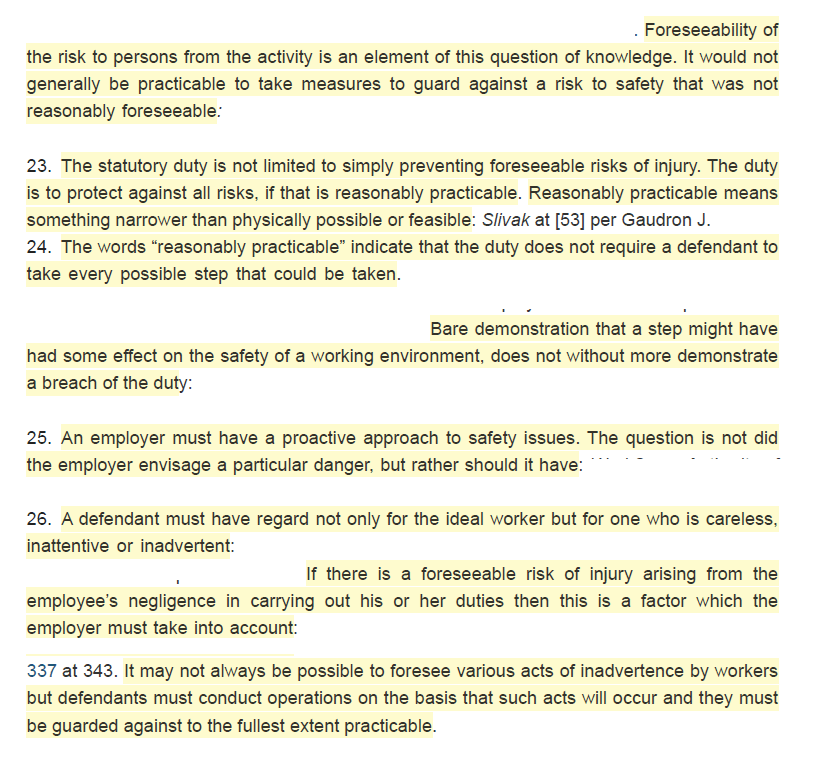
· “Foreseeability of the risk to persons from the activity is an element of this question of knowledge. It would not generally be practicable to take measures to guard against a risk to safety that was not reasonably foreseeable”
· “The statutory duty is not limited to simply preventing foreseeable risks of injury. The duty is to protect against all risks, if that is reasonably practicable”
· “Reasonably practicable means something narrower than physically possible or feasible”
· “The words “reasonably practicable” indicate that the duty does not require a defendant to take every possible step that could be taken”
· “Bare demonstration that a step might have had some effect on the safety of a working environment, does not without more demonstrate a breach of the duty”
· “An employer must have a proactive approach to safety issues. The question is not did the employer envisage a particular danger, but rather should it have”
· “A defendant must have regard not only for the ideal worker but for one who is careless, inattentive or inadvertent”
· “If there is a foreseeable risk of injury arising from the employee’s negligence in carrying out his or her duties then this is a factor which the employer must take into account”
· “It may not always be possible to foresee various acts of inadvertence by workers but defendants must conduct operations on the basis that such acts will occur and they must be guarded against to the fullest extent practicable”
About whether the risks were known or ought reasonably to have been known:
· “The defendant’s Occupational Risk Prevention Plan (the Plan) stated that failure to comply with the Cosentino Cardinal Rules “can result immediately in a very serious injury”
· “That such harm was likely to occur was foreseen in the Plan when it said that workers were to “never ”load only one part of the A-frame. They were also told to “always balance loads”
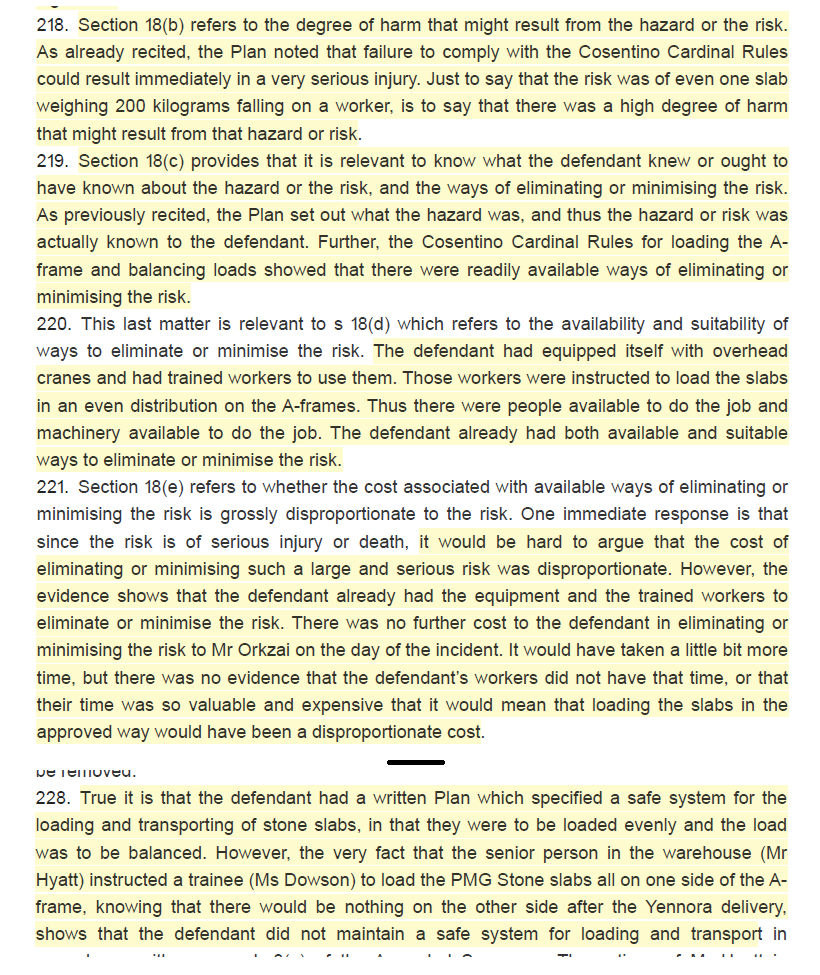
· “Section 18(c) provides that it is relevant to know what the defendant knew or ought to have known about the hazard or the risk … As previously recited, the Plan set out what the hazard was, and thus the hazard or risk was actually known to the defendant”
· “the Cosentino Cardinal Rules for loading the A-frame and balancing loads showed that there were readily available ways of eliminating or minimising the risk”
· “The defendant had equipped itself with overhead cranes and had trained workers to use them”
· “Thus there were people available to do the job and machinery available to do the job. The defendant already had both available and suitable ways to eliminate or minimise the risk”
· “There was no further cost to the defendant in eliminating or minimising the risk to Mr Orkzai on the day of the incident. It would have taken a little bit more time, but there was no evidence that the defendant’s workers did not have that time, or that their time was so valuable and expensive that it would mean that loading the slabs in the approved way would have been a disproportionate cost”
· And while they had a written safe system of work for loading/transporting stone slabs, the “the very fact that the senior person in the warehouse .. instructed a trainee .. to load the PMG Stone slabs all on one side of the A-frame, knowing that there would be nothing on the other side after the Yennora delivery, shows that the defendant did not maintain a safe system for loading and transport”
Ref: SafeWork NSW v Cosentino Australia Pty Limited [2018] NSWDC 47


 SafetyInsights.org