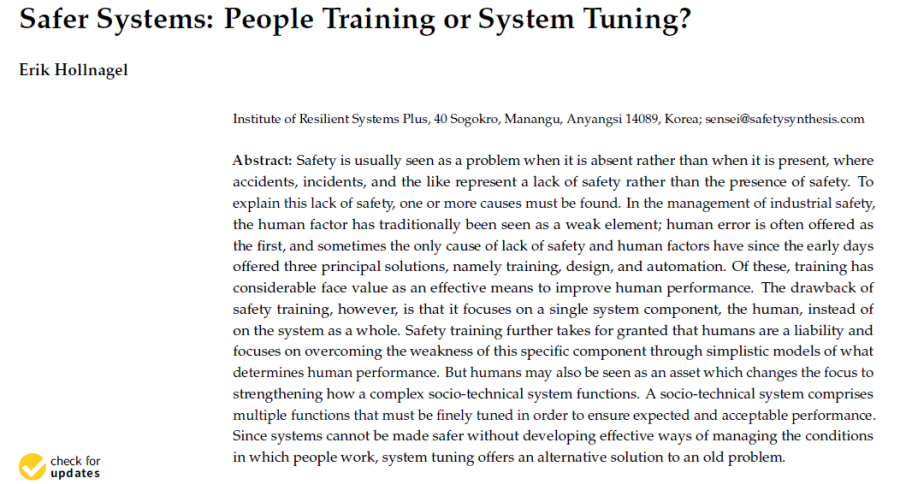
Hollnagel discusses the role of training in complex systems.
Shared under open access licence.
PS. Check out my YouTube channel: Safe As: A thrifty analysis of safety, AI and risk – YouTube
Extracts:
· “Safety is usually seen as a problem when it is absent rather than when it is present, where accidents, incidents, and the like represent a lack of safety rather than the presence of safety”
· Often “human error is often offered as the first, and sometimes the only cause” of lack of safety
· Training may have “considerable face value”, but a limitation is that it “focuses on a single system component, the human, instead of on the system as a whole”
· “Safety training further takes for granted that humans are a liability and focuses on overcoming the weakness of this specific component through simplistic models”
· A goal aim should not just be fewer accidents but understanding “why and how work goes well” and “facilitate and amplify that”
· In complex work, safety depends on “multiple functions that must be finely tuned in order to ensure expected and acceptable performance”
· A practical takeaway is that systems “cannot be made safer without developing effective ways of managing the conditions in which people work”
· “From a joint-systems perspective it is still useful—and practically necessary—to describe systems in terms of their details or particulars” but focused on how they work together
· “To achieve desired performance, and to develop a training programme for that, it is necessary to consider which skills and competences are required for the chosen purpose and to keep in mind that people’s performance always serves multiple purposes and never the avoidance of accidents alone”
· “Whatever is trained must therefore be synergistic with everything else”
· “Tuning is an engineering term that describes how the functioning of a system can be optimised for a particular environment by adjusting critical parameters and functions”
· “it is possible to tune for safety, which today means adjusting the system’s safety performance to ensure that as much as possible goes well”
· “the problem is not simply to train people to work more safely. The problem is rather to find ways to improve—or as you say, to tune—how my company works and to understand how this happens”
· “One way to start is to identify the functions that are essential for the performance you want”

 SafetyInsights.org