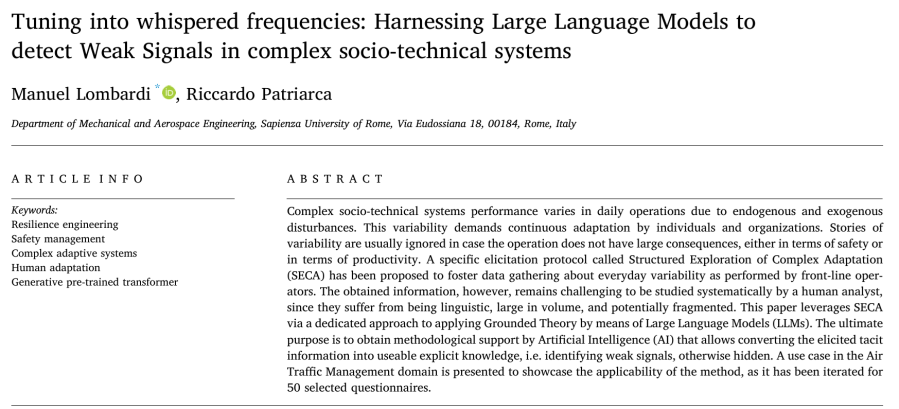
This study evaluated whether LLMs can support a scaled and systematic analysis of surveyed data about worker adaptive practices, to foster weak signal ID.
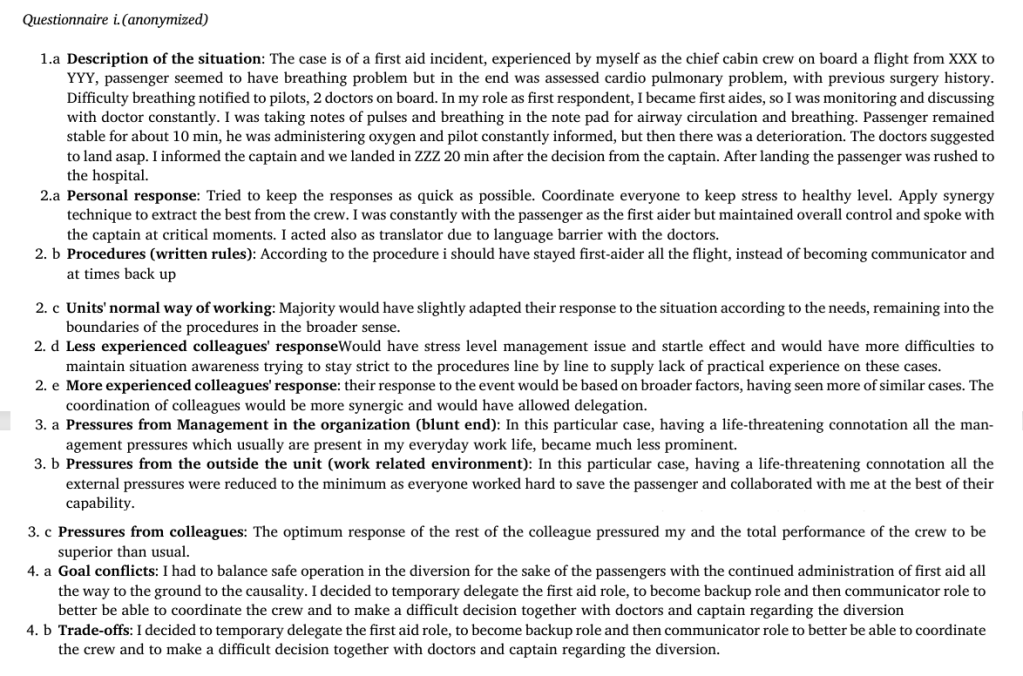
E.g. can LLMs help identify weak signals from large-scale data. In this case, textual data describing frontline personnel adaptive behaviours during everyday operations. This was obtained via survey.
PS. Check out my YouTube channel: https://www.youtube.com/@safe_as_pod
Extracts:
· “Systems performance varies in everyday operations due to various internal and external factors, with individuals forced to adapt their performance to cope with any given situation”
· “The factors behind these adaptations are not usually evident, as they may emerge from disconnected pieces of information. Making sense of them refers to identifying ‘weak signals’”
· “Data gathering on adaptive performance is rarely performed, if disconnected from adverse events,” even though it “may have several benefits to fully grasp the actual status of the system and understand the mechanisms that sustain its operation.”
· Manual analysis is useful, but limited as “the dominance of human contribution in textual data analysis significantly limits its applicability and scalability”
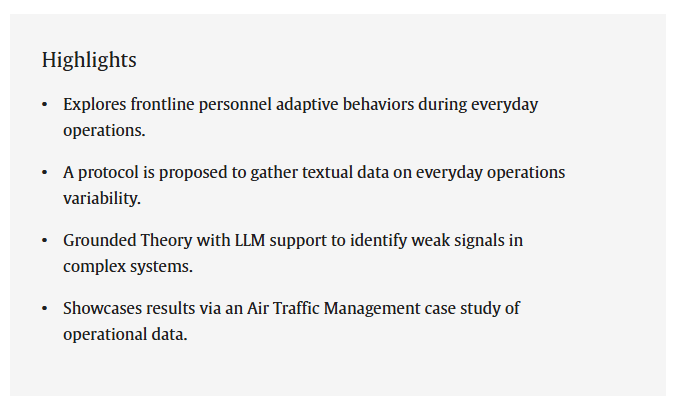
· The “weak signals identified through the proposed approach are intrinsically socio-technical, as they emerge from the ways in which people adapt, coordinate, prioritize, and make trade-offs in everyday operations”
· This approach isn’t just related to weak signals of emerging risks, but “can also unearth weak signals that contribute positively to system performance”, e.g. “positive weak signals” represent the very mechanisms that ensure system resilience in everyday operations. They reveal how systems continue to function effectively despite uncertainty, constraints, and competing goals, by relying on adaptive capacity rather than strict procedural compliance”
· “This study demonstrates how the application of LLM-driven analysis can reveal subtle but potentially crucial weak signals within ultra-safe, complex socio-technical environments”
· One weak signal was “the combination of the absence of specific procedures and colleagues’ pressure during events characterized by communication issues”
· The study “demonstrates how the application of LLM-driven analysis can reveal subtle but potentially crucial weak signals within ultra-safe, complex socio-technical environments”
· The authors claim that such patterns are “hard to grasp by traditional methods”
· Further, “proactive safety improvements” and “strengthening the foundations of knowledge management in high-stakes domains”
Lombardi, M., & Patriarca, R. (2026). Tuning into whispered frequencies: Harnessing Large Language Models to detect Weak Signals in complex socio-technical systems. Engineering Applications of Artificial Intelligence, 176, 114738.
#ai #llm #safety #risk #safetyengineering
Study link: https://doi.org/10.1016/j.engappai.2026.114738
My YouTube: https://www.youtube.com/@safe_as_pod
My site with more reviews: SafetyInsights.org
Shout me a coffee: https://buymeacoffee.com/benhutchinson
Safe As LinkedIn group: https://www.linkedin.com/groups/14717868


