Is risk discovered or simply constructed, visualised and governed?
A cool read from Cavallo’s ‘Aesthetics of Risk’, which asks us to look beyond hazards towards the future and production of risk.
Extracts from just a couple of chapters. Can post more if people are interested.
PS. Check out my YouTube and recent Critical Control / barrier vid: https://youtube.com/@safe_as_pod?si=iUaDPJynPemQRZhY
Shout a coffee: https://buymeacoffee.com/benhutchinson
Extracts:
· “There is no such thing as risk in reality”
· Risk is “a way…of ordering reality, of rendering it into a calculable form”
· “Risk is not something tangible but a form of knowledge we produce” by trying to recognise & quantify what could happen
· For some, risk is based on the mix of knowledge & uncertainty: “When there is risk, there must be something that is unknown (…) hence there must be uncertainty (…), but for this uncertainty to constitute a risk, something must be known about it”
· “Risk, then, is an uncertainty reduction process, a diagnostic method used to make decisions about the future”
· Hazards may exist independently of perception but “risk begins when we see them coming”, and involves “calculations, perceptions, and emotions”, but also imagination and perspective
· Risks are said to be created by different communities and authoritative systems to protect their identities, and what counts as dangerous instability therefore “varies from one community to another”
· Risks “can be invented and constructed to serve different interests”, and ‘risk creation’ don’t just “produce new interpretative categories, but also new realities”
· Risk systems don’t just respond to risk but also produce it: “envisioning of possible disaster scenarios and the actions to mitigate or redistribute the risks are what create risk”
· “we can fabricate risks, but they do not necessarily reflect real dangers”. E.g. Assessments, drills, simulations, manuals, alarms, and barriers may also be material expressions of someone’s perception of what might go wrong
· Aesthetics of risk are important since they make uncertain futures perceptible. E.g. maps, models, warnings, instructions, drills and data visualisations let risks be imagined, rehearsed, and acted on
· Visualising risk can empower people, e.g. safety images helped “train vigilant citizens in their ability to perceive risk”, supplying commuters & workers with a ready-made interpretation and plan of action
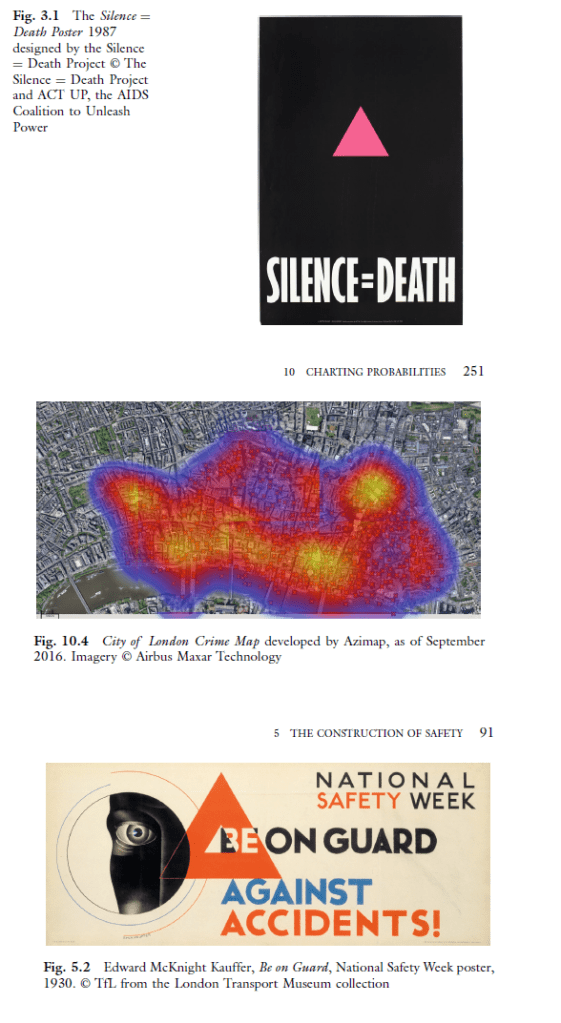
· But visuals do more than communicate, but also constrict & govern. Risk “constructs and structures social life”, particularly through political initiatives
· Hence, risk diagrams aren’t neutral pictures of reality but are prescriptive. They “invite and to some extent ‘prescribe’ particular ways of perception and action… diagrammatic reasoning is always rule-based”
· Maps are never just a description, e.g. “crime mapping is an exercise of power… The map is the phenomenon objectified, and once objectified, it is its own proof”
· “Maps and models are not just representations but instruments of power, repression, or emancipation. They express probabilities and not absolute truths”
· Models can silence future predictions by “assuming that the future would be no different from the past”, and “Many futures are denied existence because they do not fit the pre-emptive logic of our automated systems”
· And warnings also fade into administration, where over time warnings “translate the knowledge of risk into its administration… incorporated as they are in the procedural protocols of risk management”
· Labelling something or someone dangerous prompts protective behaviour & risk governance can promote “individual responsibility and freedom of choice”, while also legitimising state to regulate that ‘risky behaviour’
· Visualising risk can thus prepare people but also shape & define what they should notice, fear and do
· Risks comms aren’t neutral – Cavallo warns that risk techniques can “instrumentalise public opinion”, even while helping us “mediate, rehearse, and prepare” for real risks
Book link: https://doi.org/10.1007/978-3-032-20806-4
#risk #risksociety #aesthetics #semiotics

 SafetyInsights.org