
‘All useful systems are sociotechnical’
Part 2 extracts from Leveson’s ‘An introduction to Systems Engineering’.

This is from a systems engineering & cybernetics perspective.
PS. Check out my YouTube and recent Critical Control / barrier vid: https://youtube.com/@safe_as_pod?si=iUaDPJynPemQRZhY
Shout a coffee: https://buymeacoffee.com/benhutchinson
· Leveson argues that “All useful systems are sociotechnical”, and per the Ralph Miles Jr quote, “Overlying every technical or civil system is a social system that provides purpose, goals, and decision criteria”
· “No technical systems exist in a nonsocietal vacuum”
· Leveson notes “improving safety requires focusing on the sociotechnical system as a whole and designing it to achieve our goals, including the defined safety goals”
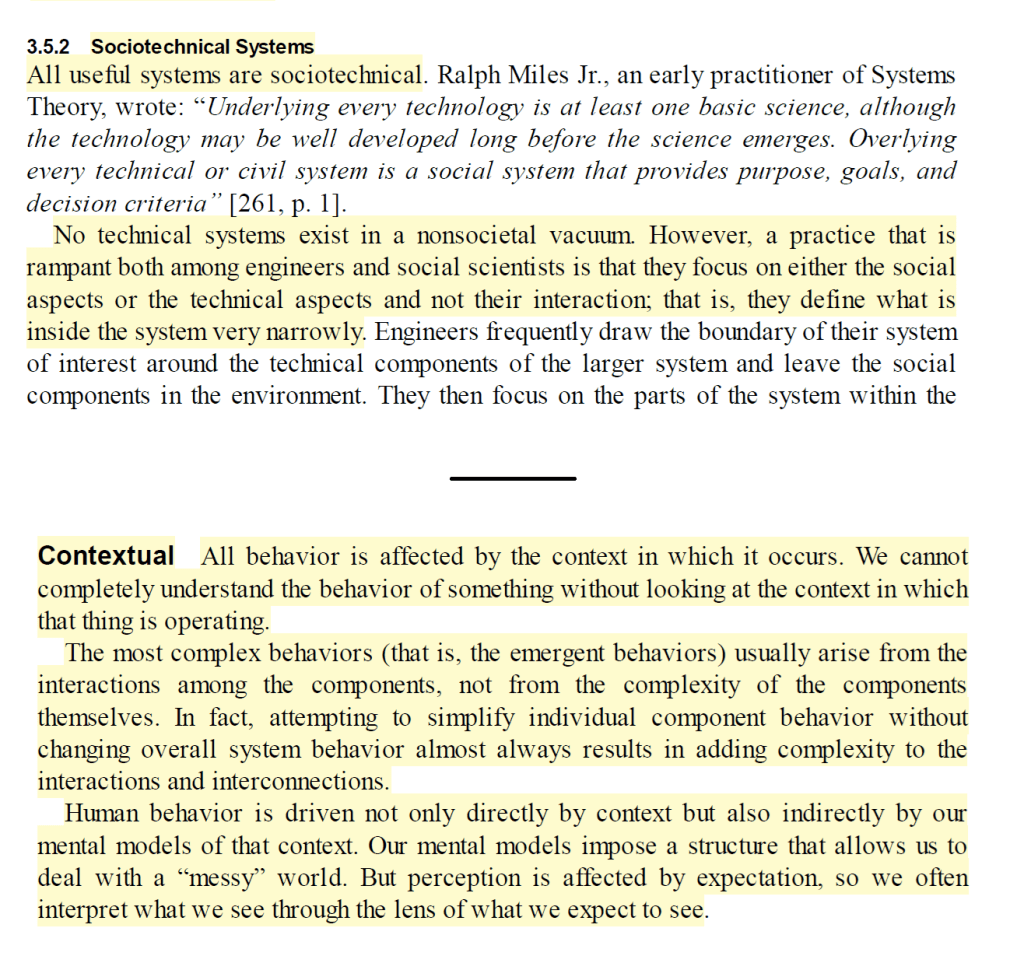
· And problematically we often optimise one part of a complex, sociotechnical system without considering the whole system’s behaviour
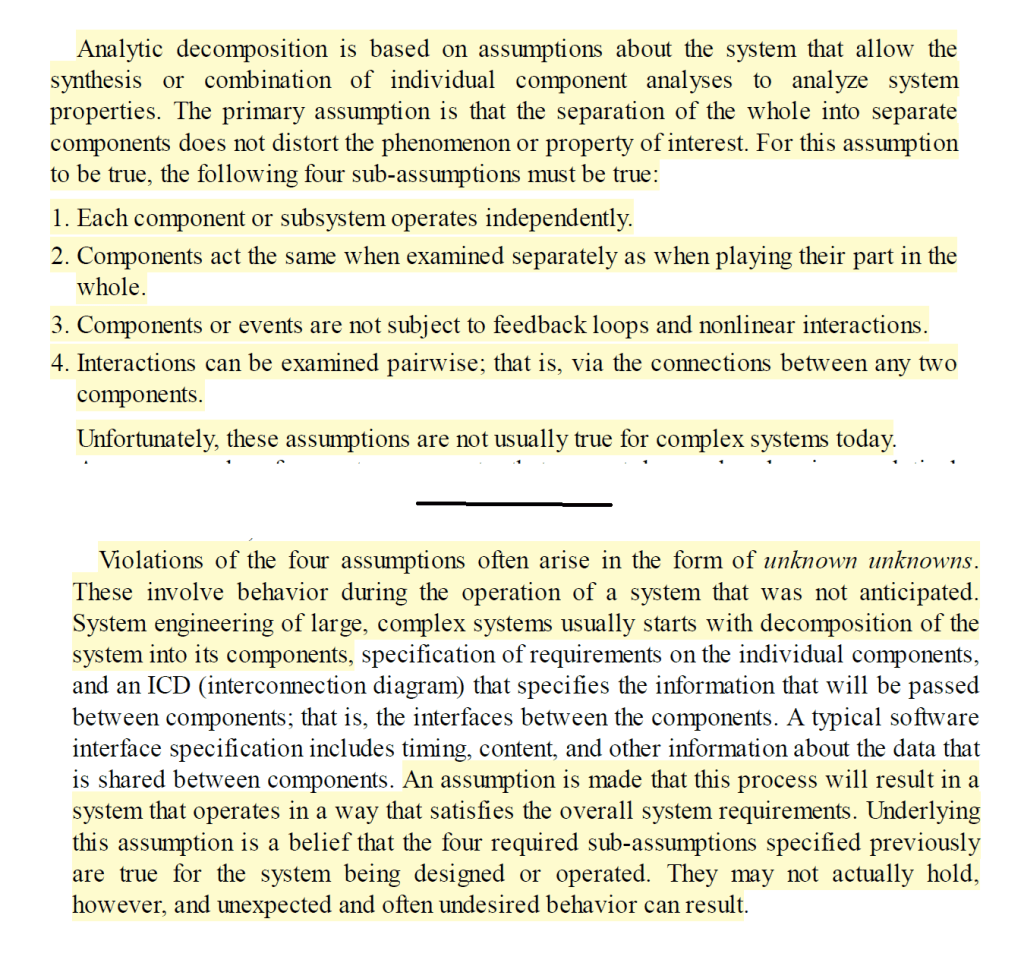
· Use of analytical decomposition is said to be based on assumptions about the system, including each component acting independently, components acting the same when examined separately as when acting as a whole system, & interactions can be examined pairwise
· However, “these assumptions are not usually true for complex systems today”
· Violations may arise via unknown unknowns – system behaviour that wasn’t anticipated
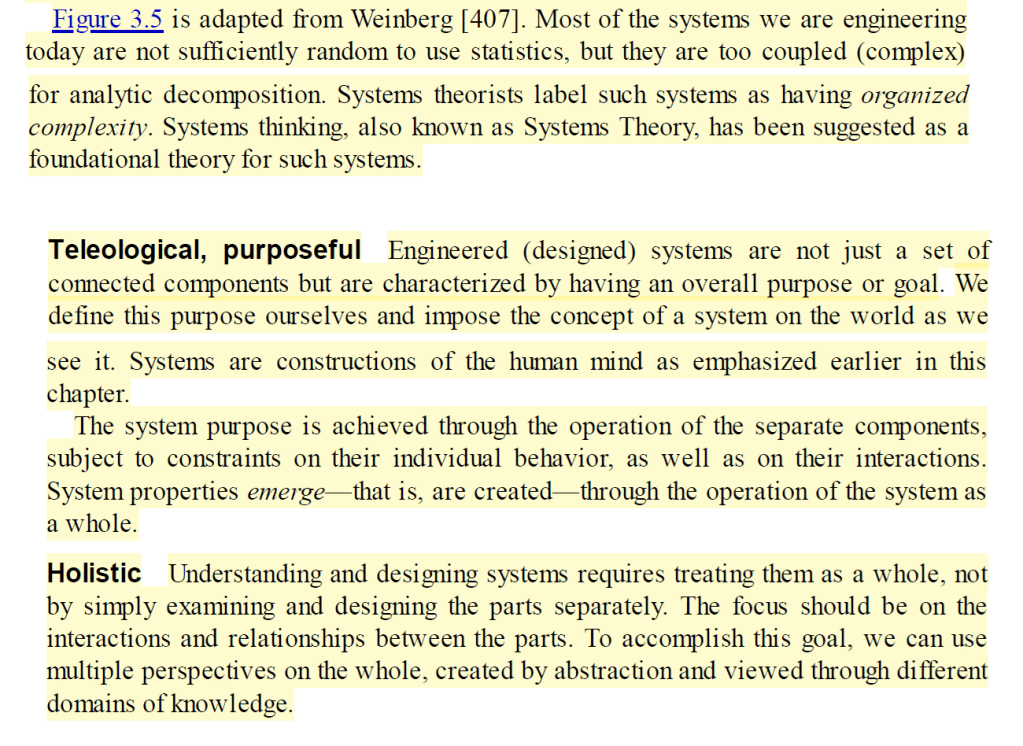
· Leveson unpacks elements of complexity, including the idea of ‘organized complexity’
· And then discusses elements of systems thinking. First is teleological, which are purposeful – “systems are not just a set of connected components but are characterized by having an overall purpose or goal”
· These goals are imposed by people & don’t exist in nature
· “System properties emerge—that is, are created—through the operation of the system as a whole”
· They’re holistic – we need to understand & design by treating them as a whole, including interactions & relationships between the parts, and a way to do this is via abstraction
· They’re contextual & hence “All behavior is affected by the context in which it occurs”. Leveson says that we can’t completely understand the behaviour of something without looking at its operating context
· She says that the most “complex behaviors (that is, the emergent behaviors) usually arise from the interactions among the components, not from the complexity of the components themselves”
· Further “attempting to simplify individual component behavior without changing overall system behavior almost always results in adding complexity to the interactions and interconnections”
· Leveson argues that human behaviour isn’t only directly driven by context but also by our own mental models. Our “mental models impose a structure that allows us to deal with a “messy” world”
· But, “perception is affected by expectation, so we often interpret what we see through the lens of what we expect to see”
#systems #sts #systemsthinking #systemssafety #safety #risk


