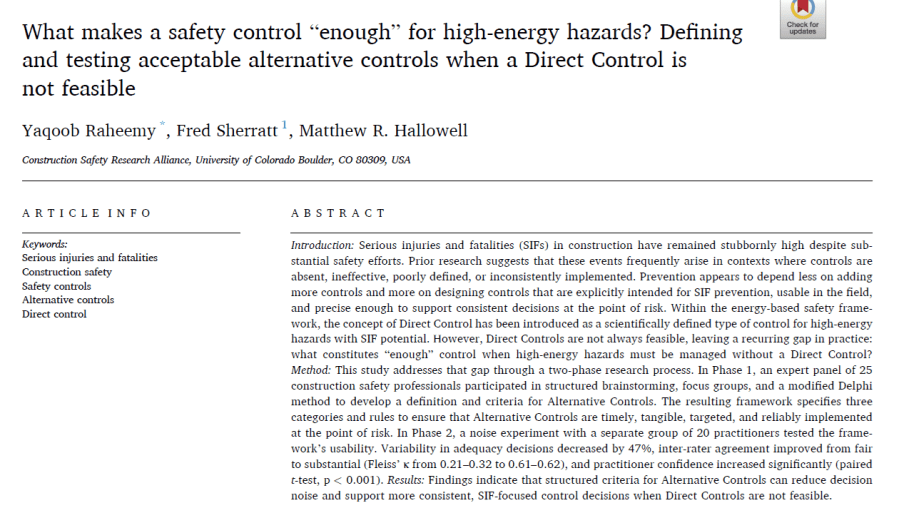
When no Direct Control (DC) is appropriate, how do we decide when alternative measures are sufficient?
This study developed decision aids for answering that question and tested whether the rules helped practitioners make more consistent decisions when judging Alternative Controls (AC).
Shared under an open access licence.
PS. Check out my YouTube and recent Critical Control / barrier vid: https://youtu.be/Ly1mEn_KCLQ?si=yG3yRVOM0r2eyyKI
Shout a coffee: https://buymeacoffee.com/benhutchinson
Extracts:
· SIFs have remained “stubbornly high”, where prior research suggests SIFs arise where “controls are absent, ineffective, poorly defined, or inconsistently implemented”
· Work from Selleck et al. emphasised that preventing SIFs “depends less on simply adding more controls and more on designing controls that are explicitly SIF-focused and reliable at the point where workers interact with high- risk activities”
· Other work showed the relationship between energy and injury severity, where “energy magnitudes below 500 J were typically associated with first-aid injuries [and 500 – 1500 MTIs] … energy magnitudes exceeding 1500 J, defined as ‘high-energy,’ were frequently linked to SIFs”
· DCs require “(a) they specifically address high-energy sources; (b) they effectively reduce exposure when properly installed and verified; and (c) they remain effective even in the presence of unintentional human error during work”
· They propose screening questions for ‘Energy Controls’, being timely (in place during active work), tangible (physically present) and targeted (specifically installed targeting high-energy hazard)
· They found that the structured criteria tested in this study for AC can “reduce decision noise and support more consistent, SIF-focused control decisions when Direct Controls are not feasible”
· Three categories of acceptable ACs were agreed upon: physical obstacle, dedicated monitoring, visual reminders, and at least two of these must be in place representing different categories
· Moreover, ACs must “intentionally and not incidentally” target high-energy hazards
· All workers exposed to the hazard must have: verified specialty training related to the hazard and controls, safe work plan, quality pre-job brief
· The framework “functions effectively as a decision aid for judging adequacy in high-energy scenarios, particularly in situations where practice would otherwise rely on broad rules, local interpretation, or individual experience alone”


