Can one tragic event make things worse for thousands who aren’t at risk?
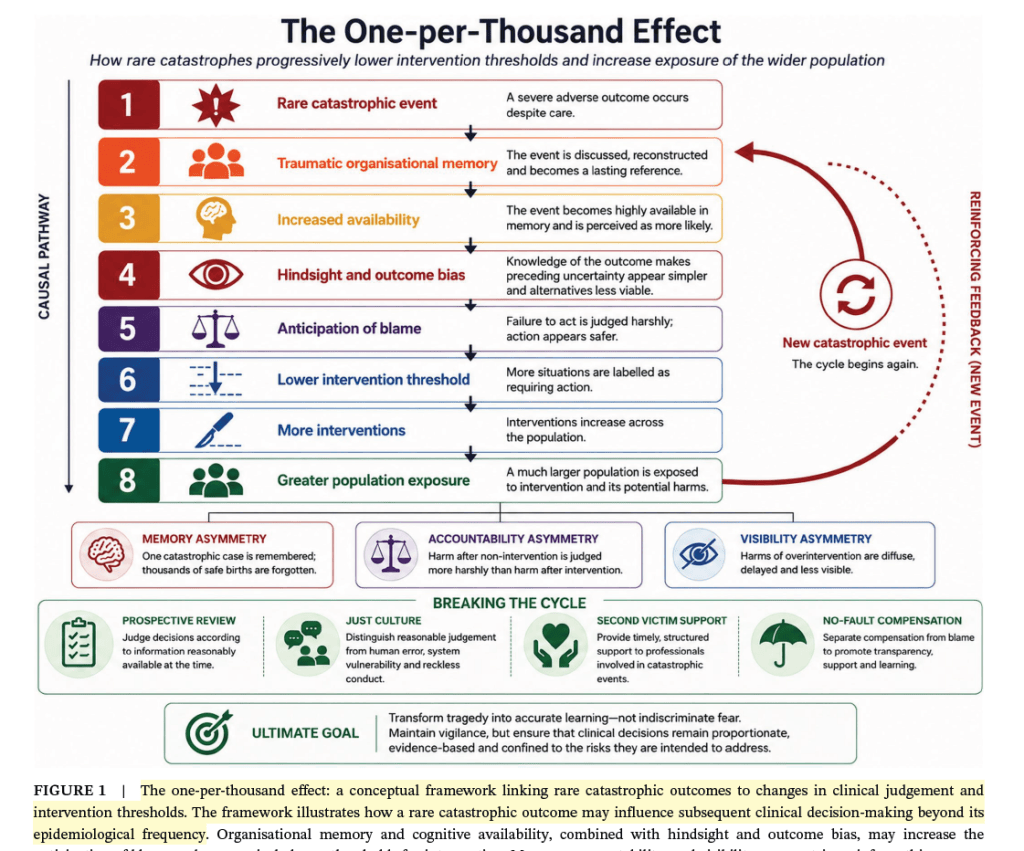
Really interesting conceptual paper discussing a one-per-thousand effect: the process which “a rare catastrophic outcome acquires an organisational influence disproportionate to its frequency”.
PS. Check out my YouTube: https://youtube.com/@safe_as_pod?si=V2dbdmW–WbnhzA9
Shout a coffee: https://buymeacoffee.com/benhutchinson
Extracts:
• “Every obstetrician remembers the newborn who was severely injured. Few remember, with comparable intensity, the thousands who were born safely”
• “systems do not respond to risk solely according to probability. They are also shaped by the social meaning assigned to adverse outcomes and by the expectation that events perceived as morally intolerable should always be preventable”
• “Decision‐making under uncertainty is particularly vulnerable to distortion when outcomes are severe, emotionally salient, and memorable”, and “institutionally unforgettable”
• “Once the final outcome is known, hindsight and outcome bias may make preceding uncertainty appear simpler, harm more predictable, and alternative actions more obviously preferable than they appeared at the time”
• “Emotionally salient events are more easily recalled than routine successful outcomes, increasing their perceived probability” and these exceptional cases “acquires a normative role that extends well beyond its statistical significance”
• Experience isn’t “stored as an objective record of frequencies. Instead, emotionally intense, morally disturbing, and professionally consequential events leave disproportionately durable cognitive traces”
• And rare or exceptional events, despite thousands of successful ones “may become the defining memory for an entire generation of clinicians”
• And this “selectivity is neither irrational nor pathological. Human cognition has evolved to retain events associated with threat because remembering rare but devastating experiences may improve future survival”
• “Catastrophic events also reshape professional identity”, where clinicians may experience guilt, anxiety & 2nd victim phenomenon
• “Defensive medicine is commonly described as the use of tests, procedures, or referrals primarily to reduce professional exposure rather than to improve patient care”
• And “Medico‐legal pressure appears to influence caesarean delivery, referral patterns, documentation, and clinicians’ willingness to tolerate ambiguity”
• They note its effects are not the strongest when action to take is clear or inappropriate but rather “most powerfully in the grey zone where observation and intervention are both clinically defensible but carry markedly different retrospective risks”
• Retrospective risk in the grey zone is “asymmetrical. Failure to intervene before injury is readily reconstructed as a missed opportunity, whereas intervention followed by a healthy outcome is rarely examined with equivalent intensity”
• They also discuss a “Zero‐Risk Paradox”, where “The aspiration to prevent severe maternal and neonatal harm is ethically compelling and clinically necessary” where it “becomes problematic only when the pursuit of safety is transformed into an expectation that biological risk can be eliminated”
• A zero-risk logic promotes “progressively greater intervention, while those interventions generate additional harms without necessarily abolishing the original danger
• They suggest to “preserve the distinction between prospective information and retrospective knowledge”, assessing “each action according to what was reasonably knowable at that moment”
• “organisations should monitor not only adverse outcomes but also intervention intensity and the harms associated with overintervention”
Study link: https://doi.org/10.1111/jep.70629


