
Really cool article talking about probability – does it exist? Is it an objective property of the world, or a subjective and constructed phenomenon? And more. Thanks to Ben Cattaneo for putting this on my radar.
Can’t do this justice and I’ve skipped HEAPS, so check out the full paper. Thanks to **** for highlighting this article.
He opens with “Life is uncertain. None of us know what is going to happen”, and we only know a little of what has happened in the past, or is happening outside of our immediate experience.
Nicely, he says “Uncertainty has been called the ‘conscious awareness of ignorance’”. This relates to the weather tomorrow, sports predictions, and more. It’s said that while uncertainty is often expressed in terms like ‘could’ or might, “uncertain words can be treacherous”.
Different interpretations sit around probabilities and the meaning of chance. An example from the Bay of Pigs invasion is given, where the mission was given a 30% chance of success (hence, 70% chance of failure”. In the report given to the US president, “this was rendered as “a fair chance”.
Now, though, there are established scales for “converting words of uncertainty into rough numbers”, and provides an example from the UK intelligence community where ‘likely’ should mean between a 55 to 75% chance.
It’s said that attempting to put numbers on chance and uncertainty “take us into the mathematical realm of probability”.
There is a multitude of definitions and conceptualisations of probability and chance, and what they represent.
This author argues that any numerical probability, from weather forecasts, predicting sports results or estimating a health risk “is not an objective property of the world, but a construction based on personal or collective judgements and (often doubtful) assumptions”.
Moreover, the author asserts that many times, this activity isn’t even estimating an underlying and “true” quantity or factor of the world.
That is, “Probability, indeed, can only rarely be said to ‘exist’ at all”.
Primer on chance
Probability is said to be a Johnny-come-lately to maths, even though people have been gambling in some form since the dawn of time.
He argues that probability has a real ‘slipperiness’ about it and uses weather forecasts as example. Forecasters make predictions based on temp, wind speed and quantity of rain, and may say something like 70% chance for a given time and place.
Temp, wind and rain can all be measured with their ‘true’ values or representations; they’re all based in reality. But, importantly, “there is no ‘true’ probability to compare the last with the forecaster’s assessment. There is no ‘probability-ometer’. It either rains or it doesn’t”.
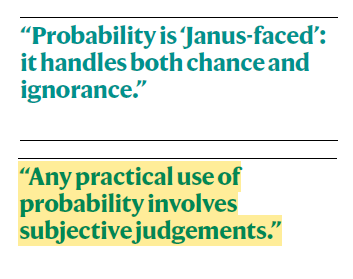
Probability is said to be Janus-faced – by covering both chance and ignorance. He uses an example of a coin toss, and asks somebody what is the probability of a Heads; they guess 50-50. He then flips the coin, takes a peek at how it landed, and ask’s you again: what’s the probability of Heads now?
He says that while people may begrudgingly repeat 50-50 – the event has now happened (the flipper knows the answer). Hence, “there is no randomness left — just your ignorance”.
The activity has changed from aleatory uncertainty, which is said to be the future we cannot know, now to epistemic uncertainty – what we currently don’t know. Numerical probability is used in both situations.
And, even though probabilities may take the semblance of objective facts, he argues that “this is always based on subjective assumptions”. For instance, guessing 50-50 for Heads depends on trusting the coin flipper in the first place (of a fair toss or fair coin, or not lying about the result).
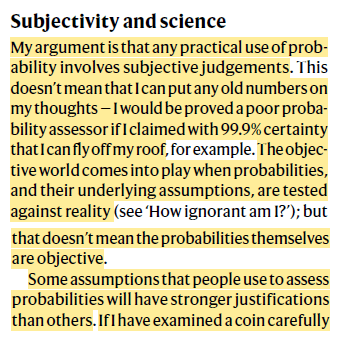
Next he asserts that “any practical use of probability involves subjective judgements”. This doesn’t mean people can draw upon any random numbers – e.g. claiming with 99.9% certainty that he could fly if jumping from his roof would make him a pretty poor probability assessor. And, of course, some assumptions used in judgements have stronger justifications than others.
Quoting the paper since he explains it better than I:
“The objective world comes into play when probabilities, and their underlying assumptions, are tested against reality”, but that “doesn’t mean the probabilities themselves are objective”.
Down the rabbit hole
Next he addresses a question about whether our subjective “but perhaps flawed estimates of some underlying ‘true’ probability, an objective feature of the world?”
First, he allows the possibility of some weird findings in the quantum world. There are also some limited range repeatable situations of immense complexity that essentially act deterministically – roulette wheels, shuffled cards, lotto balls and more. And perhaps the motion of particles under Brownian motion.
In these sorts of limited range and complex phenomena, it “might be reasonable … to assume a pseudo-objective probability — ‘the’ probability, rather than ‘a’ (subjective) probability” (emphasis added).
But in virtually every other practical use of probabilities “it does not make sense to think of our judgements as being estimates of ‘true’ probabilities”, but are rather situations we attempt to express our personal or collective uncertainty
He talks more about perspectives of probability and subjective judgments, which I’ve skipped. However, forecasters often present probabilities like 70% chance of rain, where rain is expected to occur on 70% of states where those conditions are present.
The author prefers this definition, but “the ambiguity of probability is starkly demonstrated by the fact that, after nearly four centuries, there are many people who won’t agree with me on that”.
He covers then covers the work of de Finetti. I’ve skipped a lot here, but in short the author argues that we “perhaps don’t have to decide whether objective ‘chances’ really exist in the everyday non-quantum world”.
Hence, these apparent contradictions don’t need to have any practical impact, since “starting from a specific, but purely subjective, expression of convictions, we should act as if events were driven by objective chances”
He concludes with: “In our everyday world, probability probably does not exist — but it is often useful to act as if it does”.
I think there are a lot of parallels with the science of risk; lots of difference definitions, uses, uncertainties.
Ref: Spiegelhalter, D. (2024). Does probability exist?. Nature, 636, 19.
Study link: https://www.nature.com/articles/d41586-024-04096-5
My site with more reviews: https://safety177496371.wordpress.com
LinkedIn post: https://www.linkedin.com/pulse/does-probability-exist-ben-hutchinson-zzzyc


 SafetyInsights.org