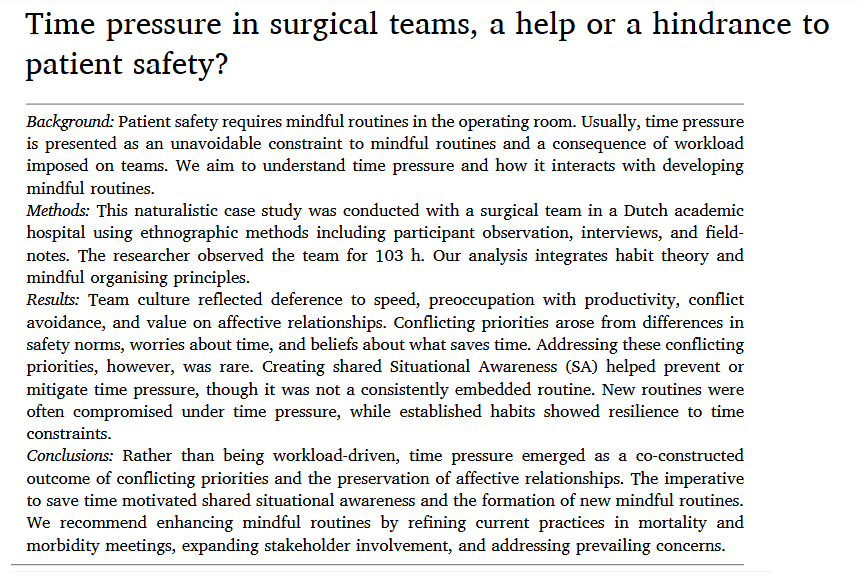
I found this an interesting and brief read about the mindful routines of operating room staff, using a naturalistic decision making approach.
Extracts:
- “While patient safety was defined as the absence of harm, it is now seen as an active capability rooted in both system robustness and human behaviours”
- “Adaptability and resilience have become recognised as essential capacities, enabling effective responses to unexpected events within an increasingly complex environment”
- “Evidence suggests that hospitals with lower mortality rates do not necessarily experience fewer errors but are more adept at recovery and rescue”
- “Patient safety requires mindful routines in the operating room. Usually, time pressure is presented as an unavoidable constraint to mindful routines and a consequence of workload imposed on teams”
- “Team culture reflected deference to speed, preoccupation with productivity, conflict avoidance, and value on affective relationships”
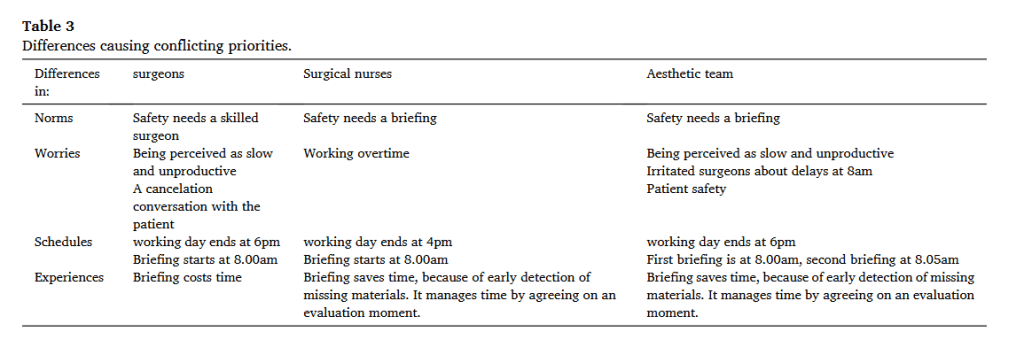
- “Conflicting priorities arose from differences in safety norms, worries about time, and beliefs about what saves time”
- “Creating shared Situational Awareness (SA) helped prevent or mitigate time pressure, though it was not a consistently embedded routine”
- “New routines were often compromised under time pressure, while established habits showed resilience to time constraints”
- “Rather than being workload-driven, time pressure emerged as a co-constructed outcome of conflicting priorities and the preservation of affective relationships”
- “The imperative to save time motivated shared situational awareness and the formation of new mindful routines”
- “A predominant aspect of the team culture was a strong deference to speed. The prevailing belief was that “a good surgeon is a quick surgeon.” Delays in induction adversely impacted the average operating time”
- “Another significant cultural aspect was a preoccupation with productivity, defined as the amount of work completed within a given timeframe”
- “A third characteristic of the team was the tendency to avoid conflict while pursuing conflicting priorities”
- “However, the focus on maintaining affective relationships led to tension when team members faced conflicting priorities”
- “We illustrated how the team carefully fostered affective relationships by respecting and accepting that some colleagues are late adopters (vignette 2), carefully navigating sensitive topics (vignette 3) providing personal attention to all members of the operating room team (vignette 4), and engaging in small talk and private connections”
- These affective routines have been described as a “complicated dance” that maintains relationships and minimises tension while still achieving goals”
- However, in trying to manage relationships “this approach also inhibited team members from addressing conflicting priorities and signalling time-related issues”
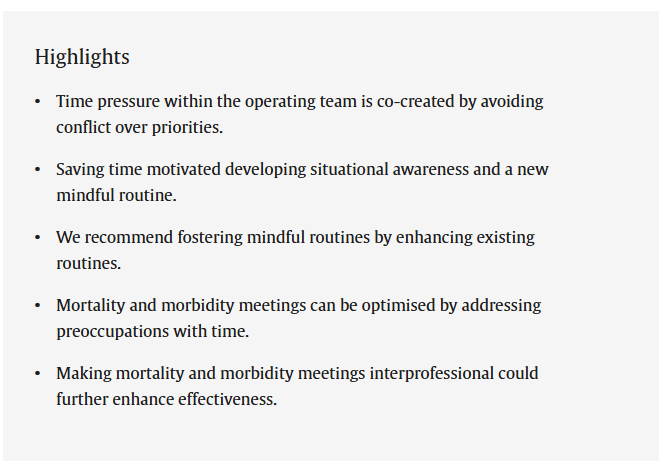
- “We conclude that time pressure did not stem from a workload imposed by management; rather, it was co-created through the pursuit of differing priorities while maintaining affective relations”
- “Therefore, addressing conflicting priorities and practising heedful relating sometimes alleviated time pressure, though these practices were not standard”
- “once a habit is established – such as the time out (quote 7) or the morbidity and mortality meeting (quote 6)- the original rationale for the habit may become irrelevant to its execution, and time pressure ceases to be a threat. Neal et al. [33] state that habits are not influenced by people’s goals. Even moderately strong habits require substantial conscious effort to change [33]. Developing new habits require environmental cues that trigger the habitual behaviour, repetition, and socialising processes”
- “The observation that the established routine of morbidity and mortality meetings was not highly valued aligns with findings from other studies [40,41]. Nonetheless, this existing routine is performed automatically, even under time pressure, as it does not demand significant conscious attention (bandwidth) [20,21,42]. This presents an opportunity to optimise the routine”
- “The drive to save time acted as a motivator for cultivating SA and establishing a new mindful routine. Established routines appeared resilient to time pressure”
Ref: van Harten, A., Niessen, T. J., Koksma, J. J., Gooszen, H. G., & Abma, T. A. (2025). Heliyon.

Study link: https://doi.org/10.1016/j.heliyon.2025.e41967
Shout me a coffee: https://buymeacoffee.com/benhutchinson

 SafetyInsights.org