

This article covered a more progressive view on human performance, with suggestions on some tools.
Too much to cover, so just a few points.
They start by saying to consider three truisms: “To err is human. Workers are fallible. Errors are inevitable (as well as predictable)”.
These are fundamentals to understanding the human performance approach in safety. Human performance includes how workers, the organisation, the environment, management and systems “work synergistically as an entire system”.
Workers are the focal area of this approach, since “any flaws in the system can affect workers’ performance” and likewise, people can negatively affect the system.
Nevertheless, errors in this perspective are viewed primarily “as consequences of working in a flawed system”.
Despite attributions of human error being the ‘cause’ of 80% of failures, deeper analysis reveals that many of these failures are associated with latent organisational factors, leaving “about 30% … by individual workers interfacing “erroneously” with systems and equipment”.
As such, incidents are typically via a confluence of factors that are both within and beyond the control of workers. Error is universal, and the belief that error is abnormal and people introduce unreliability into a system “is in itself an error of understanding”.
Moreover, the susceptibility of people to system-induced errors is heightened in complex environments that contain “concealed weaknesses” – these latent conditions which “provoke error or weaken controls”.
They focus on two main ways to approach error 1) focus on active error prevention, more at the level of the worker, and 2) minimise the effects of the error.
Latent Organisational Weaknesses
They define latent organisational weaknesses as “hidden deficiencies in management processes or values which can create workplace conditions that provoke errors and their precursors and/or degrade the integrity of controls”.
These weaknesses often lie dormant until revealed by investigations [*** although are often readily visible when focusing on daily work].
These latent conditions are “normally management’s to identify and solve”, but workers are typically in an ideal position to observe the preconditions for these latent factors.
Initiating Actions & Active Errors
Active errors/actions are “physical, initiating actions that have immediate, observable and undesirable outcomes”.
We can often find these factors because workers “touch” the work, task or equipment”, so are readily observable [or at least, readily constructible when creating meaning]
Most of these actions/errors are insignificant. Errors can be broken into slips, lapses and mistakes:
Slips: when physical actions, like turning the wrong valve, fails to achieve the intended outcome
Lapses: a failure of memory or recall, forgetting to turn off the valve
Mistakes: when the inadequate or inappropriate plan/action is used to achieve the goal
Error – an intrinsic part of human nature
Next they unpack the humanistic nature of error. Error is “provoked by a mismatch between human limitations and workplace conditions”, and including their ability to perform the expected actions.
Error Precursors & Error Traps
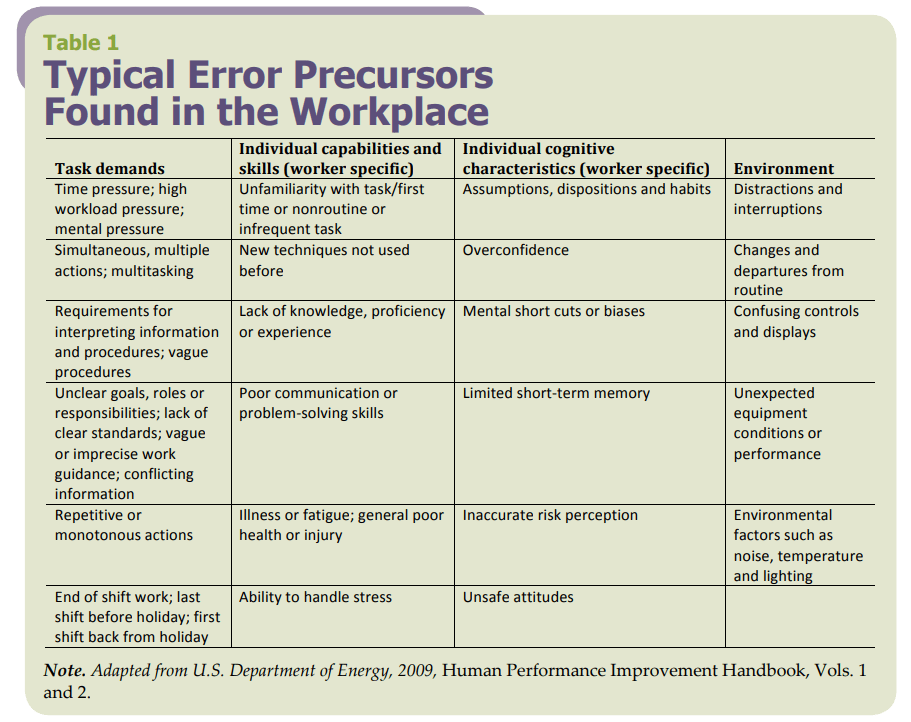
Error precursors are conditions that provoke error – generally unfavourable conditions interfering with expected performance.
It’s argued that these precursors “are not cryptic or unintelligible to workers. They are observable and can be corrected”.
Precursors can be grouped into four areas: task demands, individual skills, individual cognitive capabilities, and workplace environment.
Error-likely situations may also be present, and these increase the chance of an error when in the presence of error precursors. They’re more likely when the task exceeds the person’s capabilities, or when situational factors aggravate human limitations. They’re also known as error traps.
They list examples of error precursors:
Types of Performance
Next the authors cover the skill, rule and knowledge based modes of performance.
Skill-based
· Skill-based involves highly practiced and usually physical actions, conducted in similar situations
· Usually executed from memory without significant conscious thought or attention
· Here “workers function effectively by using preprogrammed sequences of behavior that do not require much conscious control”
· A problem with skill-based performance is that with greater task familiarity comes a normalisation of the perceived risk
· Skill-based errors are said to be primarily execution errors – action slips and lapses
· Based on some nuclear data, these errors is less than 1 in 10,000
· While 90% of a person’s daily routine is spent in skill-based modes, some other nuke data suggests ~25% of errors in this mode
Rule-Based Performance
· Rule-based modes work more for less-familiar and less-practiced activities
· Here “workers apply memorized or written rules to managing work situations” [** Note, rules in this context doesn’t just mean written procedural rules, but also logical rules]
· Rule-based modes typically follow an if / then logic, and people apply these logics to tasks
· A limit of rule-based modes is how to ensure prepared responses are available for anticipated and unanticipated situations
· Since if-then logics require interpretation, a key error mode here is misinterpretation, like applying the procedure in a wrong manner
· These mode failures “are often classified as failure of expertise mistakes”
· Errors in this mode are said to involve chances of 1 in 1,000, with some nuke data suggesting 60% of errors in this category
Knowledge-Based Performance
· This mode covers unknown situations, with no existing skills or rules are recognisable
· People rely on their understanding, knowledge, perceptions, prior scenarios/patterns and more
· This is the most cognitively involved performance mode
· Common misalignments here involve mismatched mental models
· Errors are said to be particularly high in these situations, ~1 or 2 in 10, and ~15% of errors in the nuke industry have been linked to this mode
They say that, overall, many organisations embracing the human performance philosophies see about shifting performance processing from knowledge-based to rule-based, “due to the fact that the error rates decrease by at least a factor of 10 in the rule-based mode”.
Human Performance Tools
Next the paper covers several performance tools. I’ve skipped all of these except a couple. They say a general principle of the tools is either slowing down the task and processing speeds, providing mental and social skill prompts to complement existing skills, or work as a cognitive aid of sorts.
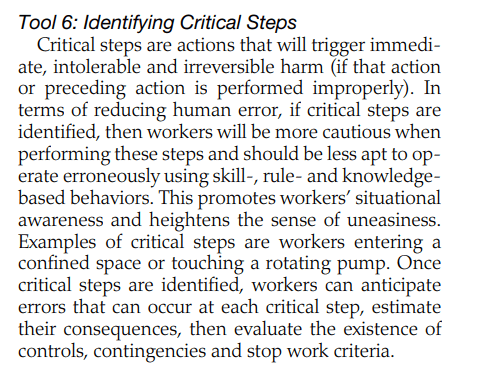
One tool is around identifying critical steps. Critical steps are “.actions that will trigger immediate, intolerable and irreversible harm (if that action or preceding action is performed improperly)”.
Another is “three-way communication”. This involves the communication sender stating the message, the receiver acknowledging the message and repeating in a paraphrased form, and the sender acknowledging the receiver’s reply.
You may be familiar with these safety critical comm protocols if you work in industries like rail or aviation.
Human Performance and Safety Management
They argue that while this article “has posited that workers should be on the defensive against active errors and their precursors in the workplace”, that’s not to lay blame on people because they err.
Rather, organisations should (and are) primarily responsible for eliminating and managing safety hazards. However, pragmatically speaking, “workers cannot rely solely on management and management systems”.
And recognising how latent conditions can hide as “land mines”, workers should adopt their own personal defences. Quoting the article, “Since safety can be viewed as the presence of defenses in processes, procedures, facilities, methods and practices (Muschara, 2012), workers must become defensive safety warriors”.
Therefore, workers are in the best position to identify conditions and precursors to error and harm, which may not have been effectively picked up or mitigated via organisational systems and approaches.
Further, they highlight that “Safety management systems are always flawed during their development and implementation”, and won’t always anticipate and control all possible work situation hazards.
Management approaches are also “slow to adapt to changing and variable situations or uncertainty because of their rigid, controlled and complicated structures”.
Hence, if we view safety as the ability to perform in varying and unpredictable situations, regularly in a changing environment, then people are critical to overcome the various management system flaws.
In concluding, they argue that “Systems are often not well designed and maintained; designers cannot foresee and anticipate every contingency; procedures may be incomplete or inaccurate; and workers may not behave as they are expected to behave”.
But in recognising that, people are also “remarkably adaptive and compensating to uncertainty and threats in the workplace”. Things usually go right because of the adaptability of people, and their own “personal defences and concern for their own well-being”.
Ref: Wachter, J. K., & Yorio, P. L. (2013). Human performance tools: engaging workers as the best defense against errors & error precursors. Professional safety, 58(02), 54-64.

LinkedIn post: https://www.linkedin.com/pulse/human-performance-tools-engaging-workers-best-defense-ben-hutchinson-cwtic


One thought on “Human Performance Tools: Engaging Workers as the Best Defense Against Errors & Error Precursors”