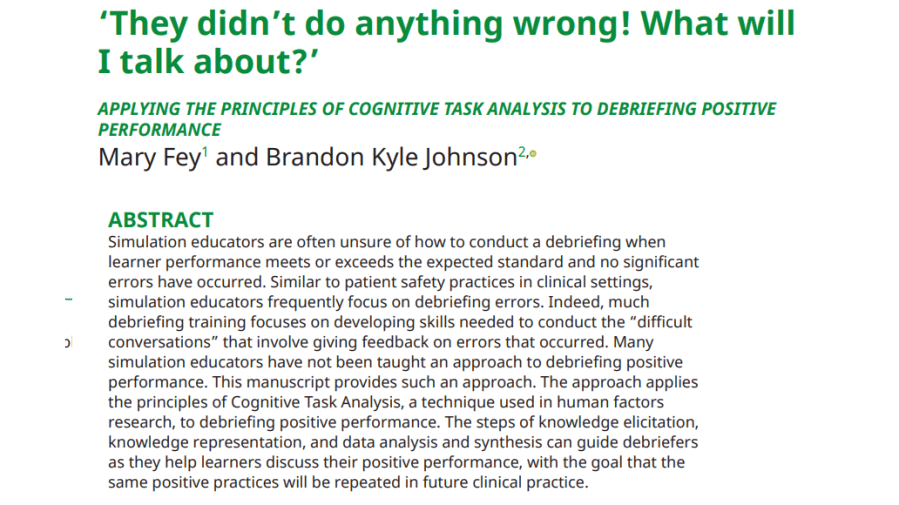
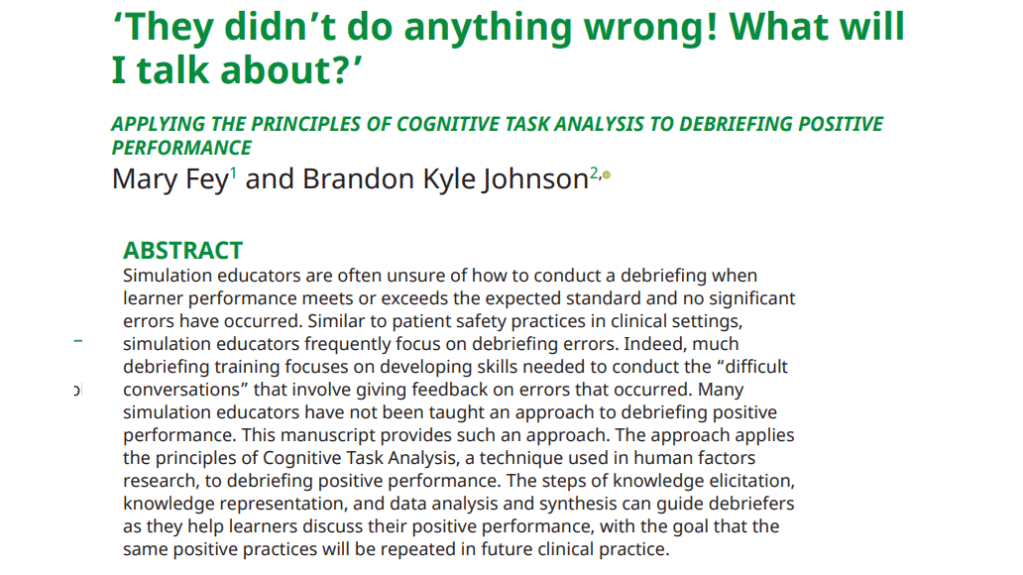
An interesting paper exploring the use of Safety-II inspired debriefs, learning from successful performance.
They used cognitive task analysis techniques.
Not a summary, but it’s open access and really brief – so check it out 👍
Extracts:
· “simulation cases are often deliberately designed to push learners to their zone of proximal development .. where perfect performance is not expected. In this desire to improve practice, simulationists often ignore or overlook positive performance”
· “The methods used by patient safety teams generally focus on clinical practice errors or near misses .. That is, most of our efforts to improve practice focus on the relatively small percentage of time that clinicians make mistakes”
· “The Safety-II mindset is one in which we are curious to know how the successful team adjusted their approach .. In the case of novice learners, explicating the cognitive steps that underlay good practice can be enlightening and promote the formation of schema for use in future”
· “For expert learners, surfacing the reasoning process that contributed to good decision-making is a retrieval exercise that may strengthen that neural pathway”
· “Unlike debriefing an error, the goal now is to uncover the correct thinking that led to the right decisions”
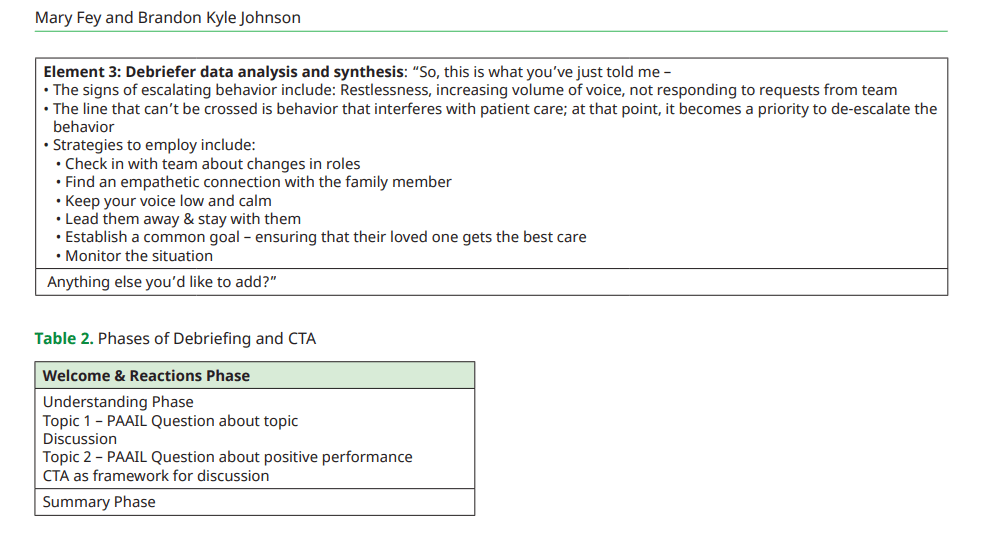
· They provide steps to facilitate the debrief, which guides the learner to identify important cues, patterns of thinking, rules of thumbs, key decisions and actions (image 2)
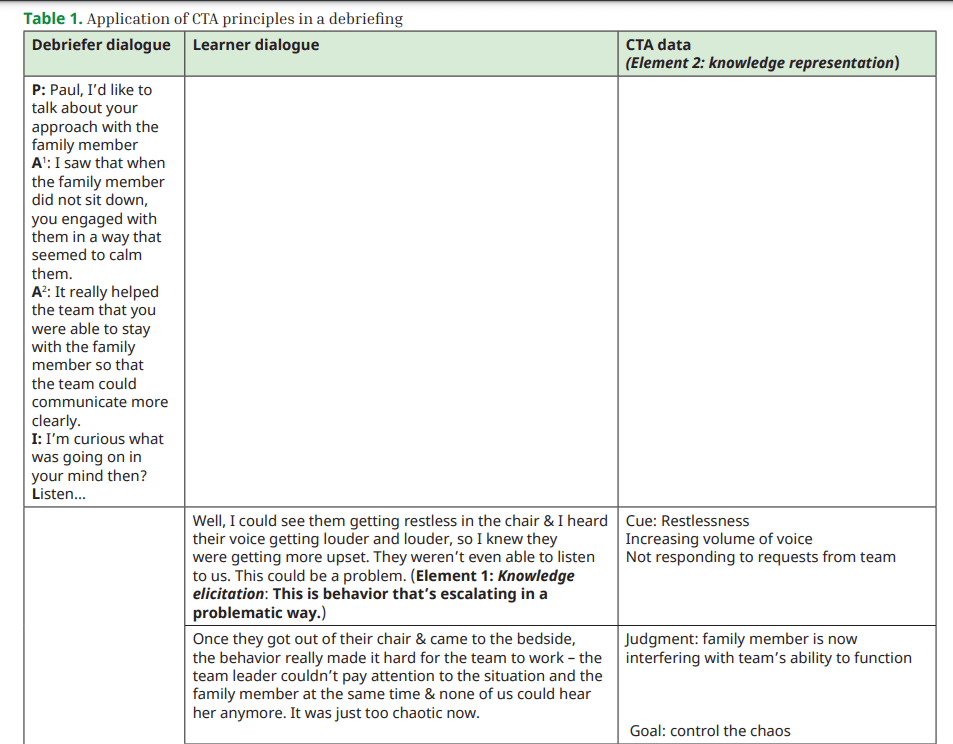
· The facilitator then facilitates a synthesis of the intel, where their goal “is to see the simulation through [the participant’s] eyes: what did they see that led them to the conclusion about the clinical problem”
· “It is not uncommon for experienced clinicians to have difficulty surfacing their thinking. When this happens, the learner may make a statement such as ‘I(we) just did what I always do in that situation’. The debriefer can encourage the learners’ self-reflection by explaining the value in making explicit the subtle judgments of the expert”
· “For example, ‘Lets unpack the thinking behind your decisions: what data did you focus on, how did you interpret that data, what led to your decisions”
· They give an example that Gary Klein frequently provides about a fire fighter who withdrew his team from a burning house moments before the floor collapsed
· He didn’t know in the moment why he had a bad feeling, but after further debrief he picked up various cues like the fire didn’t respond to water as expected, it was abnormally hot and too quiet
Ref: Fey, M., & Johnson, B. K. (2023). They didn’t do anything wrong! What will I talk about?. International Journal of Healthcare Simulation, 1-6.

Study link: https://www.upstate.edu/academic-affairs/pdf/nothingwrong_what-do-i-debrief.pdf

 SafetyInsights.org