
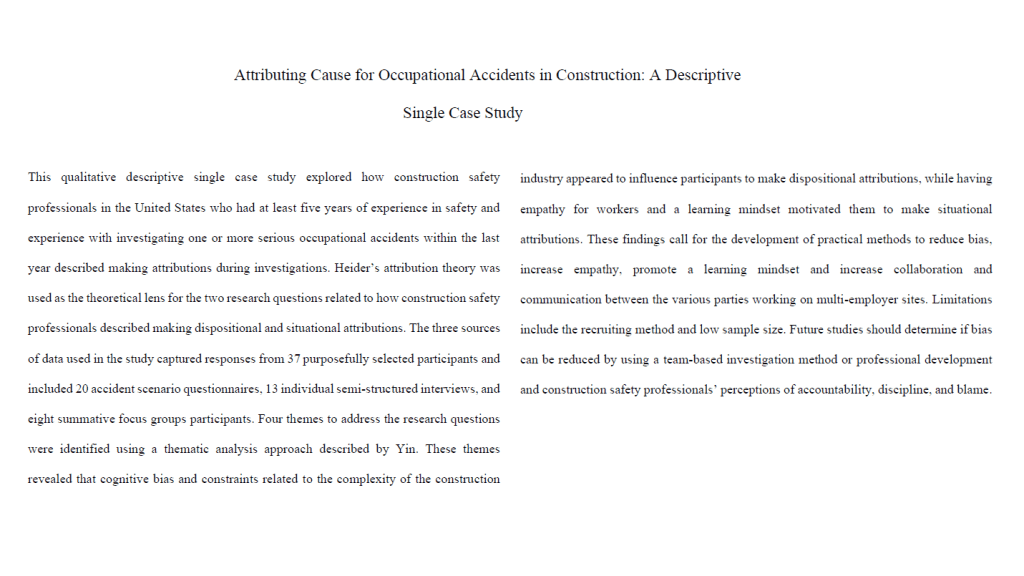
This thesis from Jennifer Serne explored how construction safety professionals attribute accident causes.
37 participants were included with 20 accident scenarios, 13 individual semi-structured interviews and 8 summative focus groups.
For background:
· Originally proposed by Heider in 1958, it’s said that people are “psychologically driven to determine the causes of others’ behavior”
· And that these “determinations attribute behavior to factors outside the actor, such as situational or environmental issues, or to causes from within the actor, such as personality traits”
· People, according to Heider, prone to attributing others’ behaviour more to dispositional factors, like personality, while underplaying the role of situational factors in influencing behaviour
· Research has supported this contention – with some research finding that the fundamental attribution error “often influences investigators when determining an accident’s causes” and that “this bias resulted in investigations that focused on the individuals closest to the incident while underestimating other factors”
In contrast, the finding from this study found that:
· “while it was clear that safety professionals in this dissertation study had experiences making both types of attributions, they did not appear to make dispositional attributions more frequently than situational ones” (emphasis added)
· Hence, “almost all participants suggested that they preferred making situational attributions to encourage learning as opposed to dispositional attributions that focused on blaming workers”
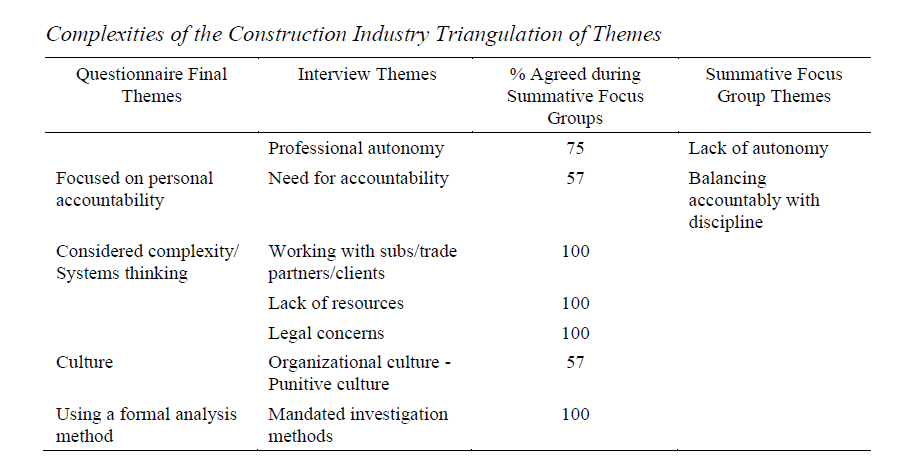
Nevertheless, some common constraints faced by safety professionals in construction influenced them towards dispositional attributions investigations. Some included the temporary environment, participation of multiple businesses across many trades and worksites and tight schedules. Other factors linked to dispositional attributions included the complexity of the sites, and “issues related to the varying expectations regarding safety, accident investigations, and a lack of cohesive safety culture amongst trade partners”.
Investigations were also seen to be hampered by differing expectations on how to undertake accident investigations, different underpinning philosophies about accident causation and learning, and more.
A lack of collaboration across different businesses in the contracting chain impacts learning, which may also affect dispositional attributions.
This study also found that the “the tendency to make biased attributions appeared to be intensified when a previous working relationship existed between the worker and the investigator”, and hence “previous experience with a worker could cause bias and the tendency to jump directly to a dispositional attribution”.
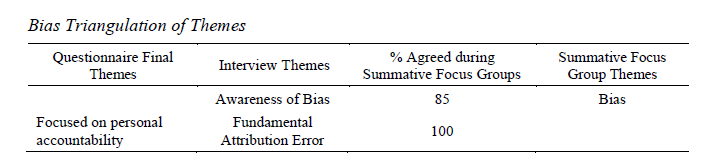
Moreover, other research suggested that investigators may be biased towards employee dispositional judgements if “the investigator already expects a worker to behave unsafely due to previous experience with that worker’s unsafe behavior”. As per another cited study, investigators can be influenced by their close relationship with the workers they investigate.
Despite other research which suggested that practitioners have trouble identifying their own biases, this study found the opposite – that seasoned professionals were pretty good at detecting their ‘bias blind spot’.
This sample also possessed learning mindsets, which they said helped to drive external attributions over dispositional. The finding that professionals had learning mindsets was said to be at odds with the (limited) extant body of research suggesting that safety professionals “ do not keep abreast of academic developments in safety or invest in professional development that involves studying safety science”. That same body of research has also suggested that the construction industry hasn’t widely “embraced new ways of thinking about accident causation and does not appear to take a learning mindset”.
Participants in this study reported that working for progressively orientated companies with a learning mindset helped them foster their own learning mindset. They said that companies with leaders who believed that “the purpose of accident investigations was to learn and improve, not punish workers allowed them to focus on making situational attributions and learning”.
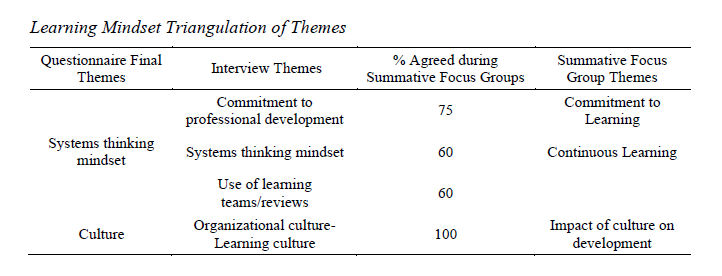
The paper argues that there is a “reciprocal relationship between a construction company’s culture and their safety professional’s mindsets regarding learning from incidents”.
Some final points:
· The prevalence of empathetic thinking within this sample of safety professionals is consistent with other work; where safety people “were found to be intrinsically motivated to care about workers”
· “This study also revealed that possessing empathy for workers and a learning mindset encourages making external attributions”
· Professionals showing empathy and being motivated to have a deep understanding of worker experiences seemed to be intensified in the participants who had some prior experience doing construction work themselves
· While the organisation’s values and mindsets (e.g. towards learning and empathy etc.) may also likewise attract and shape the mindsets of employees, other work focused on construction safety professional work attitudes “that professionals who worked for an organization that conflicted with their desired culture resulted in goal conflicts, reduced their motivation, and increased their desire to quit”
Ref: Serne, J. N. (2024). Attributing Cause for Occupational Accidents in Construction: A Descriptive Single Case Study (Doctoral dissertation, Grand Canyon University).

LinkedIn post: https://www.linkedin.com/pulse/attributing-cause-occupational-accidents-construction-ben-hutchinson-qubac

 SafetyInsights.org