
This was an interesting article from 1912 highlighting the role that fatigue has in industrial accidents.
Also challenges ‘carelessness’, saying it doesn’t account for the effects of fatigue.
While scientific knowledge has progressed over the century, it’s cool how well they articulated the issue.
· Image 1 top panel shows a breakdown of accidents per time of day, showing accident frequency increasing over uninterrupted work periods
· I’ve included newer data from Simon Folkard (image 1 bottom panel) showing a similar trend, with higher accident risk with longer time before a break
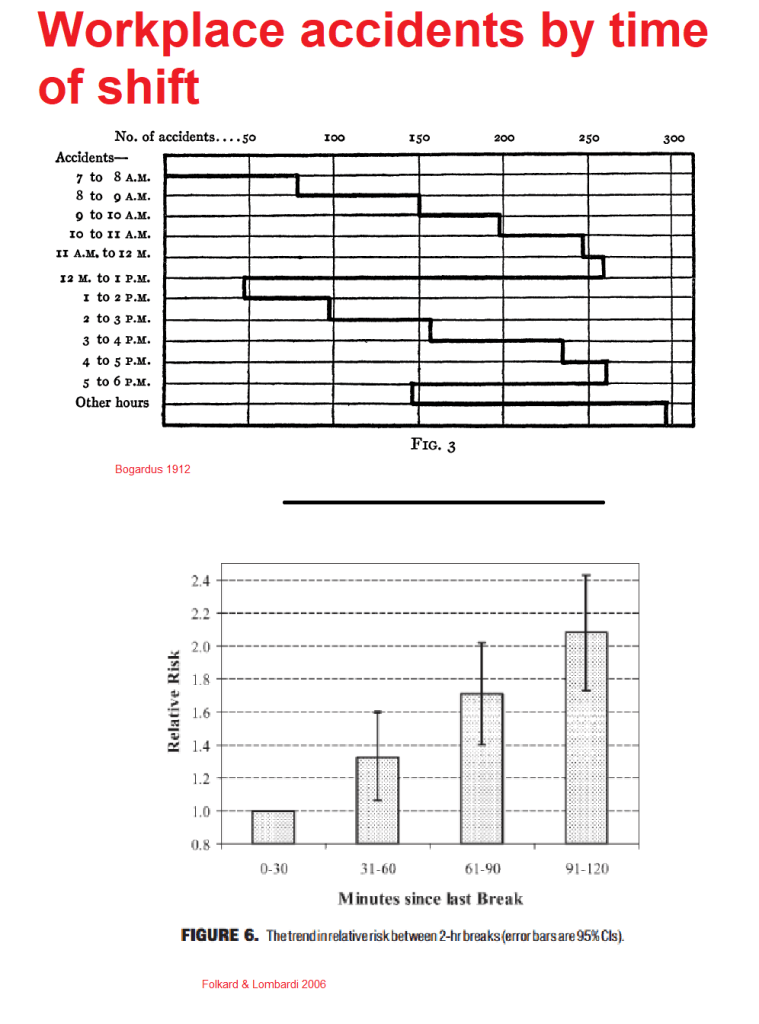
· The increase in accidents increases during the morning and afternoon
· “It is indisputable, in fact, that the more fatigued a worker is, the more liable he is to accident”
· They explain the mechanisms as being more physical energy and “muscular inaccuracy”, nerve exhaustion and some other stuff – which we now know that while neuromuscular fatigue is a relevant factor, it’s also heavily situated in the brain regarding sleep homeostasis, cognitive resources/time on task, and circadian factors
· “fatigue that explains the increasing progression of accidents with the progress of working hours in industries where work is most often limited to watching machinery”, such might be found in monotonous work
· While a myth that existed the time suggested most accidents occurred on a Monday due to excesses over the weekend (drinking), this data did not support that myth
· They found, instead, that accidents peaked on Tuesdays and throughout the work week
· “Continuous work, other things being equal, is accompanied, hour by hour, by an increasing number of accidents”
· “these facts the law of fatigue is based which is so generally a fundamental explanation of the cause of accidents”
· The effects of fatigue that accompanies work “is greatly accelerated by the conditions peculiar to industrial conditions-by the monotonous and speeded-up operations, by the mental strain which comes from trying to attend to simple operations maintained at a terrific rate”
· Many accidents had previously been attributed to ‘carelessness’
· However, “we are now beginning to realize is often due to the mere stress and strain under which modern factory operatives work”

· And “Carelessness is not an ultimate cause …but a resultant from any one of a multitude of things, one of which is the haste and disregard of personal risk resulting almost inevitably from a piece-work system”
· The rest are more related to other factors resulting from other factor
· “So-called carelessness may be explained by the fact that the fatigued workman is unable to give as close attention to safety appliances and machine guards as a normally resistant workman can give”

Ref: Emory S. Bogardus. Source: American Journal of Sociology, Vol. 17, No. 4 (Jan., 1912), pp. 512-539

Study link: https://www.journals.uchicago.edu/doi/pdf/10.1086/211977

 SafetyInsights.org