This may interest people. It covers concepts of resilient performance within seaports.
It’s a bit random (seaports), but otherwise gives a handy overview of resilience terms and applications.
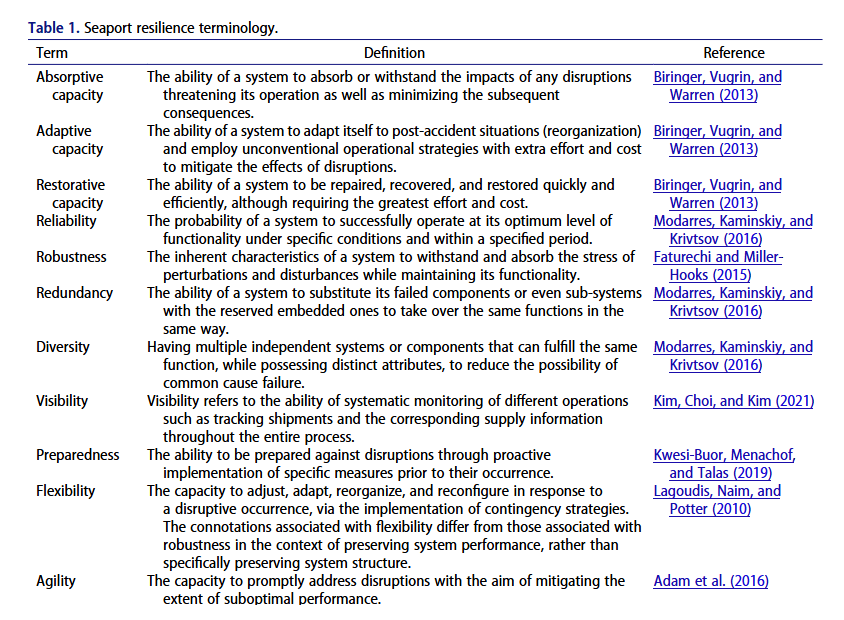
The first two images are just basic definitions.

Extracts:
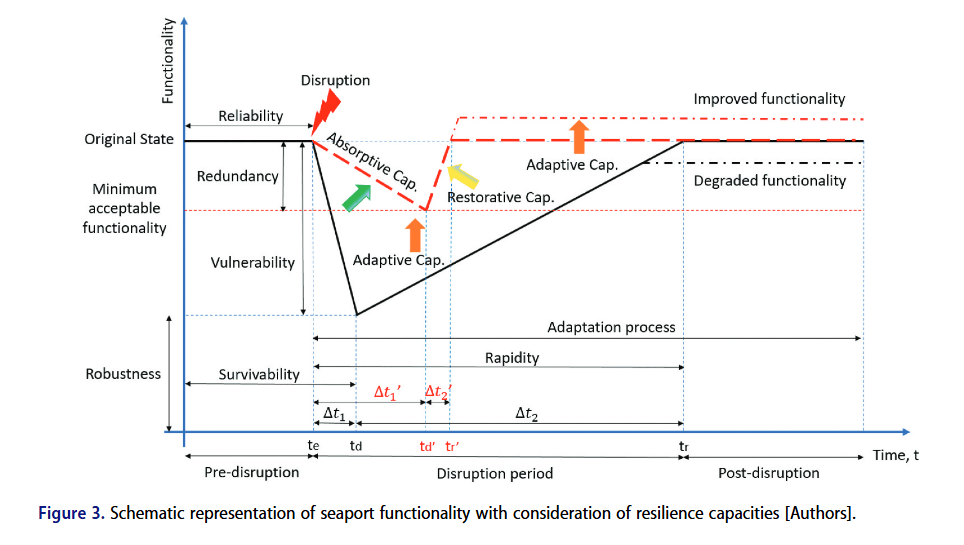
· Image 3 represents resilience elements during disruptions – from pre-disruption, to the disruption, then post-disruption.
· During pre-disruption, the port functionality depends on design configuration, systems reliability, and operating conditions. This is represented linearly, for simplicity.
· During the disruption, the system’s absorptive capacity is triggered; divided into two phases: phase 1 is withstanding the disruption via redundant or diversified capabilities.
· Phase 2 shows how performance may extend beyond the exhaustion of redundancies/slack. System functionality hits its lowest point – determined by its robustness.
· “the extent to which functionality decreases reflects the degree of vulnerability in the system, indicating a lack of robustness”. Vulnerability is shown to inversely correlate with robustness.
· During recovery in post-disaster, a range of factors, e.g. human, tech, budget, agility, flexibility etc. dictate recovery.
· The red dashed line indicates the presence of a highly resilient system. Here “A stronger absorptive capacity not only reduces the vulnerability, but also prolongs the occurrence of minimal functionality”.
· “with enhanced adaptive and restorative capabilities, there can be an observed rise in the rate of recovery, suggesting a more rapid process of repair”
Ref: Massoud Mohsendokht, Christos Kontovas, Chia-Hsun Chang, Zhuohua Qu, Huanhuan Li & Zaili Yang (23 Mar 2025): Resilience analysis of seaports: a critical review of development and research directions, Maritime Policy & Management.

Study link: https://doi.org/10.1080/03088839.2025.2483410


