

This explored Design for Resilient Performance (DfRP) via their framework. Not a summary – just a few extracts, but maybe I’ll summarise it in the future.
Some extracts:
· “Resilient performance (RP) is a socio-technical system’s ability to adjust its functioning prior to, during, or following changes and disturbances, thereby sustaining operations under both expected and unexpected conditions”
· “Although RP is, to some extent, intrinsic to the self-organization of socio-technical systems, relying solely on this source of resilience is too risky and unethical” and implies “RP playing out mostly at the individual level and at the expense of people’s self-sacrifice such as burnout and high workload”
· In contrast, work system design argues for designing resources and structures to support people
· DfRP is “the use of design principles to support integrated human, technical, and organizational adaptive capabilities”
· Image 1 is their DfRP framework, including social, technical, work organisation and external environment subsystems. The challenge in DfRP is the joint optimisation of the sub-systems
· These principles are aligned with four resilient potentials from Hollnagel and RE: monitoring, anticipating, responding, and learning
· In their DfRP, they adopt Wiig et al.’s four questions: resilience for what? To what? Of what? Through what?
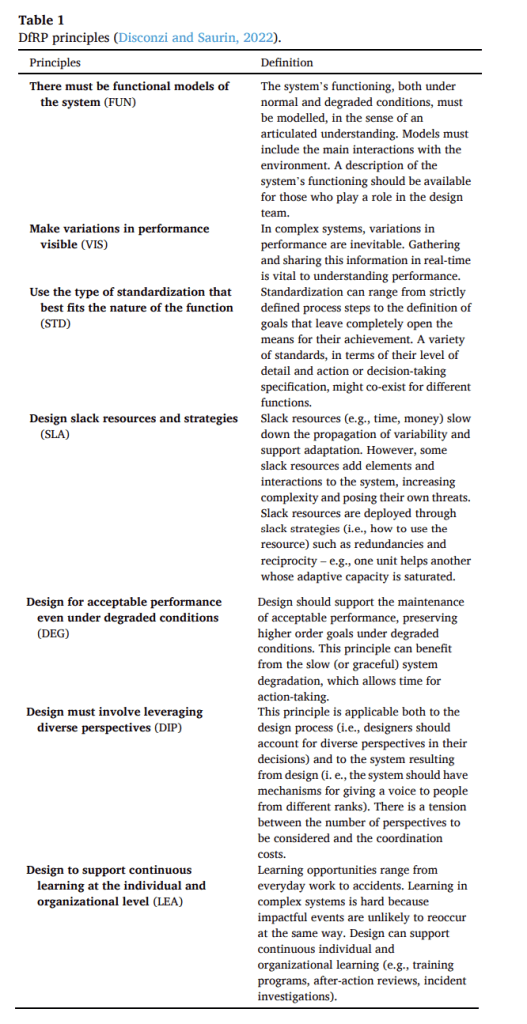
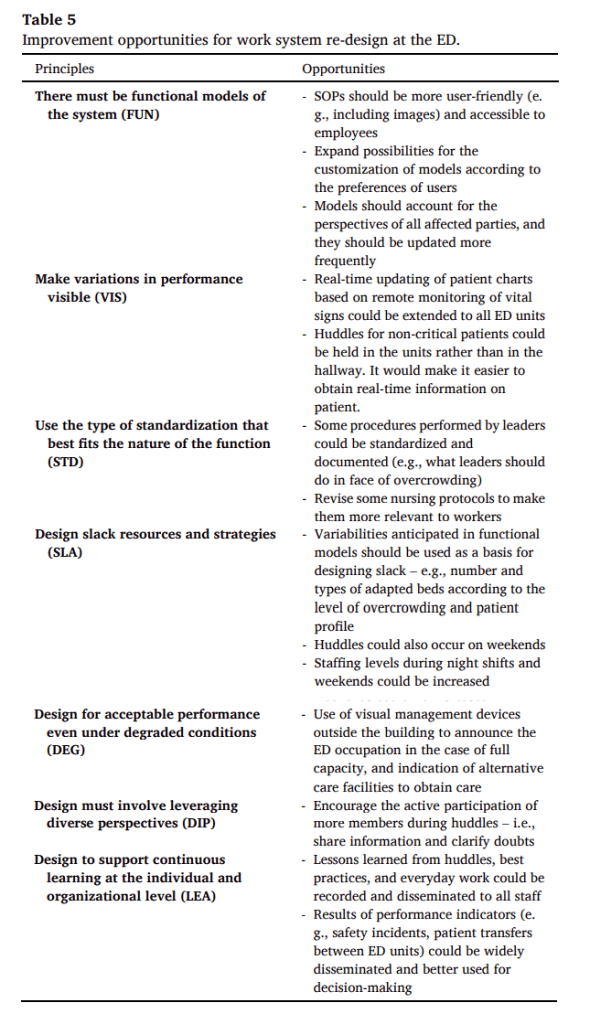
Image 2 shows an example of their DfRP applied to redesign of the emergency department. They also a subsystem resilience scoring system in the paper but I’ve skipped this.
Finally, they have some propositions for applying DfRP:
· “practices of DfRP, in order to be sustainable at the longterm, must be perceived as cost-effective by designers and users of designs”
· DfRP is bounded by system complexity (e.g., degree of stability, degree of coupling, diversity of elements, interactions with the external environment), which is a source of both opportunities and constraints”
· “DfRP tends to benefit from interconnected designs at the macro, meso, and micro levels”
· “DfRP tends to benefit from short control cycles, playing out as a manifestation of the learning principle”
· “DfRP tends to benefit from decentralized and customized designs that meet needs and preferences of designers, playing out as a manifestation of the standardization principle”
· “DfRP tends to benefit from information gathered in realtime from direct sources, with a time lag as low as possible between collection of information and decision-making”
· The uptake of this proposition plays out as a manifestation of the principle on giving visibility to performance variations as these can be accurately identified and quickly dealt with”
Ref: Disconzi, C. M. D. G., & Saurin, T. A. (2024). Principles and practices of designing for resilient performance: An assessment framework. Applied Ergonomics, 114, 104141.

Study link: https://doi.org/10.1016/j.apergo.2023.104141

 SafetyInsights.org