
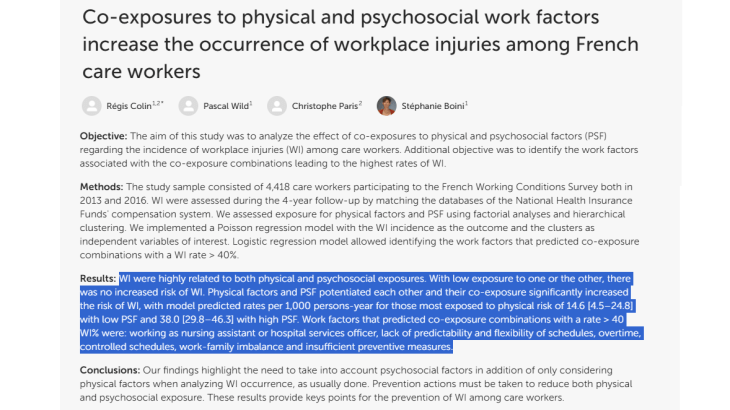
Psychosocial and physical workplace exposures found to be co-related in workplace injury (WI), according to this study.
It’s one of heaps of studies highlighting the interactions between psychosocial factors and physical and psychological injury.
E.g. Physical exposures were on their own were not great predictors of self-declared injury, and it was the interactions that best predicted injury.
I’ll start posting more of these, but this looked at injury across >4k French care workers.
Background:
· A 2019 Danish study “concluded that in addition to physical burden, poor collaboration between and support from colleagues increased the risk of back injury”
· A Dutch study “found that low autonomy and exposure to harassment and violence inside and outside the organization were associated with WI [Workplace Injury] for workers”
· Higher prevalence of worker injury has been found with co-exposure to physical and psychosocial factors, and this was found longitudinally from all sectors of activity
Results:
· “WI were highly related to both physical and psychosocial exposures”
· “With low exposure to one or the other, there was no increased risk of WI”
· “with low exposure to physical risk factors, there was no increased risk of the
· occurrence of WI” and “with low PSF exposure, the predicted rates of WI were not different according to the level of exposure to physical factors”
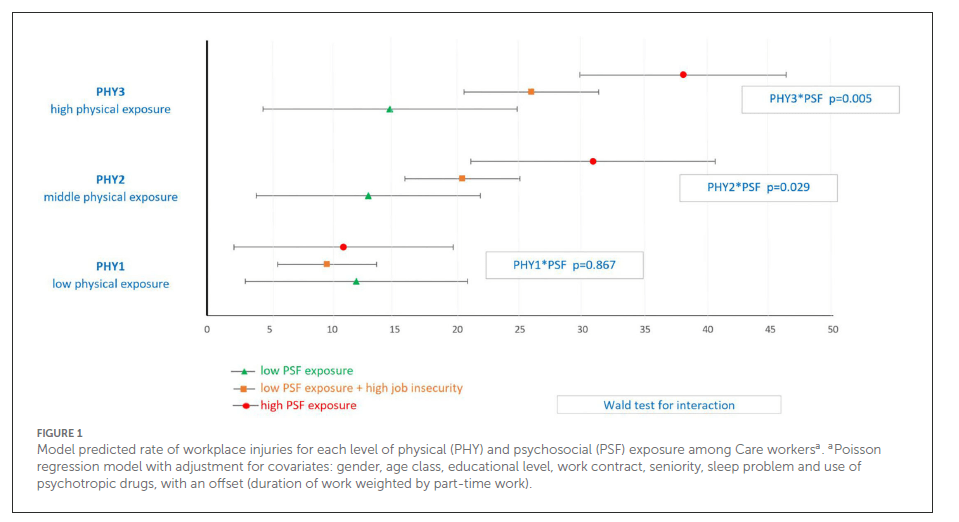
· “Physical factors and PSF potentiated each other and their co-exposure significantly increased the risk of WI with model predicted rates per 1,000 persons-year for those most exposed to physical risk of 14.6 [4.5–24.8] with low PSF and 38.0 [29.8–46.3] with high PSF”
· “Work factors that predicted co-exposure combinations with a rate > 40 WI% were: … lack of predictability and flexibility of schedules, overtime, controlled schedules, work-family imbalance and insufficient preventive measures”
· For the high WI rate group, the “PSF mainly involved consisted of poor social relationships at work, whatever the type of physical factors and, to a lesser extent, low autonomy, high job insecurity and high labor intensity”
· Organisational factors related to the high injury rate group were: schedule inflexibility, work duration, mandatory overtime, impossibility or difficulty to be absent in the case of unforeseen personal or family events and inadequate safety prevention policy
Ref: Colin, R., Wild, P., Paris, C., & Boini, S. (2022). Co-exposures to physical and psychosocial work factors increase the occurrence of workplace injuries among French care workers. Frontiers in public health, 10, 1055846.

Study link: https://doi.org/10.3389/fpubh.2022.1055846

 SafetyInsights.org
One thought on “Co-exposures to physical and psychosocial work factors increase the occurrence of workplace injuries among French care workers”