
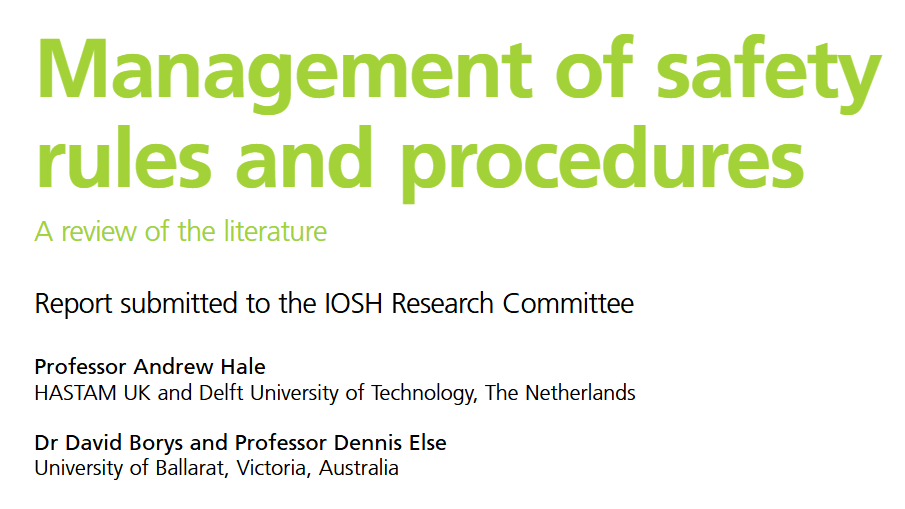
Really interesting report from Hale, Borys & Else about the nuances of rules, and contrasting model 1 / model 2.
[* Check out this week’s compendium dedicated to Hale & Hopkins, link below]
A few extracts:
· A classic Dutch railways study showed that 3% of workers used rules often and 50% almost never, 47% found rules to often be unrealistic, 29% thought rules are used for blame, 95% couldn’t finish the work if all rules were followed, 70-79% thought there were too many rules or were too complicated
· Some argue that “there are already too many rules in most complex technologies and no more are needed to make them safer”
· Next model 1 & model 2 rules are discussed (image 1)

· Model 1 is “rationalist and prescriptive in its approach, and appeals to engineering concepts and truths” and “Rules are devised by experts to guard against the errors and mistakes of fallible human operators at the sharp end”
· These rules are “seen as essentially static, to be worked out as a one-off exercise and only to be modified when the activity changes substantially”
· “They are to be documented in manuals, or more recently in databases, made available to the workforce, incorporated in training and signed for to signify intent to comply”
· “Their image is essentially top–down, applying to the operational workforce and only relevant to the management in their role as enforcers”, which interestingly some data indicates that “managers are just as fervent violators of rules as the workforce”
· Deviations from rules are seen as “essentially negative”, and model 1 is the dominant logic of rules from the media following major accidents, and “that powers much of behavioural-based safety”
· Model 2 sees rules “as patterns of behaviour, socially constructed, emerging from experience with actions and activities by those carrying them out. They are characterised as local and situated in the specific activity, in contrast to the written rules, which are seen as being at a generic level”
· “This view of rules is essentially bottom–up and dynamic. It recognises that rules can never be complete and the written ones are seen as essentially underspecified, requiring a process of translation and adaptation before application to any given, specific situation”
· “This implies that written rules should not be at the detailed, action level but, at most, at the process rule level”
· “The real experts in this conceptualisation are the operators … whose ability to conduct and navigate this dynamic process of negotiation and construction of rules is seen as an essential part of their skill and identity”
· “Rules are seen in model 2 as a support and guidance for the expert, as templates and resources for adaptation, but not something requiring strict compliance and no substitute for competence”
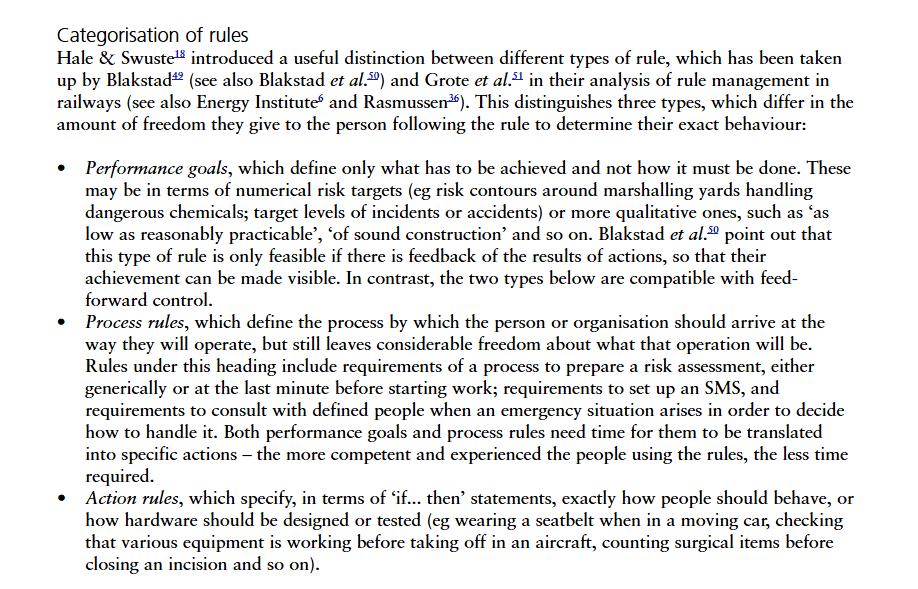
· Types of rules are also discussed (image 2): performance rules (what has to be achieved but not how), process rules (the process to follow but leaving freedom how to achieve it), and action rules (concrete steps, IF-THEN statements etc, exactly how people should behave)
· Next they discuss Rasmussen’s dynamic risk model and drift to danger where “an SMS establishes a safe zone of operation, guarded by risk controls. However, the operation of the activity is subject to pressures from competition, the market and regulation”
· Some have conceptualised rules as one part of the joint system that “[act] as beacons that define the boundary of the safe zone”
· They point to some of the resistance to rules in highly skilled professions, e.g. craftmanship.
· Craftmanship includes: de-emphasising formal rules since the rules cannot cover all contingencies, tacit knowledge which is learned by exposure and interaction, which provides more situated experience “than by formal training”, and personal responsibility where “the attribution of accidents as a shameful proof of lack of personal professionalism”
· Finally, image 3 covers a process for the development, testing and implementation of rules


Shout me a coffee (one-off or recurring monthly)
Hale/Hopkins compendium: https://safetyinsights.org/2025/05/20/compendium-an-ode-to-andrew-hopkins-andrew-hale/

 SafetyInsights.org