
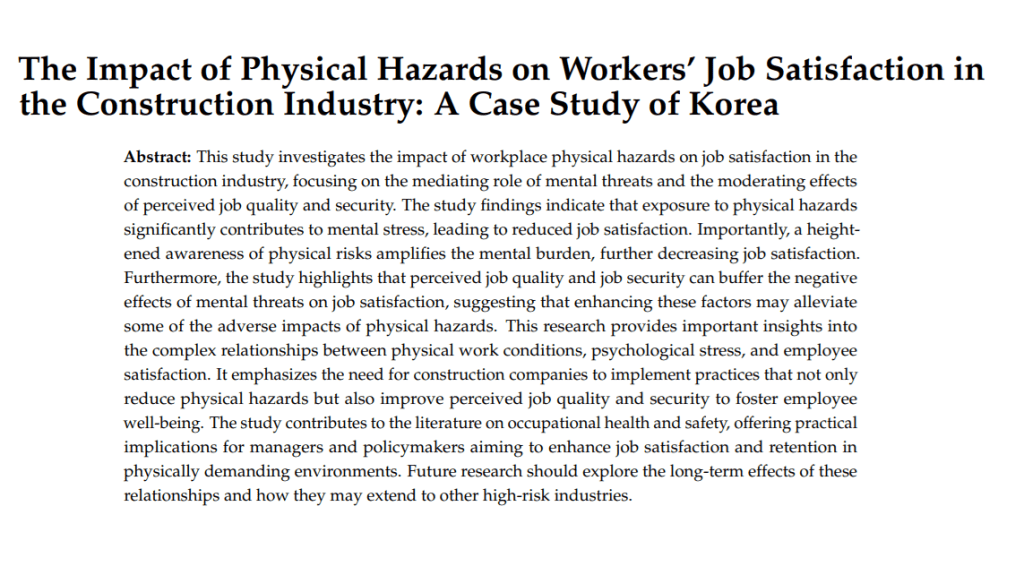
This study explored how physical workplace hazards influence job satisfaction in construction, and how mental threats mediate the relationship, and how perceived job quality and security moderate the effects.
2,202 construction workers in Korea were surveyed.
Key findings:
· “exposure to physical hazards significantly contributes to mental stress, leading to reduced job satisfaction”
· And “a heightened awareness of physical risks amplifies the mental burden, further decreasing job satisfaction”
· “perceived job quality and job security can buffer the negative effects of mental threats on job satisfaction, suggesting that enhancing these factors may alleviate some of the adverse impacts of physical hazards”
· “This research provides important insights into the complex relationships between physical work conditions, psychological stress, and employee satisfaction”
· “It emphasizes the need for construction companies to implement practices that not only reduce physical hazards but also improve perceived job quality and security to foster employee well-being”
· “Beyond immediate safety risks, physical hazards can erode job satisfaction over time. This decline may lead to broader organizational challenges, such as reduced employee retention, lower productivity”
· “The buffering effect of job quality and security indicates that employees in high-quality, secure jobs are better equipped to manage the negative impact of workplace stressors”
· “the presence of physical hazards can induce chronic mental stress, even in the absence of actual accidents. Such persistent stress may have long-term consequences, including impaired mental health, increased burnout, and decreased productivity”
· “While minimizing physical hazards remains a central priority, we highlight the importance of implementing strategies that enhance employees’ perceptions of job quality and security”
· “Task complexity shows a significant negative relationship with perceived mental threat (β = −0.049, p < 0.05). As task complexity increases, the perception of mental threat decreases”
· Hence, more challenging or stimulating tasks may “help alleviate stress by engaging workers cognitively [where] tasks that provide intellectual stimulation or a sense of accomplishment can serve as coping mechanisms, reducing the psychological burden associated with one’s job”
· “Such tasks may offer workers a sense of focus or mastery, potentially mitigating stress levels, especially in high-demand environments”
· “Higher levels of supervisor support correlate with lower levels of perceived mental threat”
In all:
“we should view the presence of physical hazards as both a potential cause of physical injury and a source of psychological strain, emphasizing the need to address both aspects of well-being in high-risk work environments”
Ref: Seo, H. J., Hyun, E. J., & Yoon, Y. G. (2024). Behavioral Sciences, 14(12), 1197.

Shout me a coffee (one-off or monthly recurring)
Study link: https://www.mdpi.com/2076-328X/14/12/1197

 SafetyInsights.org