

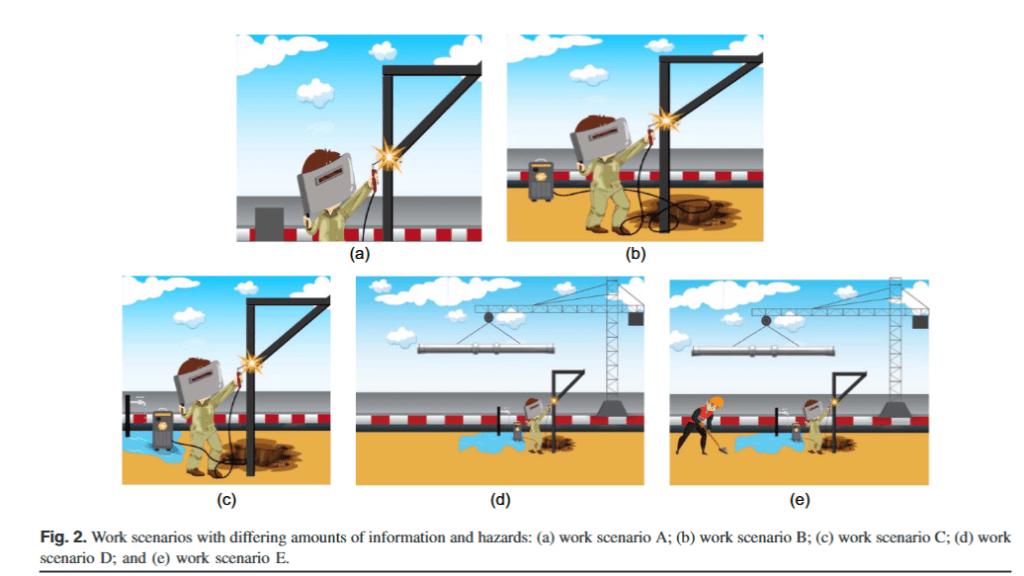
This study investigated how 181 fieldworkers rate the severity and frequency of safety incidents for five construction work scenarios.
The scenarios introduced new hazards into the scenarios, assessing how workers responded, if at all.
Background:
· Safety risk perception (SRP) is estimated using the participants’ perception of the safety hazards severity and frequency of occurrence
· As hazard exposures remain underperceived, the “likelihood of catastrophic and unexpected injuries dramatically increases”
· As expected, SRP varies between people and experts
· One study found that the presence of multiple hazards in the workplace can “hinder workers’ ability to recognize all potential hazards”, suggesting that “workers may focus on a few hazards while overlooking others”
· Other factors affect SRP, including ethnicity, local culture, education level and age have significant influence
· Other pertinent influences on SRP include safety climate, inattentional blindness, project type, and emotional assessment of risk
· Some research has posited that “workers all tend to place more emphasis on the severity of hazards than on the likelihood of them occurring”
· “One of the most challenging parts of construction is that the workplace is always changing. In a dynamic work environment, hazards can arise or change rapidly”
· Hence, this study looked at SRP while introducing new hazards into the workplace (via the scenarios)
Results
Key findings:
· “as new hazards were introduced in the work scenarios, the fieldworkers had a significant change in their perception of risks for about 71% of the accident causes”
· “They were able to assess safety risks related to slip, trip, fall; struck-by; caught-in or -between; electrocution; stepping on an object; fall to a lower level; and trapped-in by collapsing”
· “However, they failed to perceive the risk of increasing the number of workers in a hazardous work environment, indicating that workers focus on the severity of the occurrence of accidents and do not pay attention to the workers present on the scene”
So in all, workers did incorporate an assessment of new hazards entering their work environments (again, via the scenarios), but this was limited to a few hazard classes, e.g. slip and trips, struck-by, electrocution, trapped in/ collapse, caught-in / by.
Hence, “This shows that they have increased awareness and vigilance on the job for such hazards”.
Nevertheless, fieldworkers SRP wasn’t significantly influenced by the introduction of these new hazards:
· Fall to a lower level
· Stepping on objects
· New workers/work crews working in the area
They say that fieldworkers didn’t perceive the elevated risk of increasing the number of workers in a hazardous environment – hence, “This shows that fieldworkers focused on the severity of the occurrence of accidents but did not pay attention to the workers present at the scene”.
They conject that it could be a case of inattentional blindness, where individuals don’t notice an unexpected task or event information.
They discuss more research on SRP. For instance, “Weinstein (2000) discovered that “people are surprisingly insensitive to variations in hazard probability when probabilities are in the moderate to high range.”
This study found something similar, where fieldworkers were insensitive to the risk stemming from concurrent workers in the area.
Also, fieldworkers did reassess risks after the introduction of new hazards in 71% of instances, highlighting SRP sensitivities to many, but not all, hazards in the workplace.
Therefore, “This suggests that fieldworkers cannot assess 100% of the risks in a workplace with varying levels of hazard information like the construction industry”.
Ref: Ibrahim, A., Nnaji, C., Namian, M., & Shakouri, M. (2024). Evaluating the Impact of Hazard Information on Fieldworkers’ Safety Risk Perception. Journal of Construction Engineering and Management, 150(3), 04023174.

Shout me a coffee (one-off or monthly recurring)
Study link: https://doi.org/10.1061/JCEMD4.COENG-14061
LinkedIn post: https://www.linkedin.com/pulse/evaluating-impact-hazard-information-fieldworkers-risk-ben-hutchinson-pl0vc

 SafetyInsights.org