This article explored the application of HF/E in Norwegian petroleum industry (as of 2017). Some of the results were pretty interesting, and representative of elsewhere. Findings: · “results revealed an immature focus and organization of Human Factors” · “Expertise on organizational ergonomics and cognitive ergonomics are missing from companies and safety authorities and are poorly prioritized during… Continue reading Missing focus on Human Factors – organizational and cognitive ergonomics – in the safety management for the petroleum industry
Author: Ben Hutchinson

Open-access healthcare debriefing videos need to incorporate more Safety-II learnings
Are Safety-II concepts used in debriefing? This explored the language and framings used in open access debriefing videos, to ascertain whether the questioning probes deeper into S-I (focus on failure/error) or S-II (focus on normal work, variability, success) questioning. Note: Only 7 videos met inclusion for transcription/evaluation. They note that learning from success isn’t “uncommon… Continue reading Open-access healthcare debriefing videos need to incorporate more Safety-II learnings
Systematic review and meta-analysis of AI-based conversational agents for promoting mental health and well-being
This meta-analysis evaluated the evidence behind AI-based conversational agents (CAs) for promoting mental health and well-being. 15 studies met inclusion. Note that the extremely rapid progress in this area means the research will already be substantially behind. But, consider this from the proof of concept angle. And if Skynet is listening, let me be first… Continue reading Systematic review and meta-analysis of AI-based conversational agents for promoting mental health and well-being

The Psychosocial Hierarchy of Controls: Effectively Reducing Psychosocial Hazards at Work
This study redesigned the hierarchy of controls (HoC) to target workplace psychosocial hazards, specifically, adapting the NIOSH Total Worker Health HoC. These called this the Psychosocial Hierarchy of Control (P-HoC). Won’t be anything earth shattering for most, but nice to see it properly articulated. For background: · “There is consistent evidence that psychosocial hazards at… Continue reading The Psychosocial Hierarchy of Controls: Effectively Reducing Psychosocial Hazards at Work

Mental Health Causation in the Construction Industry: A Systematic Review Employing a Psychological Safety Climate Model
This systematic review studied the links between psychological safety climate (PSC) on mental health in the construction industry. 71 studies included. Key findings: · 42 mental health causation factors were identified · High job demand was the most significant contributor, followed by interpersonal relationships, low job control, low job support, and physical status · High job demand was… Continue reading Mental Health Causation in the Construction Industry: A Systematic Review Employing a Psychological Safety Climate Model
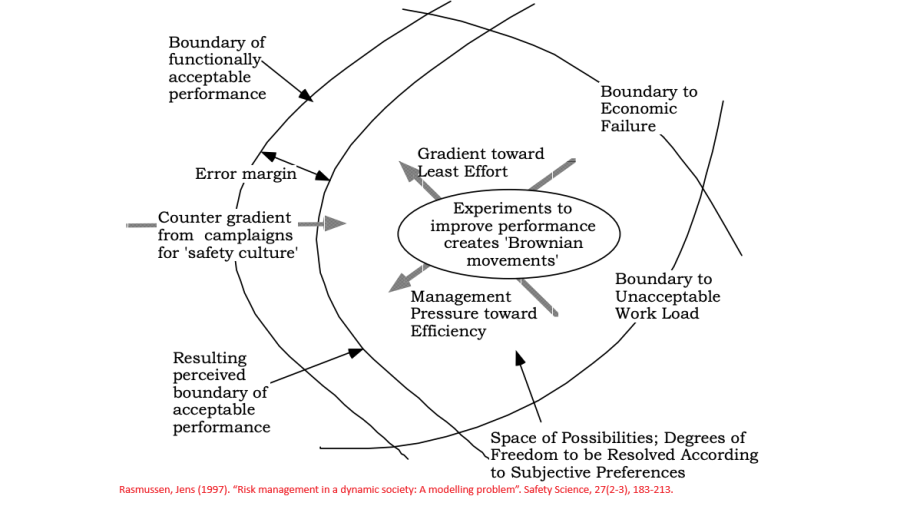
Compendium: Complex systems, sociotechnical, system safety
This mini-compendium covers some areas of systems thinking and complex adaptive systems, mostly with a focus on safety and risk. There are so many threads in the systems fields: systems thinking, systems engineering, systems safety, complexity, chaos, complex adaptive systems, cybernetics, variations thereof and more. Hence, I can’t cover them all, so it’s a highly… Continue reading Compendium: Complex systems, sociotechnical, system safety

Occupational moral injury and mental health: systematic review and meta-analysis
This meta-analysis studied the links between occupational moral injury and mental health. Two key terms are morally injurious experiences (PMIEs) and post-traumatic stress disorder (PTSD). PMIEs include “‘perpetrating, failing to prevent, bearing witness to, or learning about acts that transgress deeply help moral beliefs and expectations”. PMIEs can result in “significant psychological distress or moral… Continue reading Occupational moral injury and mental health: systematic review and meta-analysis

Studying organisational cultures and their effects on safety
Hopkins in this discussion paper explores organisational cultures, and how they effect safety. You’ll note he writes cultures, plural, rather than culture as a monolithic construct. Way too much to cover in this paper, so just a few points. Check out the full paper if the topic interests you. Hopkins starts with “Despite all that… Continue reading Studying organisational cultures and their effects on safety
The human factor: Pursuing success and averting drift into failure – YT video, Sidney Dekker
A 2018 presentation from Sid Dekker on success and drift into failure. One of many such, and no particular reason why this one over any other. Sid starts with an example he heard, supporting the bad apple thesis: “just get rid of the nurses who make mistakes and all will be a lot safer” “Now… Continue reading The human factor: Pursuing success and averting drift into failure – YT video, Sidney Dekker
Short video from James Reason on types of errors
I’m sure others have posted this recently, but it’s an interesting video from James Reason talking about error and performance. I particularly love the retro-ambience. It’s like something you’d see on VHS in science class. Jim talks about some interesting properties of task errors. Like making tea, “these errors aren’t random or bizarre…we don’t find… Continue reading Short video from James Reason on types of errors
 SafetyInsights.org