
Does HOP improve organisational learning behaviours and reduce quality deviations? It turns out, probably. This Master’s thesis from Chris Mastrangelo studied the effects of HOP principles on learning-behaviours, multi‑year trends in deviations, root‑cause classifications, corrective and preventive actions (CAPAs), and Human Performance Assessment (HPA) maturity assessments. Thesis link in comments. The HOP adoption was also… Continue reading HOP improves learning and reduces quality deviations – new research
Author: Ben Hutchinson
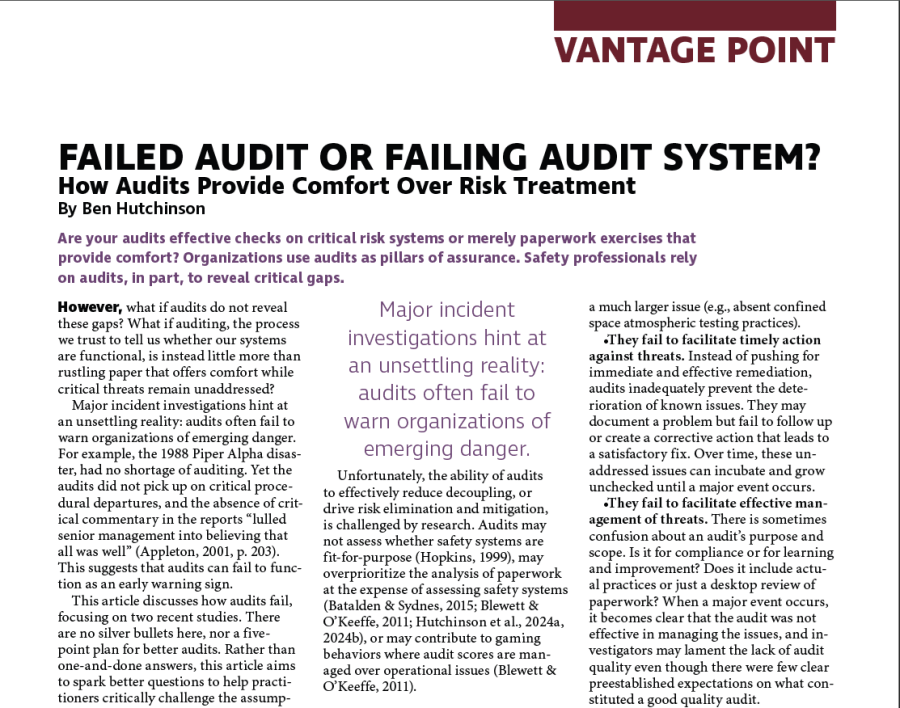
My new paper: Failed audit or failing audit system? From Professional Safety / ASSP
Are your audits effective checks on critical risk systems or merely paperwork exercises that provide comfort? Happy to share a little article I penned for Professional Safety / American Society of Safety Professionals (ASSP). Big thanks to them for the opportunity – and for making it look all purdy. Here I discuss some research on… Continue reading My new paper: Failed audit or failing audit system? From Professional Safety / ASSP
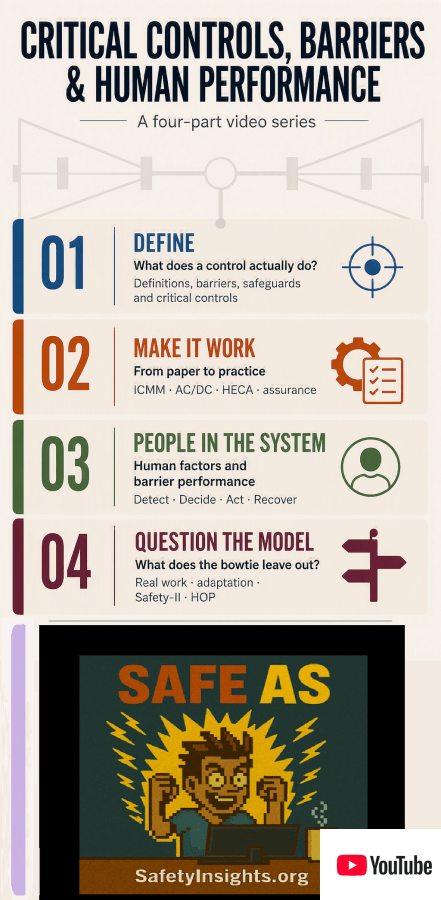
New 4 part Critical Control / Barrier and Human Performance YouTube series
Let’s goooo – I’ve spent the last few weeks on a 4 part Barrier / Critical Control YouTube series. It draws on multiple sources including ICMM, CSRA, IOGP, CIEHF & more, and really sucked to produce. So hope it’s interesting. The episodes are: Part 1 – What is a risk control or barrier meant to… Continue reading New 4 part Critical Control / Barrier and Human Performance YouTube series
Part 1 Dr Guido Carim Jr: Safety-II, rules, workarounds, adaptive capacity, learning & more
Part 1 interview with Dr Guido Carim Junior, an Associate Professor of Aviation, pilot, researcher, and safety scientist. We explore what safety ‘is’ beyond absence of incidents, limitations of procedures in complex environments, and why real-world situations rarely unfold how manuals anticipate. Guido shares insights from aviation research on adaptive capacity, informal learning, crew expertise,… Continue reading Part 1 Dr Guido Carim Jr: Safety-II, rules, workarounds, adaptive capacity, learning & more
Balanced approach to serious injury and fatality prevention: Exploring empirical relationships between short and long-term measures of safety performance
What tells you more about tomorrow’s fatality risk – last month’s injury rate or today’s control of high-energy hazards? An interesting study Arnaldo Bayona & Matthew Hallowell and colleagues exploring the relationship between assessments of pre-job safety brief (PJSB) quality and HECA (high-energy control assessments) and work conditions, and links with injury and SIFs. Not… Continue reading Balanced approach to serious injury and fatality prevention: Exploring empirical relationships between short and long-term measures of safety performance

Risk Management vs. Rule Compliance: The False Choice
When you’re standing on the frontline making an operational call, risk doesn’t come with a green or red light. You have to make a binary decision: stop or go. We don’t necessarily make it easy for our decision-makers to make good, defendable decisions. This video unpacks Andrew Hopkins’ 2011 Safety Science article, “Risk Management &… Continue reading Risk Management vs. Rule Compliance: The False Choice
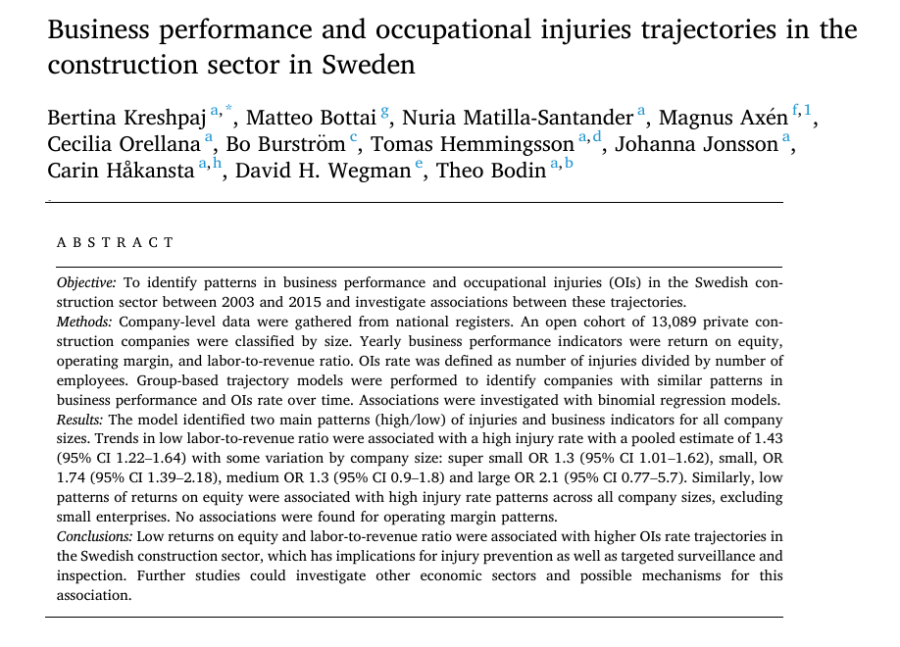
Do less profitable construction companies have more injuries?
Do less profitable construction companies have more injuries? This investigated business performance measures and occupational injuries (OIs) in Swedish construction companies. >13k companies between 2003 – 15 were investigated. PS. Check out my YouTube: https://youtube.com/@safe_as_pod?si=iUaDPJynPemQRZhY Shout a coffee: https://buymeacoffee.com/benhutchinson Extracts:· They observe that OIs “tend to rise during periods of economic growth and decrease during recessions”… Continue reading Do less profitable construction companies have more injuries?

AI flatters you: sycophantic models
“Absolutely — that’s a very nuanced observation.” New research shows AI isn’t just ‘too agreeable’, it can actually change how we see ourselves. The 2026 Science study discussed in my vid found that sycophantic AI (flattering, people-pleasing, affirming) boosts our confidence even when we’re wrong, reduces willingness to fix conflicts, & makes us more dependent… Continue reading AI flatters you: sycophantic models
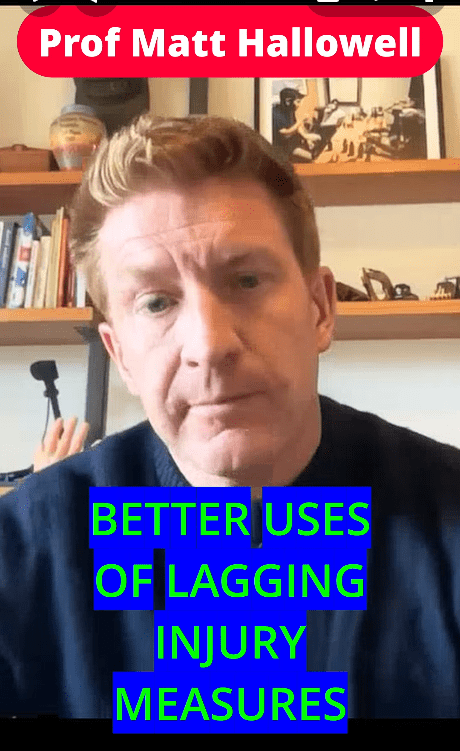
Dr Matt Hallowell: What are better use cases for lagging injury measures, like TRIR / LTIR?
What are better use cases for lagging injury measures, like TRIR / LTIR? Here Professor Matthew Hallowell discusses their use, and, if they’re not statistically robust for their common use cases, what should we measure instead? Links to the full 2 part interview below also. Part 1: Part 2:
Safety clutter: An attribute-based conceptualization and taxonomy for diagnosis (full PDF)
“some safety effort functions as “safety clutter:” work that consumes time and resources without improving safety” A new article on safety clutter worth your time from Yaqoob Raheemy, Matthew Hallowell, Helen Lingard & Fred Sherratt. Shared under an open access licence. PS. Check out my YouTube: https://youtube.com/@safe_as_pod?si=iUaDPJynPemQRZhY Shout a coffee: https://buymeacoffee.com/benhutchinson Extracts: · “safety clutter is… Continue reading Safety clutter: An attribute-based conceptualization and taxonomy for diagnosis (full PDF)
 SafetyInsights.org