This meta-analysis reviewed the antecedents of psychological and organisational safety climate, organised into three categories: situational factors, interpersonal interactions, and personal factors. Link in comments. There’s heaps to unpack here, so I’ll focus on a few things I liked. Psychological safety climate was related to antecedents reflected under situational factors (eg leadership), interpersonal interactions (leader-member… Continue reading How is safety climate formed? A meta-analysis of the antecedents of safety climate
Construction workers’ awareness of safety information depending on physical and mental load
This studied situational awareness (SA) in relation to induced mental and physical workloads while performing work on a real construction site. They drew on Endsley’s three-level model of SA, being: Level 1: perception of elements in the current situation; said to be the “most fundamental component of SA”. Given that attention is selective, things can… Continue reading Construction workers’ awareness of safety information depending on physical and mental load
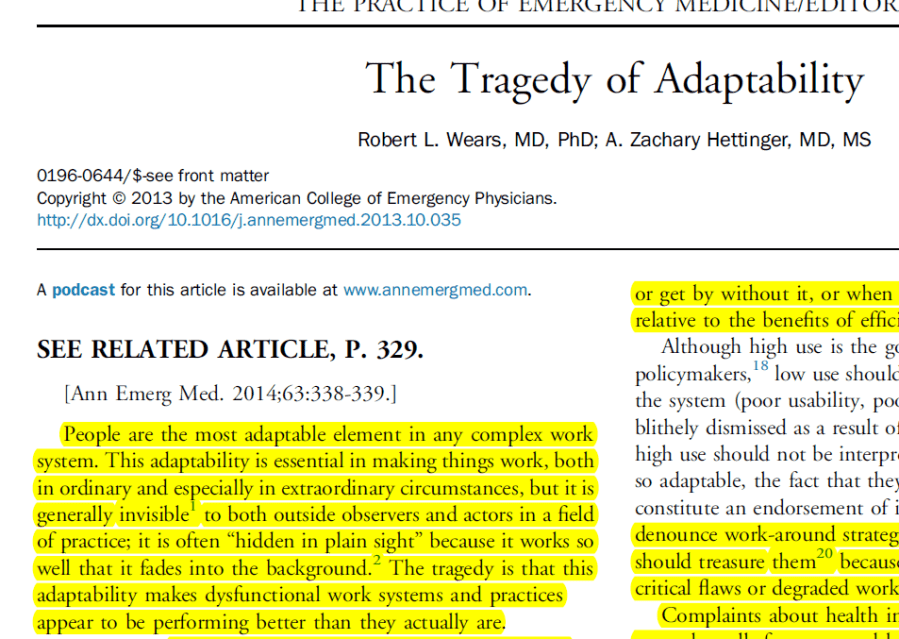
The Tragedy of Adaptability
This is one of my favourite discussion papers. Systems/processes in large and complex organisations can be difficult to use and access and not fit-for-purpose. People then find ways to adapt and “finish the design” of dysfunctional systems. For only two pages, this very brief paper hits pretty hard. “People are the most adaptable element in… Continue reading The Tragedy of Adaptability
Utilizing construction safety leading and lagging indicators to measure project safety performance
This studied 8 conventional performance indicators from 47 construction projects to see if a greater number of leading indicators, site inspections or toolboxes led to a lower lagging indicator frequency. First, no relationship was found between number of medical injuries and safety talks or site inspections. A small relationship was found between number of first… Continue reading Utilizing construction safety leading and lagging indicators to measure project safety performance
Injury inequalities among U.S. construction workers
This evaluated racial/ethnic inequalities in work-related injuries among US construction workers. Data was drawn from the 2004-2007 National Health Interview Survey data, which drew on survey results from 24,000 respondents. Results: Compared to white, non-Hispanic workers, minority workers were significantly more likely to suffer work-related injuries. They were also more likely to have lower socioeconomic… Continue reading Injury inequalities among U.S. construction workers
Mind the gap: Examining work-as-imagined and work-as-done when dispensing medication in the community pharmacy setting
This explored the gap between work-as-imagined (WAI) and work-as-done (WAD) in community pharmacies compared between hierarchical task analysis of operating procedures versus field observations of work. 3 community pharmacies were included. Like elsewhere, the authors note that an existing assumption in community pharmacy is that individual pharmacies adhere to SOPs and with the pharmacist on… Continue reading Mind the gap: Examining work-as-imagined and work-as-done when dispensing medication in the community pharmacy setting
Leading or lagging? Temporal analysis of safety indicators on a large infrastructure construction
This study from Lingard and Hallowell et al. is very cool. They analysed safety data on a large construction project over 5 years. First it gives a good summary of issues around defining lag vs lead indicators. Some criticism has been levied at injuries and incidents due to their low statistical probability of occurring they… Continue reading Leading or lagging? Temporal analysis of safety indicators on a large infrastructure construction
Effectiveness of occupational health and safety training: A systematic review with meta-analysis
This meta-analysis evaluated the published evidence to assess the efficacy of OHS training in terms of knowledge, attitude and beliefs, behaviour and health. 28 studies were included in the analysis. Results: Overall, results indicated a strong support for the effectiveness of training on worker attitudes and beliefs. This was also found to a lesser extent… Continue reading Effectiveness of occupational health and safety training: A systematic review with meta-analysis
When Safety Event Reporting Is Seen as Punitive: “I’ve Been PSN-ed!”
This looked at the use of blame and punitive language in Patient Safety Net reports (PSNs), an event reporting system. It’s argued that a culture of blame “discourages event reporting, and receiving punitive reports inhibits the development of a just culture … thus reducing individual and system improvement in patient safety” (p1). A punitive report… Continue reading When Safety Event Reporting Is Seen as Punitive: “I’ve Been PSN-ed!”
The Risk of Using Risk Matrices
This summarises research on Risk Matrix (RM) limitations and adds some new limitations. First, purported benefits of RMs is that they are intuitive & simple, and easy to explain and score. However, the authors note that the development of RMs has taken place isolated from scientific research in decision making and risk management. Research and… Continue reading The Risk of Using Risk Matrices

