
Here’s a bunch of linked articles (and a video) unpacking the constructs, or uses, of “human error”. (‘Keep calm’ header image source is my own, from a presentation) Welcome any additions. Shout me a coffee Link: https://safety177496371.wordpress.com/2021/08/05/searching-for-the-origins-of-the-myth-80-human-error-impact-on-maritime-safety/ Link: https://safety177496371.wordpress.com/2025/01/31/hollnagel-on-human-error-error-as-cause-process-or-outcome/ Link: https://safety177496371.wordpress.com/2024/09/05/the-emperors-new-clothes-or-whatever-happened-to-human-error/ Link: https://safety177496371.wordpress.com/2024/07/24/human-error-and-violation-of-rules-in-industrial-safety-a-systematic-literature-review/ Link: https://safety177496371.wordpress.com/2024/07/01/design-rules-based-on-analyses-of-human-error/ Link: https://safety177496371.wordpress.com/2024/06/21/understanding-human-error-in-naval-aviation-mishaps/ Link: https://safety177496371.wordpress.com/2024/05/24/state-of-science-evolving-perspectives-on-human-error/ Link: https://safety177496371.wordpress.com/2024/05/14/six-stages-to-the-new-view-of-human-error/ Link: https://safety177496371.wordpress.com/2024/04/16/human-performance-in-barrier-thinking-problems-with-human-error-post-1/ Link: https://safety177496371.wordpress.com/2024/01/18/perspectives-on-human-error-hindsight-biases-and-local-rationality/… Continue reading Constructions of “Human Error” (Mini-Compendium)
Tag: ai
Hollnagel on “Human error”: error as cause, process or outcome
Not much to say – some extracts from a 2007 chapter from Erik Hollnagel, unpacking whether we really need “human error”? I knocked the summary up last night and will probably post in the next couple of weeks. Oh man, I need to give up on chapters…what a slog. He argues: · Human error “is not… Continue reading Hollnagel on “Human error”: error as cause, process or outcome

Contextualising new safety paradigms: A study in a large Australian construction company
This study explored the presence, implementation, appetite and feasibility of 12 principles representing “new safety paradigms”. It involved focus groups with 53 participants and a cross-sectional survey of 514 employees. I’ve skipped HEAPS (actually, the entire results section – so check out the full paper). Background: · “The review by Karanikas et al. (2022) revealed… Continue reading Contextualising new safety paradigms: A study in a large Australian construction company
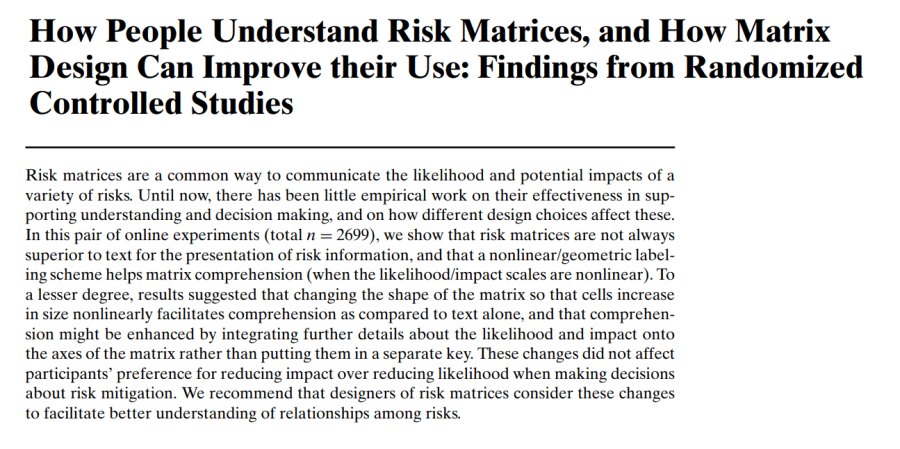
How People Understand Risk Matrices, and How Matrix Design Can Improve their Use: Findings from Randomized Controlled Studies
This study explored different risk matrix designs on user comprehension and use of matrices. I’ve posted a lot of research dunking on risk matrices (RMs), so here’s another olive leaf focusing on designing something potentially more useful. [** I still stand by the critical orientation, since we have little good evidence that RMs improve risk… Continue reading How People Understand Risk Matrices, and How Matrix Design Can Improve their Use: Findings from Randomized Controlled Studies
Wrong, Strong, and Silent: What happens when automated systems with high autonomy and high authority misbehave?
This article from Dekker and Woods discusses the ‘risks of literal-minded automation’, being a “system that can’t tell if its model of the world is the world it is actually in”. This issue manifests in automated systems being wrong, strong and silent—and while the issue has existed for at least 70 years, the risk “looms… Continue reading Wrong, Strong, and Silent: What happens when automated systems with high autonomy and high authority misbehave?
Harnessing the power of ChatGPT to promote Construction Hazard Prevention through Design (CHPtD)
This study compared whether ChatGPT can assist in hazard recognition during Construction Hazard Prevention Through Design (CHPtD) sessions (e.g. safety in design). Via randomised controlled experimental design, 162 civil and construction engineering students were tasked with hazard recognition activities with or without ChatGPT assistance. Providing background: Results: Ref: Uddin, S. J., Albert, A., & Tamanna,… Continue reading Harnessing the power of ChatGPT to promote Construction Hazard Prevention through Design (CHPtD)
Normal accident theory and learning from major accidents at the National Aeronautics and Space Administration (NASA)
This paper discussed four major NASA accidents in the context of Normal Accident Theory (NAT), high reliability and some other aspects of organisational theory. Then they discuss some ‘remedies’ to counter some of the organisational risk factors. I’ve skipped large amounts of this paper, so much that maybe even parts of this summary won’t make… Continue reading Normal accident theory and learning from major accidents at the National Aeronautics and Space Administration (NASA)
Quantitative Risk Assessments as Enabling Devices in Cybersecurity
Oof, a real banger Master’s from Colette Alexander, exploring the role of Quantitative Risk Assessments (QRA) as fantasy documents and enabling devices in cybersecurity. Can’t do this justice, so just a few extracts: Study link: http://lup.lub.lu.se/student-papers/record/9148570/file/9148571.pdf My site with more reviews: https://safety177496371.wordpress.com LinkedIn post: https://www.linkedin.com/posts/benhutchinson2_oof-a-real-banger-masters-from-colette-activity-7259318324717592576-y2Qs?utm_source=share&utm_medium=member_desktop
Can ChatGPT exceed humans in construction project risk management?
This study pit ChatGPT 4 versus competent construction personnel (project/site managers, engineers etc.) in a task of project risk management. They specifically compared results between the AI model and people on a construction project case study: · Identify and list the potential project risks · Which risks are most critical and analyse them? · How are these risks… Continue reading Can ChatGPT exceed humans in construction project risk management?
Hazard identification performance comparison between virtual reality and traditional construction safety training modes for different learning style individuals.
This new study may interest people – it compared hazard identification performance between VR and traditional construction safety training. They also compared the results to different learning styles (which I’ve skipped). Key findings: · “both traditional and VR training can improve the efficiency of visual search during individual hazard identification, increase hazard identification accuracy by individuals,… Continue reading Hazard identification performance comparison between virtual reality and traditional construction safety training modes for different learning style individuals.
 SafetyInsights.org