
REALLY interesting findings from Associate Professor Masahiro Yoshida. It suggests that automation over a historical context didn’t really drive down workplace injuries since it tended to be employed in already mature industries. And, ready access to cheap migrant workforces may hinder broader industrial risk reduction due to a negative correlation with automation investment. And the… Continue reading Automation’s lacklustre effects on fatal accidents & cheap migrant labour hampering adoption of engineering controls
Tag: artificial-intelligence
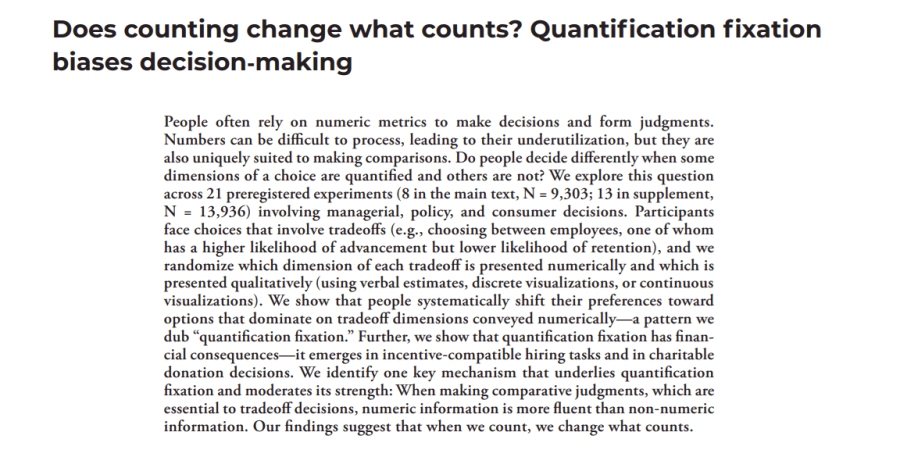
Does counting change what counts? Quantification fixation biases decision-making
Saw this posted on LinkedIn (forget who shared it) and found it really interesting. This study, across 21 experiments and 23k participants in managerial, policy and consumer contexts, studied how numbers and quantification distorts decision-making Context: · Quantification is spreading and has reached into almost every personal and professional area · New-borns are given Apgar… Continue reading Does counting change what counts? Quantification fixation biases decision-making

Compendium: Blame, Just Culture & language
Here’s another compendium of articles exploring blame and language in the construction of post-hoc causality explanations, or how blame effects learning and investigations. The other part covers some articles around Just Culture and restorative culture. Note: I’ve mostly focused on articles that I’ve either already summarised or that I could find a full text link… Continue reading Compendium: Blame, Just Culture & language
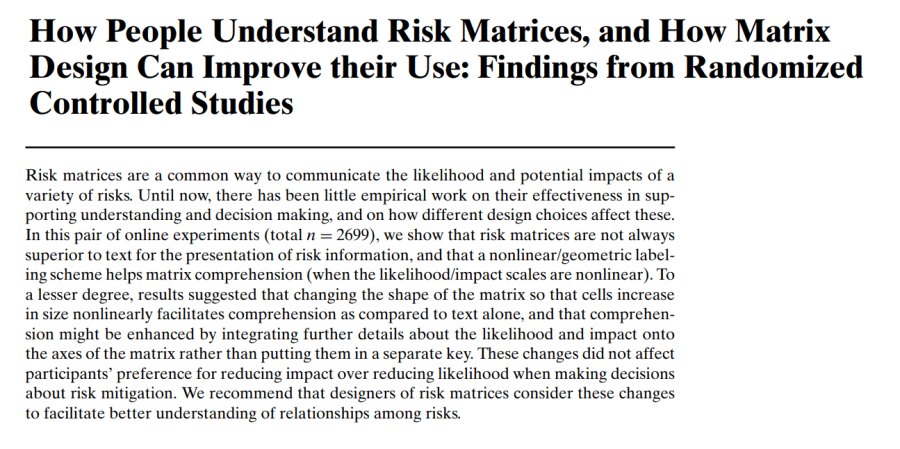
How People Understand Risk Matrices, and How Matrix Design Can Improve their Use: Findings from Randomized Controlled Studies
This study explored different risk matrix designs on user comprehension and use of matrices. I’ve posted a lot of research dunking on risk matrices (RMs), so here’s another olive leaf focusing on designing something potentially more useful. [** I still stand by the critical orientation, since we have little good evidence that RMs improve risk… Continue reading How People Understand Risk Matrices, and How Matrix Design Can Improve their Use: Findings from Randomized Controlled Studies
Wrong, Strong, and Silent: What happens when automated systems with high autonomy and high authority misbehave?
This article from Dekker and Woods discusses the ‘risks of literal-minded automation’, being a “system that can’t tell if its model of the world is the world it is actually in”. This issue manifests in automated systems being wrong, strong and silent—and while the issue has existed for at least 70 years, the risk “looms… Continue reading Wrong, Strong, and Silent: What happens when automated systems with high autonomy and high authority misbehave?
Harnessing the power of ChatGPT to promote Construction Hazard Prevention through Design (CHPtD)
This study compared whether ChatGPT can assist in hazard recognition during Construction Hazard Prevention Through Design (CHPtD) sessions (e.g. safety in design). Via randomised controlled experimental design, 162 civil and construction engineering students were tasked with hazard recognition activities with or without ChatGPT assistance. Providing background: Results: Ref: Uddin, S. J., Albert, A., & Tamanna,… Continue reading Harnessing the power of ChatGPT to promote Construction Hazard Prevention through Design (CHPtD)
Normal accident theory and learning from major accidents at the National Aeronautics and Space Administration (NASA)
This paper discussed four major NASA accidents in the context of Normal Accident Theory (NAT), high reliability and some other aspects of organisational theory. Then they discuss some ‘remedies’ to counter some of the organisational risk factors. I’ve skipped large amounts of this paper, so much that maybe even parts of this summary won’t make… Continue reading Normal accident theory and learning from major accidents at the National Aeronautics and Space Administration (NASA)
Can ChatGPT exceed humans in construction project risk management?
This study pit ChatGPT 4 versus competent construction personnel (project/site managers, engineers etc.) in a task of project risk management. They specifically compared results between the AI model and people on a construction project case study: · Identify and list the potential project risks · Which risks are most critical and analyse them? · How are these risks… Continue reading Can ChatGPT exceed humans in construction project risk management?
 SafetyInsights.org