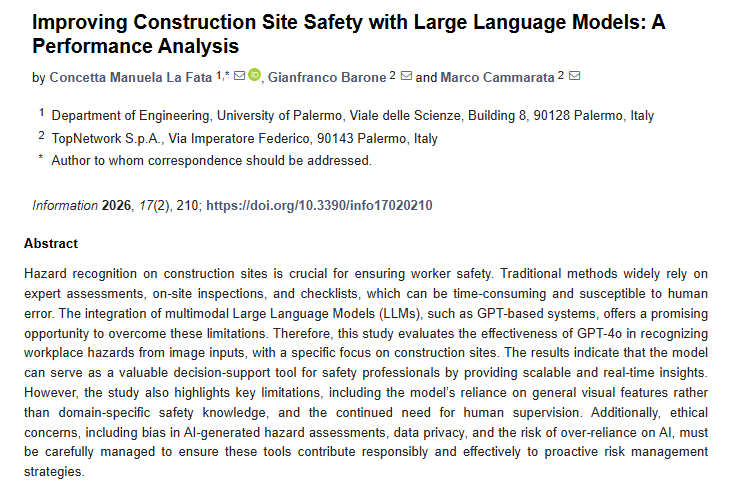
This preliminary, proof of concept study explored the effectiveness of GPT-4o in construction visual hazard recognition. They contrasted performance against OHS experts. Source was **static images** from Google and real construction sites (not real-time video analysis). The LLM & experts were asked to rate the hazard, justify their judgement, and assess the immediate issues, use… Continue reading Improving Construction Site Safety with Large Language Models: A Performance Analysis
Tag: chatgpt
Safe As: Can AI make your doctors worse at their job?
Can #AI make your doctor worse at their job? This multicentre study compared physician ADR (Adenoma Detection Rate) before and after AI-assisted detection – and then after removing the AI-assistance. What do you think – will the overall benefits of AI overweigh the negative and unintended skill drops of people? (*** Please subscribe, like and… Continue reading Safe As: Can AI make your doctors worse at their job?
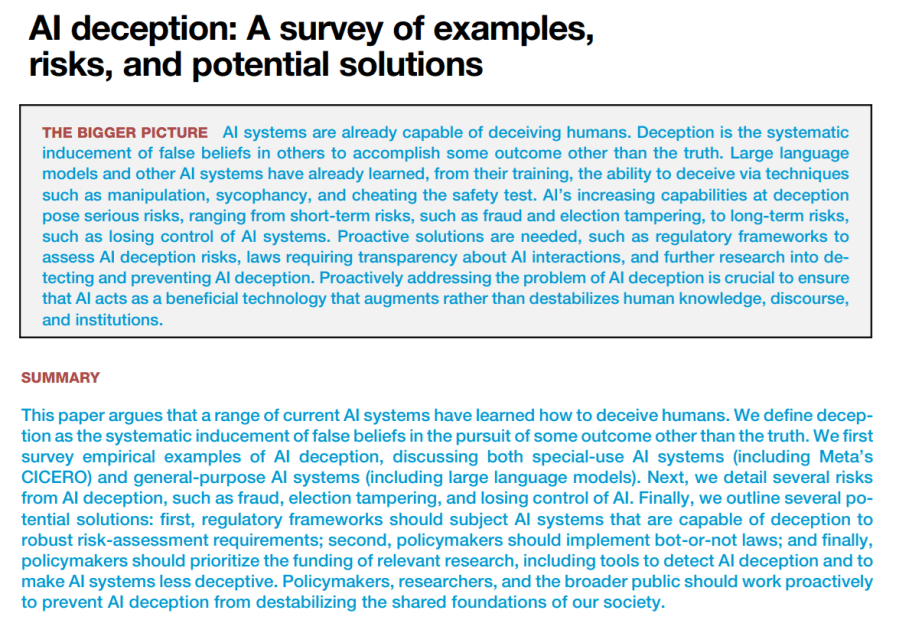
AI deception: A survey of examples, risks, and potential solutions
This study explored how “a range of current AI systems have learned how to deceive humans”. Extracts: · “One part of the problem is inaccurate AI systems, such as chatbots whose confabulations are often assumed to be truthful by unsuspecting users” · “It is difficult to talk about deception in AI systems without psychologizing them. In humans,… Continue reading AI deception: A survey of examples, risks, and potential solutions

The literacy paradox: How AI literacy amplifies biases in evaluating AI-generated news articles
This study explored how AI literacy can amplify biases when evaluating AI-generated news based on their content type (data-driven vs emotional). Extracts: · “Higher AI literacy can intensify opposing biases. When individuals better understand the use of AI in creating data-driven articles, they exhibit automation bias… Conversely, when AI generates opinion- or emotion-based articles, high literacy… Continue reading The literacy paradox: How AI literacy amplifies biases in evaluating AI-generated news articles

Large Language Models in Lung Cancer: Systematic Review
This systematic review of 28 studies explored the application of LLMs for lung cancer care and management. Probably few surprises here. And it’s focused mostly on LLMs, rather than specialised AI models. Extracts: · The review identified 7 primary application domains of LLMs in LC: auxiliary diagnosis, information extraction, question answering, scientific research, medical education, nursing… Continue reading Large Language Models in Lung Cancer: Systematic Review
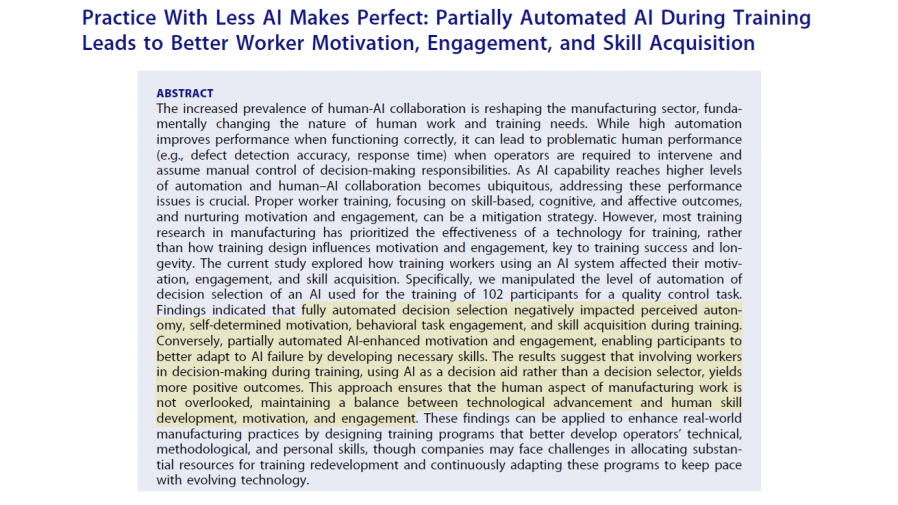
Practice With Less AI Makes Perfect: Partially Automated AI During Training Leads to Better Worker Motivation, Engagement, and Skill Acquisition
How does AI use in training improve, or impact, skill acquisition? This study manipulated training protocols with varying levels of AI decision-making automation, among 102 participants during a quality control task. Extracts: · “Partial automation led to the most positive outcomes” · “Participants who were trained with the fully automated version of the AIEDS had a significantly… Continue reading Practice With Less AI Makes Perfect: Partially Automated AI During Training Leads to Better Worker Motivation, Engagement, and Skill Acquisition

Safe As 33: Is ChatGPT bullsh** you? How Large Language models aim to be convincing rather than truthful
Large Language Models, like ChatGPT have amazing capabilities. But are their responses, aiming to be convincing human text, more indicative of BS? That is, responses that are indifferent to the truth? If they are, what are the practical implications? Today’s paper is: Hicks, M. T., Humphries, J., & Slater, J. (2024). ChatGPT is bullshit. Ethics and… Continue reading Safe As 33: Is ChatGPT bullsh** you? How Large Language models aim to be convincing rather than truthful
Can chatbots provide more social connection than humans?
Can chatbots provide more social connection than humans? Possibly, providing that they don’t “claim too much humanity”. Three study protocols with 801, 201 and 401 had participants engage with AI social chatbots. They note that the long-term consequences of social chatbot use is unknown, but is important to study since “hundreds of millions of people… Continue reading Can chatbots provide more social connection than humans?
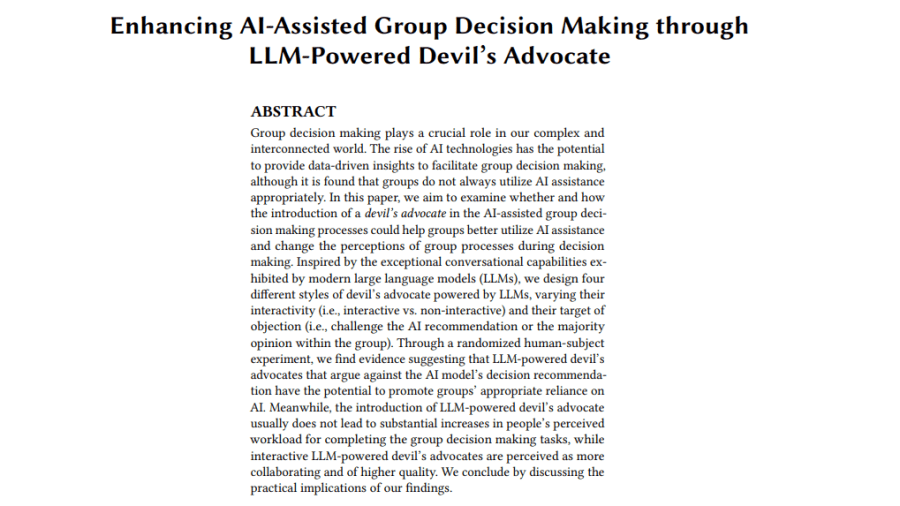
Enhancing AI-Assisted Group Decision Making through LLM-Powered Devil’s Advocate
Can LLM’s effectively play as devil’s advocate, enhancing group decisions? Something I’ve been working on lately is AI as a co-agent for cognitive diversity / requisite imagination. Here’s a study which explored an LLM as a devil’s advocate, and I’ll post another study next week on AI and red teaming. [Though this study relied on… Continue reading Enhancing AI-Assisted Group Decision Making through LLM-Powered Devil’s Advocate

The impact of generative AI on critical thinking skills: a systematic review, conceptual framework and future research directions
The impact of generative AI on critical thinking skills: a systematic review, conceptual framework and future research directions How do generative AI (GenAI) models affect critical thinking skills? This systematic review unpacked 68 studies to explore the good and the bad. GenAI are “machine-learning algorithms, usually transformer-based large-language models (LLMs), that generate new text, code… Continue reading The impact of generative AI on critical thinking skills: a systematic review, conceptual framework and future research directions
 SafetyInsights.org