NASA’s language of risk was “technical, impersonal, and bureaucratic”. Some extracts from both the Columbia accident report (CAIB 2003 image 1) and Ocasio’s chapter ‘The Opacity of Risk’, in Organization at the Limit (images 2 & 3; awesome book – I think essential reading). I’m writing up both for upcoming summaries, but for now just… Continue reading NASA and the blinding language of catastrophic risk
Tag: disaster

Barrier / control system failures in the BP Texas City disaster & organisational factors
This paper explored the barrier system (e.g. controls) performance in the genesis of the 2005 BP Texas City disaster. Not much to say – the images say enough. Some extracts: · As per image 1, several organisational factors or management delivery system were central in the poor barrier system performance · They propose many of these factors… Continue reading Barrier / control system failures in the BP Texas City disaster & organisational factors
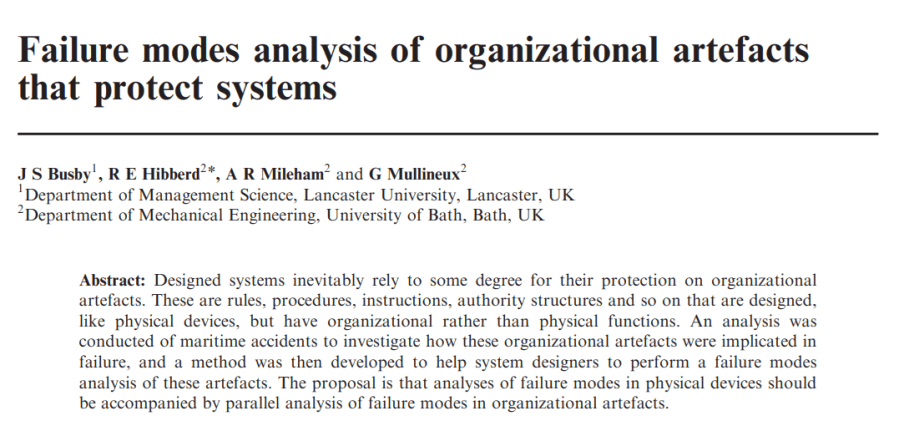
Failure modes analysis of organizational artefacts that protect systems
Really interesting 2004 paper discussing how to study the failures associated with organisational artefacts. Artefacts are “rules, procedures, instructions, authority structures and so on that are designed, like physical devices, but have organizational rather than physical functions”. It’s argued that studying failures of artefacts, like in FMEA, isn’t the same as physical failure modes, and… Continue reading Failure modes analysis of organizational artefacts that protect systems

Compendium of Nancy Leveson: STAMP, STPA, CAST and Systems Thinking
Although I don’t often mention or post about Leveson’s work, she’s probably been the most influential thinker on my approach after Barry Turner. So here is a mini-compendium covering some of Leveson’s work. Feel free to shout a coffee if you’d like to support the growth of my site: https://direct.mit.edu/books/oa-monograph/2908/Engineering-a-Safer-WorldSystems-Thinking-Applied https://doi.org/10.1177/0170840608101478 https://doi.org/10.1145/7474.7528 http://therm.ward.bay.wiki.org/assets/pages/documents-archived/safety-3.pdf http://sunnyday.mit.edu/papers/Rasmussen-Legacy.pdf https://www.tandfonline.com/doi/pdf/10.1080/00140139.2015.1015623… Continue reading Compendium of Nancy Leveson: STAMP, STPA, CAST and Systems Thinking
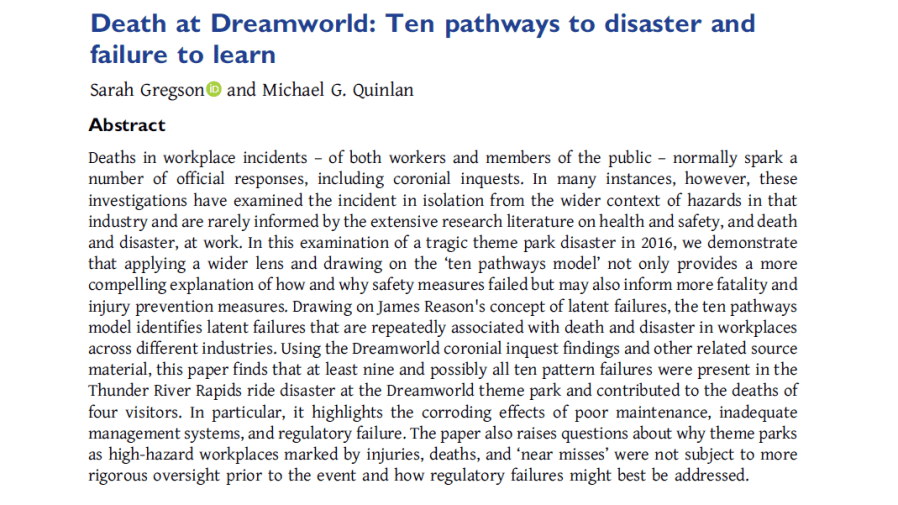
Death at Dreamworld: Ten pathways to disaster and failure to learn
This paper from Sarah Gregson and Michael Quinlan applies his ten pathways framework to the Dreamworld accident in 2016, killing four people. I’ve skipped a lot. [** Yes, hindsight and outcome biases are present with this type of analysis, as with my own auditing work. Doesn’t mean there isn’t value in exploring learning opportunities, but… Continue reading Death at Dreamworld: Ten pathways to disaster and failure to learn
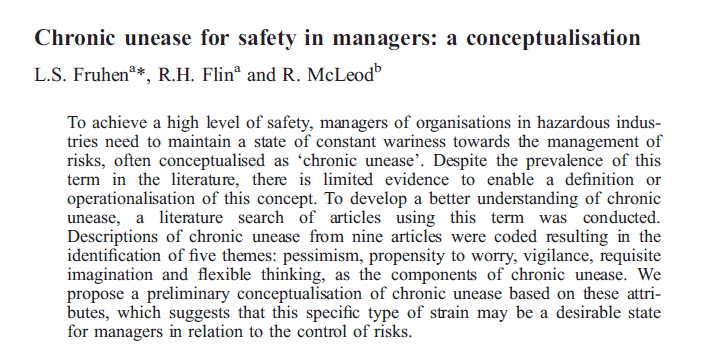
Chronic unease for safety in managers: a conceptualisation
Just a basic post today – some extracts from a paper exploring chronic unease: · Drawing on Reason’s concept, chronic unease has gone by various definitions over the years (image 1) · For Reason, it was the “tendencies of wariness towards risks” · And as a “contrast to complacency, resulting from the absence of negative events, leading ‘people… Continue reading Chronic unease for safety in managers: a conceptualisation
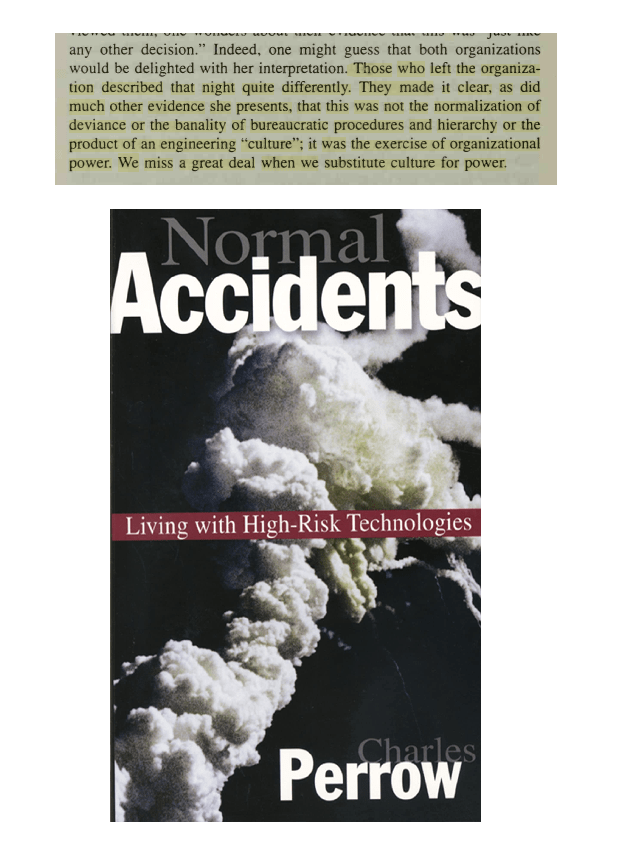
“We miss a great deal when we substitute culture for power” – Charles Perrow on the role of power in disaster
“We miss a great deal when we substitute culture for power” I love this quote from Perrow in Normal Accidents (emphasis added). Perrow briefly discusses the role of power in organising risky technology. Discussing Vaughan’s interpretation of the Challenger disaster: · “I also find the role of power and interests minimized in Diane Vaughn’s otherwise excellent… Continue reading “We miss a great deal when we substitute culture for power” – Charles Perrow on the role of power in disaster

Major accidents and their geographical and temporal patterns around the world – 1900-2024
I knocked this up over the weekend and thought it would interest people – studied the patterns of natural and human-induced disasters from 1900 to 2024. I’m focusing more on the human-induced/human-made disasters. Some findings: · Asia reported the highest number of air disasters, then Europe, NA and the fewest in Oceania · NA recorded the most… Continue reading Major accidents and their geographical and temporal patterns around the world – 1900-2024
 SafetyInsights.org