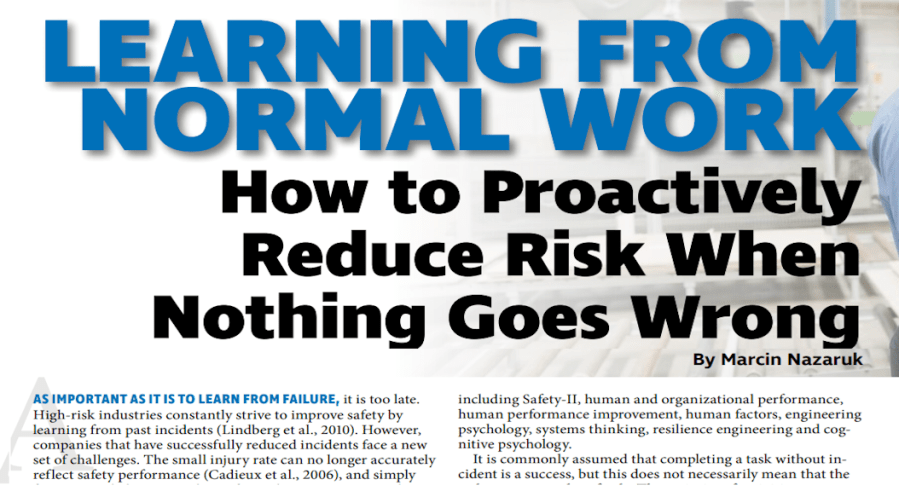
An interesting article from Marcin Nazaruk, exploring learning from everyday work. Skipping a bit, so check out the full article. First he says that while it’s important to learn from failure “it is too late”. For one, diminishing incident rates “can no longer accurately reflect safety performance … and simply focusing on behaviours and unsafe… Continue reading Learning from normal work: How to Proactively Reduce Risk When Nothing Goes Wrong
Tag: human factors

Leveraging Ergonomics and Human Factors (E/ HF) for community impact: what have we learned about how to make a difference
This was a banger – exploring the application of community ergonomics with a strong systems lens. If you’re interested in HF/E, systems thinking, social dynamics, power gradients and more then this will interest you. Can’t do it justice, so a few random extracts. Extracts: Community ergonomics is a “design approach to the interfaces between people… Continue reading Leveraging Ergonomics and Human Factors (E/ HF) for community impact: what have we learned about how to make a difference
Procedure excellence: Changing paradigms to enable human reliability
This paper from Elliot Wolf-Stokes and Rob Fisher may interest peeps – around orientating towards operational excellence. Covers a lot of ground – systemic drivers to procedural departures, error drivers in written guidance, mental models, enablers of human reliability and more. I’ve skipped HEAPS, so just a few extracts (link to full paper in comments):… Continue reading Procedure excellence: Changing paradigms to enable human reliability
The ironies of ‘human factors’
This brief book chapter from Hollnagel & Dekker adopts Lisanne Bainbridge’s idea of ironies, in the context of contemporary human factors practice. Can’t cover all the points. Highly recommend you check out Bainbridge’s original paper, though (link in comments). Ironies in this context is a “solution which expands rather than solves or eliminates a problem,… Continue reading The ironies of ‘human factors’
The science of human factors: separating fact from fiction
This brief read discussed some of the misconceptions about human factors for healthcare improvement. It’s open access, so you can read the paper yourself. They discuss where training interventions are likely to be appropriate vs not appropriate. More appropriate uses is: · To help familiarise people with new tools or functions, which should include strengths and… Continue reading The science of human factors: separating fact from fiction
Human Factors and New Views of safety applied to management systems: A systematic literature review
This conference paper from Leonidas Brasileiro, Julio Cesar de Faria Alvim Wasserman and Gilson Brito Alves Lima may interest you. It explored how different concepts under HF and New View have been applied to management systems via literature review (2000 – 2023). Note: I’ve skipped a lot, so check out the paper. Some extracts: · “New… Continue reading Human Factors and New Views of safety applied to management systems: A systematic literature review
Doctors are more dangerous than gun owners: a rejoinder to error counting
This 2006 paper from Sid Dekker critically challenges the assumptions underlying “error counting” in safety. Some points: (Not a summary) Error background Error counts by organisations are seen to have numerous benefits – providing “an immediate, numeric estimate of the probability of accidental death, injury or other undesirable event” However, categorising errors requires “a number… Continue reading Doctors are more dangerous than gun owners: a rejoinder to error counting
The Shift from System to Individual in Safety Approaches
I found these extracts interesting from Foundations of Safety Science – summarising some key developments and interpretations from over a century of safety-scientific approaches. They observe that despite a myriad of approaches, and developments, “almost every approach seems to end up reverting, one way or another, to the people who work in that system”. As… Continue reading The Shift from System to Individual in Safety Approaches

