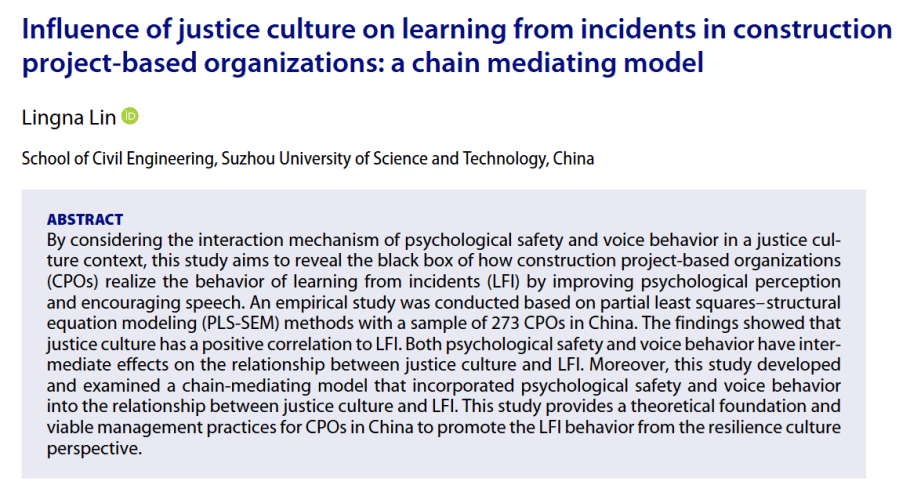
This study investigated the interaction mechanism of psychological safety and voice behaviour in a justice culture context. Specifically they explored how construction project-based organisations (CPOs) can realise learning from incidents by improving psychological perception and encouraging voice. 273 CPOs in China were studied. Background: · Learning from incidents is often said to be an important… Continue reading Influence of justice culture on learning from incidents in construction project-based organizations: a chain mediating model
Tag: learning

Building Organizational Resilience Through Organizational Learning: A Systematic Review
This explored organisational resilience (OR) through the lens of organisational learning (OL). I found it a pretty tough paper to summarise. In short, OL relies on experiential learning, a systematic approach to learning, an organisational ability to unlearn, and a context that facilitates OL. OR is defined as an organisation’s “ability to anticipate potential threats,… Continue reading Building Organizational Resilience Through Organizational Learning: A Systematic Review
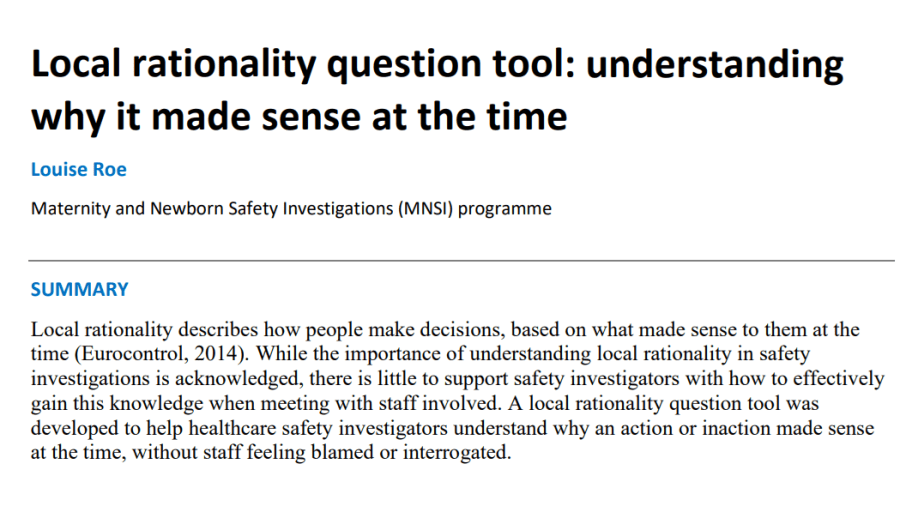
Local rationality question tool: understanding why it made sense at the time
An interesting tool for exploring a local rationality question tool (LRQ) in practice from Louise Roe, based on her conference paper. The tool has 25 items across situation, thoughts / decision making, preparedness, communication and anticipation. I’ve just covered a couple of sections (images 1 & 2). Extracts: · This tool has been used by the… Continue reading Local rationality question tool: understanding why it made sense at the time

Designing work systems for resilient performance: insights from resilience engineering
This explored Design for Resilient Performance (DfRP) via their framework. Not a summary – just a few extracts, but maybe I’ll summarise it in the future. Some extracts: · “Resilient performance (RP) is a socio-technical system’s ability to adjust its functioning prior to, during, or following changes and disturbances, thereby sustaining operations under both expected and… Continue reading Designing work systems for resilient performance: insights from resilience engineering
Resilience terminology and a visualisation of resilience/robustness in practice
This may interest people. It covers concepts of resilient performance within seaports. It’s a bit random (seaports), but otherwise gives a handy overview of resilience terms and applications. The first two images are just basic definitions. Extracts: · Image 3 represents resilience elements during disruptions – from pre-disruption, to the disruption, then post-disruption. · During pre-disruption, the… Continue reading Resilience terminology and a visualisation of resilience/robustness in practice

Deming’s system of profound knowledge: 14 points for system improvement
Another from Deming while I’m on the theme. Not much needs to be said – I think it does a lot of talking itself. Deming promoted: · Ceasing the dependence of trying to inspect-in quality · Aim for continuous learning, testing and improvement (e.g. plan, do, STUDY, act) · He was critical of zero defect approaches, arguing them… Continue reading Deming’s system of profound knowledge: 14 points for system improvement
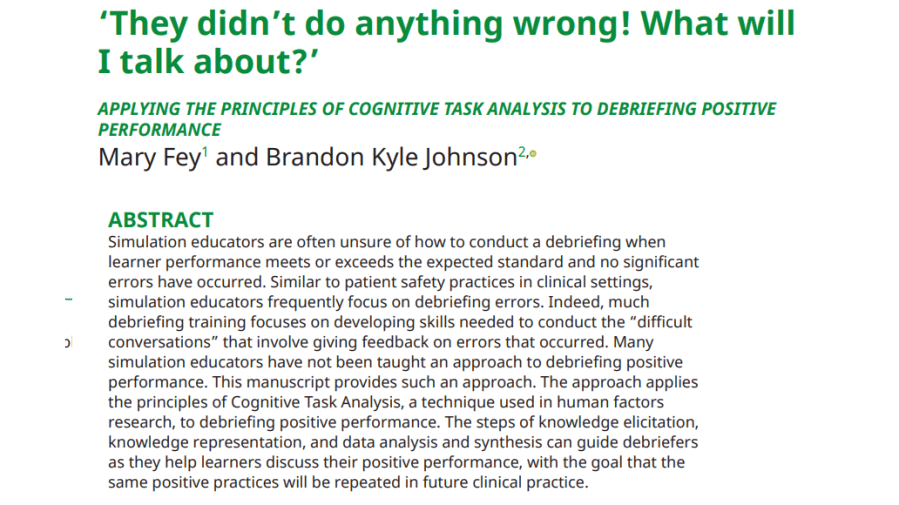
‘They didn’t do anything wrong! What will I talk about?’ Applying the principles of cognitive task analysis to debriefing positive performance
An interesting paper exploring the use of Safety-II inspired debriefs, learning from successful performance. They used cognitive task analysis techniques. Not a summary, but it’s open access and really brief – so check it out 👍 Extracts: · “simulation cases are often deliberately designed to push learners to their zone of proximal development .. where perfect… Continue reading ‘They didn’t do anything wrong! What will I talk about?’ Applying the principles of cognitive task analysis to debriefing positive performance

The rise of learning teams: How organisations in Australia are adopting group learning practices for safety improvement
This Master’s thesis from Andrew Barrett explored group learning practices, like learning teams, for safety improvement. Specifically, he studied the following question via institutional ethnographic interviews: · how are organisations in Australia adopting group learning practices for safety improvement? Way too much to cover – so check out the thesis. Some background extracts: · “Safety… Continue reading The rise of learning teams: How organisations in Australia are adopting group learning practices for safety improvement

Compendium: Blame, Just Culture & language
Here’s another compendium of articles exploring blame and language in the construction of post-hoc causality explanations, or how blame effects learning and investigations. The other part covers some articles around Just Culture and restorative culture. Note: I’ve mostly focused on articles that I’ve either already summarised or that I could find a full text link… Continue reading Compendium: Blame, Just Culture & language

Factors affecting learning from incidents: A cross-industry review
This study systematically reviewed the research to unpack the factors that influence learning from incidents (LFI). Likely nothing new to anybody, but it is a good reference paper for tracking down specific research. Background: · Common reasons for ineffective LFI are “underreporting of incidents (Sanne, 2008), incapacity to identify latent circumstances (Jacobsson et al., 2009), the… Continue reading Factors affecting learning from incidents: A cross-industry review
 SafetyInsights.org