
This study explored the presence, implementation, appetite and feasibility of 12 principles representing “new safety paradigms”. It involved focus groups with 53 participants and a cross-sectional survey of 514 employees. I’ve skipped HEAPS (actually, the entire results section – so check out the full paper). Background: · “The review by Karanikas et al. (2022) revealed… Continue reading Contextualising new safety paradigms: A study in a large Australian construction company
Tag: technology
Learning from normal work: How to Proactively Reduce Risk When Nothing Goes Wrong
An interesting article from Marcin Nazaruk, exploring learning from everyday work. Skipping a bit, so check out the full article. First he says that while it’s important to learn from failure “it is too late”. For one, diminishing incident rates “can no longer accurately reflect safety performance … and simply focusing on behaviours and unsafe… Continue reading Learning from normal work: How to Proactively Reduce Risk When Nothing Goes Wrong

Safety audits almost never target the actual sources of operational danger
Reflecting on my first audit study – we found things many would expect (image 1), like audits largely focusing on administrative items, and superficial matters. And for my construction friends, we found ‘toolboxes’ used a lot to address an issue, even if that issue didn’t have any reasonable connection to something that you’d need to… Continue reading Safety audits almost never target the actual sources of operational danger

Leveraging Ergonomics and Human Factors (E/ HF) for community impact: what have we learned about how to make a difference
This was a banger – exploring the application of community ergonomics with a strong systems lens. If you’re interested in HF/E, systems thinking, social dynamics, power gradients and more then this will interest you. Can’t do it justice, so a few random extracts. Extracts: Finally they talk about ways to improve this practice – via… Continue reading Leveraging Ergonomics and Human Factors (E/ HF) for community impact: what have we learned about how to make a difference
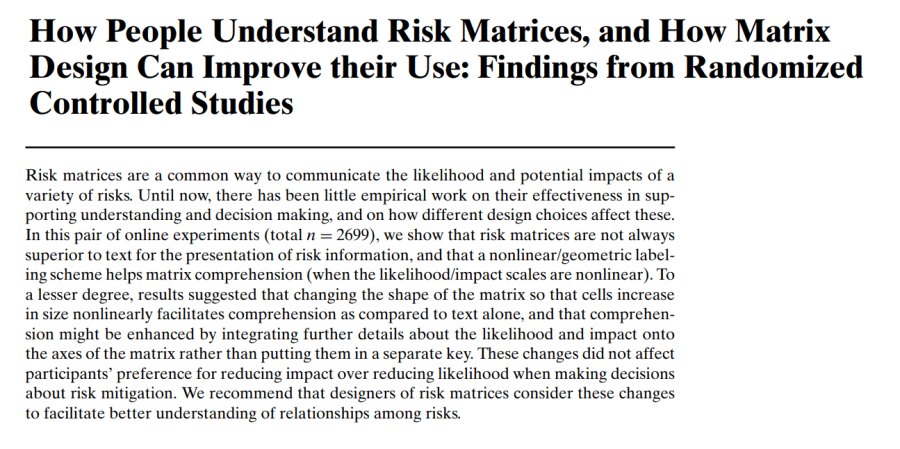
How People Understand Risk Matrices, and How Matrix Design Can Improve their Use: Findings from Randomized Controlled Studies
This study explored different risk matrix designs on user comprehension and use of matrices. I’ve posted a lot of research dunking on risk matrices (RMs), so here’s another olive leaf focusing on designing something potentially more useful. [** I still stand by the critical orientation, since we have little good evidence that RMs improve risk… Continue reading How People Understand Risk Matrices, and How Matrix Design Can Improve their Use: Findings from Randomized Controlled Studies
Does sending Safety Toolbox Talks by text message to Residential Construction Supervisors increase Safety Meeting Compliance?
This US study evaluated whether distributing construction safety toolboxes, with workplace fatalities, to supervisors by mobile phone would increase their compliance delivering toolboxes each month, 56 construction supervisors in Oregon were recruited and received a link to a toolbox talk by text message every two weeks for three months. This is based on a tool… Continue reading Does sending Safety Toolbox Talks by text message to Residential Construction Supervisors increase Safety Meeting Compliance?
Foundations of Safety Science: Resilience Engineering and safety as the presence of capacities
More extracts from Foundations of Safety Science, this time from Ch.11 on Resilience Engineering and the adaptive perspective. This is 1 of probably 2 or 3 more posts. Some extracts: These logics come from a wider body of safety science, which includes some intertwined positions, like: Parts 2 & 3…some other time. Ref: Dekker, S.… Continue reading Foundations of Safety Science: Resilience Engineering and safety as the presence of capacities
Warnings and Hazard Communications
This book chapter explored research on the design and efficacy of written warnings and hazard communications, like you’d find in product information booklets, labels etc. It’s a whole chapter, so I can only touch on some points. First they say that, overall, safety warnings are a “third line of defense behind design and guarding”, they… Continue reading Warnings and Hazard Communications
Wrong, Strong, and Silent: What happens when automated systems with high autonomy and high authority misbehave?
This article from Dekker and Woods discusses the ‘risks of literal-minded automation’, being a “system that can’t tell if its model of the world is the world it is actually in”. This issue manifests in automated systems being wrong, strong and silent—and while the issue has existed for at least 70 years, the risk “looms… Continue reading Wrong, Strong, and Silent: What happens when automated systems with high autonomy and high authority misbehave?
Harnessing the power of ChatGPT to promote Construction Hazard Prevention through Design (CHPtD)
This study compared whether ChatGPT can assist in hazard recognition during Construction Hazard Prevention Through Design (CHPtD) sessions (e.g. safety in design). Via randomised controlled experimental design, 162 civil and construction engineering students were tasked with hazard recognition activities with or without ChatGPT assistance. Providing background: Results: Ref: Uddin, S. J., Albert, A., & Tamanna,… Continue reading Harnessing the power of ChatGPT to promote Construction Hazard Prevention through Design (CHPtD)
 SafetyInsights.org