This explored the links between psychosocial risk and psychological safety on worker well-being. Survey responses from >800 workers in Malaysian were obtained. Usefully, it’s another study that slightly challenges the claim that you ‘can’t have too much psychological safety’. We need far more targeted evidence to make that claim. Extracts: · “our results revealed a significant… Continue reading The Critical Role of Psychological Risk and Safety in Eliciting Worker Well-Being
Tag: wellness

Sleep Problems and Workplace Violence: A Systematic Review and Meta-Analysis
Are sleep problems (SP) and workplace violence (WV) related? Quite possibly. This meta-analysis and systematic review unpacked 34 studies exploring the links. Extracts: VW can be classified into four types: · “Type 1, Criminal Intent, when no legitimate relationship exists between the perpetrator and the business or its employees and the perpetrator commits a crime (robbery,… Continue reading Sleep Problems and Workplace Violence: A Systematic Review and Meta-Analysis
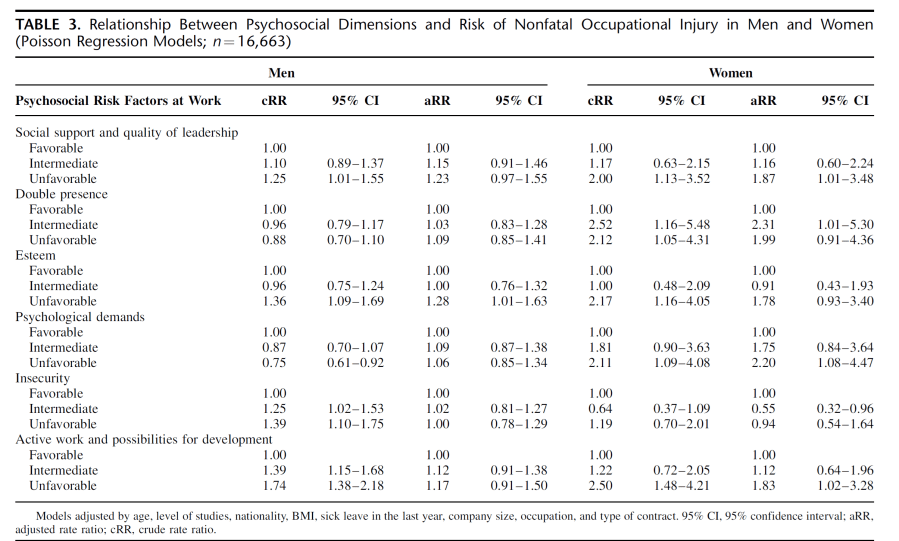
Exposure to Psychosocial Risk Factors at Work and the Incidence of Occupational Injuries: A Cohort Study in Spain
This study explored the links between psychosocial risk factors (PRF) on the incident of occupational injuries (OIs). Compared to many other studies, they used a dynamic cohort longitudinal design (>16k) participants over 1 year follow-up. The Copenhagen Psychosocial Questionnaire was used. For background: Findings: Why are PRF and OI potentially linked? They suggest: Limitations were… Continue reading Exposure to Psychosocial Risk Factors at Work and the Incidence of Occupational Injuries: A Cohort Study in Spain

Physical and Psychosocial Correlates of Occupational Physical Injury in the Global Construction Industry: A Scoping Review
This recent scoping review evaluated 77 construction studies covering various geographical regions on the physical and psychosocial correlates of physical injury. They stratified the correlates into three domains: 1. workplace physical environment (eg, exposure to physical hazards, PPE, company size & more) 2. workplace culture (eg, psychosocial stressors, gender-related barriers, migrant and ethnic disparities, educational background) 3. physical… Continue reading Physical and Psychosocial Correlates of Occupational Physical Injury in the Global Construction Industry: A Scoping Review

Implications of sleep loss or sleep deprivation on muscle strength: a systematic review
Does sleep deprivation (SD) affect various indices of muscle strength? To Jack’s complete lack of surprise: probably yes. This systematic review investigated 13 studies on the links. Tl;dr: Drop setting those Z’s may be eating into sick gainz bro For background: · 7-9 hrs sleep per night is recommended for most people · Poor quality and duration… Continue reading Implications of sleep loss or sleep deprivation on muscle strength: a systematic review
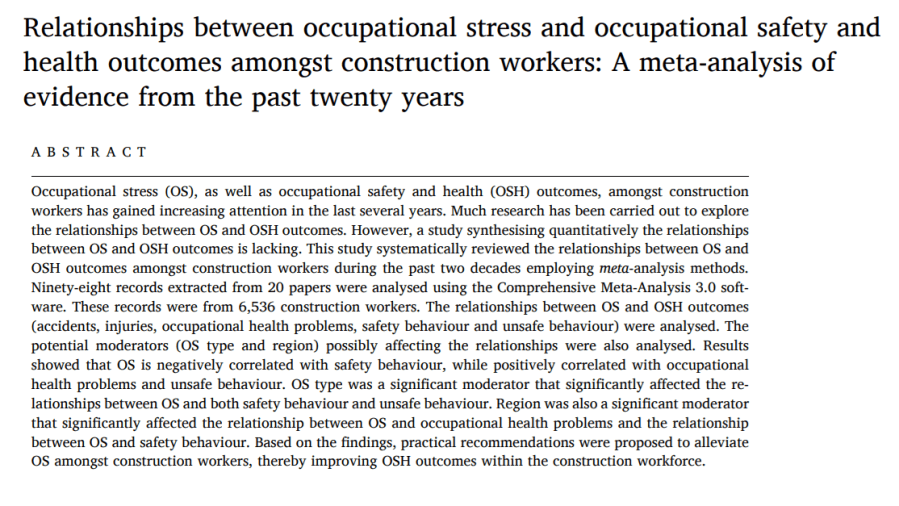
Relationships between occupational stress and occupational safety and health outcomes amongst construction workers: A meta-analysis of evidence from the past twenty years
This meta-analysis investigated the effects of occupational stress (OS) on safety and health outcomes in construction. 20 studies over 20 years, including >6k construction workers was included (not such a big sample given all of the research in construction safety, indicative of the relatively poorer quality of research that didn’t meet their inclusion criteria). [Trigger… Continue reading Relationships between occupational stress and occupational safety and health outcomes amongst construction workers: A meta-analysis of evidence from the past twenty years

The Impact of Physical Hazards on Workers’ Job Satisfaction in the Construction Industry: A Case Study of Korea
This study explored how physical workplace hazards influence job satisfaction in construction, and how mental threats mediate the relationship, and how perceived job quality and security moderate the effects. 2,202 construction workers in Korea were surveyed. Key findings: · “exposure to physical hazards significantly contributes to mental stress, leading to reduced job satisfaction” · And “a heightened… Continue reading The Impact of Physical Hazards on Workers’ Job Satisfaction in the Construction Industry: A Case Study of Korea

Mini-Comp: Psychosocial Risks / Mental-Ill Health / Psychological Injury
“wHeRe iS tHe eViDeNcE fOr pSyChOsOcIaL risks?!1?!11” I can’t be bothered repeatedly linking to the dozens of systematic reviews and meta-analyses on the connections between psychosocial factors and various indices of health, safety, and organizational performance on LinkedIn. So, I’m just compiling a few into a mini-collection. WAY WAY WAY too much to systematically cover… Continue reading Mini-Comp: Psychosocial Risks / Mental-Ill Health / Psychological Injury
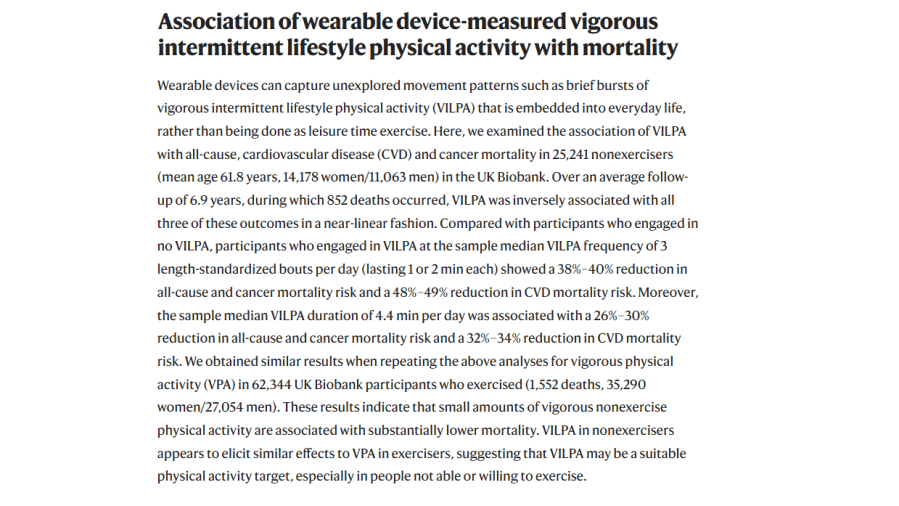
Association of wearable device-measured vigorous intermittent lifestyle physical activity with mortality
Can brief bursts of vigorous activity, like running up stairs, or walking quickly through the shops, reduce all-cause mortality? Yes according to this study. This paper was discussed on a YT channel I follow called Physionic (link to YT and paper in comments). Physical activity was measured via wearables from 25k non-exercisers (UK Biobank data)… Continue reading Association of wearable device-measured vigorous intermittent lifestyle physical activity with mortality

Leadership, followers’ mental health and job performance in organizations: A comprehensive meta-analysis from an occupational health perspective
This meta-analysis studied the links between leadership and mental health and job performance indices of followers. [NB. Look out for next week’s compendium on leadership research] No real surprises with the findings. They note that leadership, of course, “is not a neutral element”, and may influence both positive and negative effects. Extracts: · “results reveal that… Continue reading Leadership, followers’ mental health and job performance in organizations: A comprehensive meta-analysis from an occupational health perspective
 SafetyInsights.org