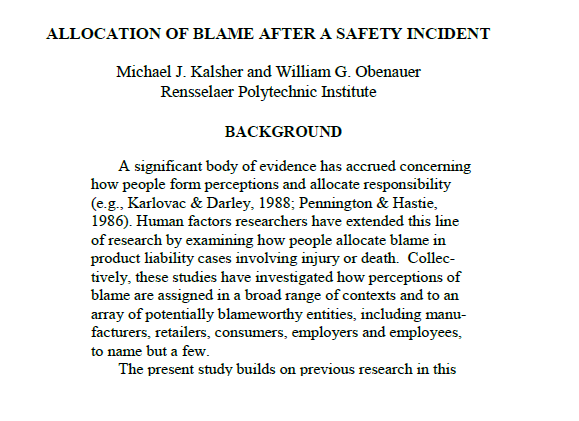
This single page conference paper discussed an experiment on how blame is allocated following incidents.
The scenario was a “realistic, but fictitious” incident involving a worker (both experienced or not experienced, depending on the scenario), whom is killed when touching an energised bus bar while feeding electrical wire into a pedestal.
They systematically manipulated the quality of the warning the worker received in a) a real warning on a commercial product 2) a redesigned warning and 3) the worker’s on-the-job experience.
For background they note that the “quality of warning interacts with efforts on the part of various potentially blameworthy entities (e.g., manufacturers, distributors, employers)to do their part in disseminating warning materials down the chain to end users”.
They predicted that experienced workers would receive more blame than inexperienced, independent of warning quality.
Key finding:
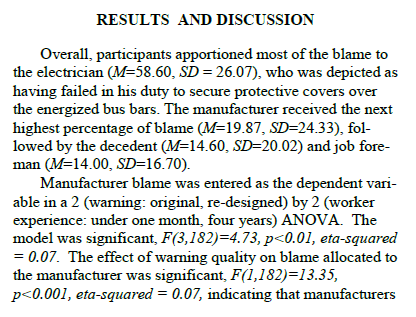
· “participants apportioned most of the blame to the electrician (M=58.60, SD = 26.07), who was depicted as having failed in his duty to secure protective covers over the energized bus bars”
· “The manufacturer received the next highest percentage of blame (M=19.87, SD=24.33), followed by the decedent (M=14.60, SD=20.02) and job fore-man (M=14.00, SD=16.70)”
· “The effect of warning quality on blame allocated to the manufacturer was significant .. indicating that manufacturers received significantly less blame (M=13.86, SD=20.47) for the accident given the (better) re-designed warning than they did in the original (poor) warning condition”
· “Neither the effect of worker experience nor the interaction of experience and warning condition were significant”
· “Contrary to our predictions, the worker’s level of experience did not influence allocations of blame, including to the manufacturer”
· “Warning quality, however, did influence how blame was apportioned, in particular to the manufacturer”
· “Consequently, these findings add to the growing body of evidence suggesting that safety sells”
· “Specifically, evaluators consistently assign less blame to manufacturers when they are perceived as adequately warning about their products’ residual hazards”
Ref: Kalsher, M. J., & Obenauer, W. G. (2018, September). Proceedings of the Human Factors and Ergonomics Society Annual Meeting (Vol. 62, No. 1, pp. 1636-1636).

Study link: https://doi.org/10.1177/1541931218621370

 SafetyInsights.org