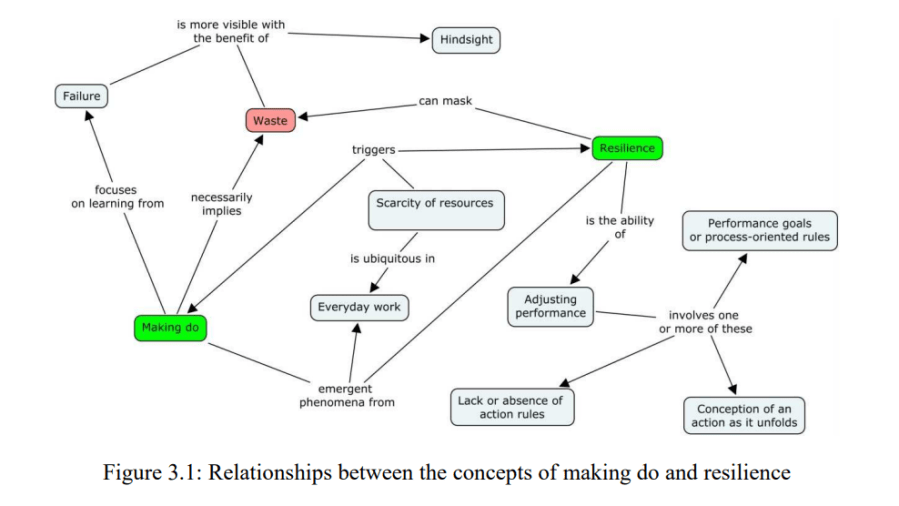
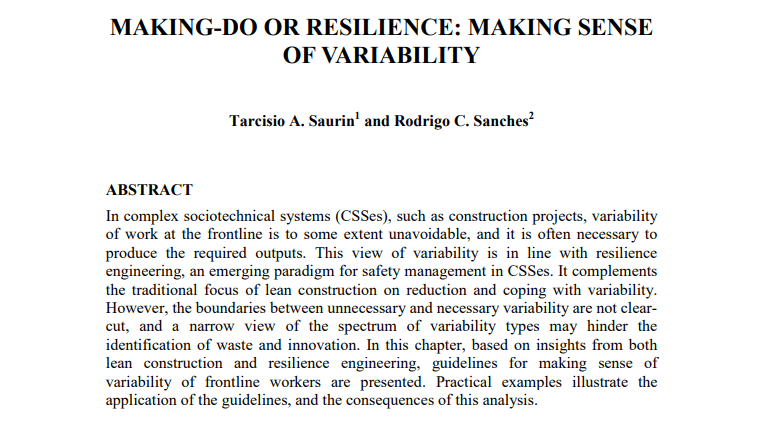
This paper explores the difference between ‘making do’ and resilience.
Not a summary, but a few extracts:
· Making do has been defined, from a waste perspective as “a situation where a task is started without all its standard inputs, or the execution of a task is continued although the availability of at least one standard input has ceased”
· Making do “implies that work-as-done is different from work-as-imagined in plans”
· Whereas making do might imply a reduction in performance from a lean perspective, “resilience engineering (RE) explicitly values the positive side of variability, particularly that arising from informal working practices, and associated with the performance of frontline workers”
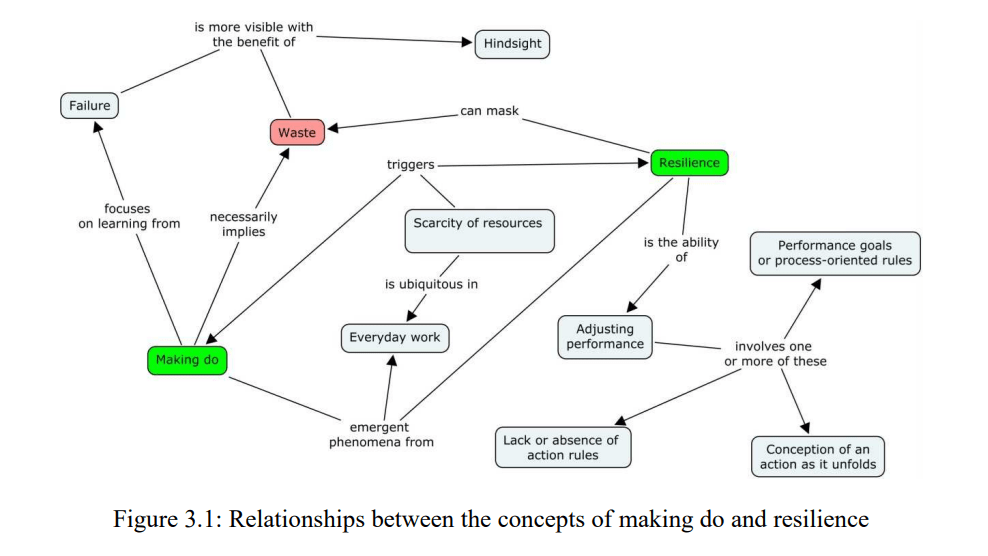
· They propose that adjusting functioning from the RE lens means: “(i) the insufficiency or absence of action rules, which specify in terms of if-then statements how people shall behave (e.g. wearing a seat belt when in a moving car) (ii) improvisation, which is … the real-time conception and execution of a novel solution to an event that is beyond the boundaries that an organisation has anticipated or prepared for”
· Next “(iii) the isolated existence of performance goals and/or process-oriented rules. While performance goals define only what has to be achieved, not how it must be done, process-oriented rules define the process by which the person or organisation should arrive at the way they will operate”
· “A core assumption of RE is that regardless of the effectiveness of technological and management practices, variability cannot be completely eliminated from complex sociotechnical systems”
· Variability is defined by “technological, which are carried out by various types of machinery; human, which are carried out by individuals or groups; and organisational, which are carried out by large groups of people, where the activities are explicitly organised”
· “Hollnagel also proposes that the variability of the outputs of functions be classified with regard to time (too early, on time, too late, or not at all) and precision (precise, acceptable, or imprecise)”
· They associate making do with unsuccessful resilience “which performance adjustment implies either waste or safety hazards” and successful resilience when “performance adjustment helps to tackle waste, without having any undesired side-effects”
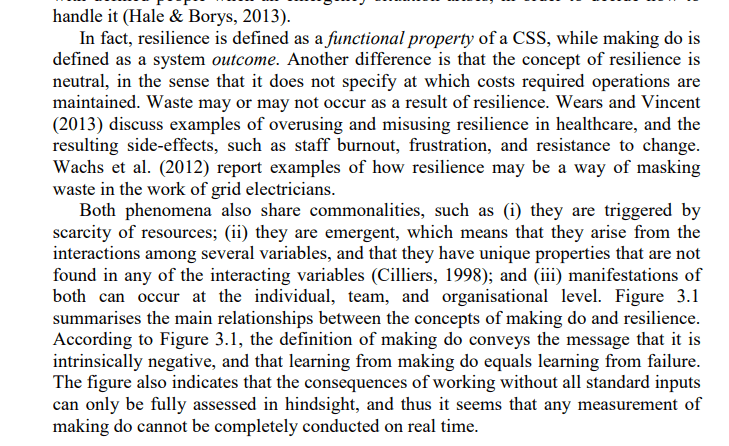
· “resilience is defined as a functional property of a CSS, while making do is defined as a system outcome”
· “Another difference is that the concept of resilience is neutral, in the sense that it does not specify at which costs required operations are maintained. Waste may or may not occur as a result of resilience”
Ref: Saurin, T.A.; Sanches, R. 2016. Making-do or resilience: making sense of variability. In: Emuze, F.; Saurin, T.A. (Eds.). Value and Waste in Lean Construction. Chapter 2, pp. 15-22. Routledge: Oxon


 SafetyInsights.org